

On this page
Most students learn the rule for multiplying decimals as a trick: ignore the points, multiply, then count the places back in. It always works, but if you do not know why, it is easy to drop a zero under exam pressure. Here is the reason, a step-by-step method, the 10, 100 and 1000 shortcut, and a short check.
Why do decimal places add when you multiply?
A decimal is a fraction whose denominator is 10, 100, 1000 and so on. The NCERT Class 7 chapter Another Peek Beyond the Point (Ganita Prakash, Part II) builds the rule from exactly this idea: multiplying decimals is the same as multiplying their fractions.
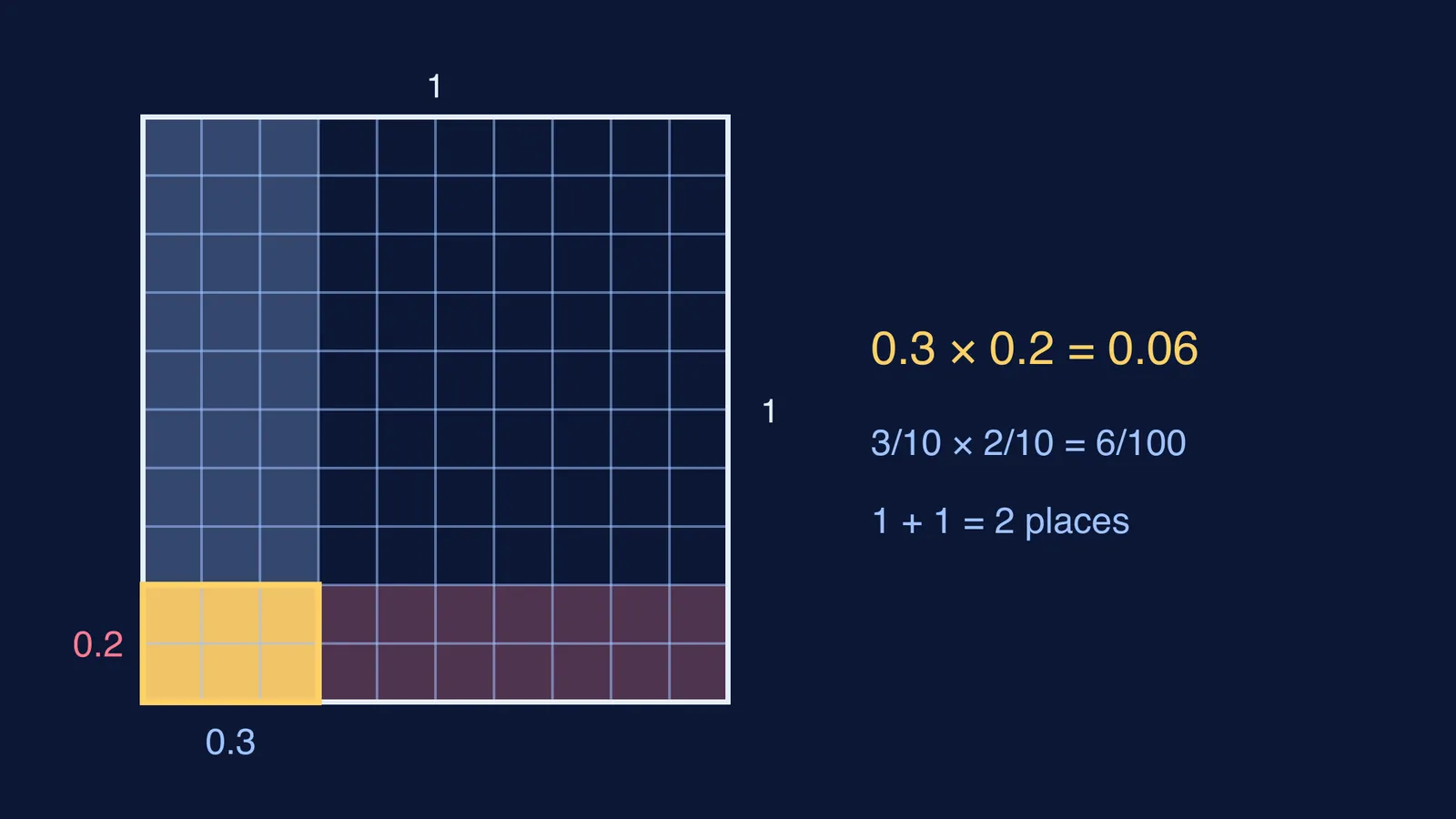
Take 0.3 × 0.2. Written as fractions, that is 3/10 × 2/10. Multiply the tops and the bottoms: 6/100, which is 0.06. One zero in each denominator became two zeros in the product.
The textbook states the general version plainly: the number of zeros in the product of the denominators is the sum of the number of zeros in each denominator, and the decimal point is placed by that total (NCERT, section 4.2). One zero in the denominator means one decimal place, so the decimal places add. Tenths times tenths gives hundredths, which is why 0.3 × 0.2 is 0.06 and not 0.6.
How do you multiply decimals step by step?
Remove the decimal points and multiply the whole numbers.
Count the digits after the decimal point in each number and add the counts.
Starting from the right of your product, count that many places to the left and put the point there.
If you run out of digits, add zeros in front.
Estimate to check that the size makes sense.
NCERT's own example: 596 × 248 = 147808, and 5.96 has 2 decimal places while 24.8 has 1, so 5.96 × 24.8 = 147.808 (NCERT Class 7). The estimate 6 × 25 = 150 agrees, so the point is in the right place.
Two cases catch most students:
Zeros in front. 0.02 × 0.3: 2 × 3 = 6, and you need 2 + 1 = 3 places, so write 0.006.
Zeros at the end. 2.5 × 0.04: 25 × 4 = 100, and you need 1 + 2 = 3 places, so 0.100, which is 0.1. Count the places before you drop any end zeros, not after.
For a refresher on tenths and hundredths, our guide to reading decimal place value covers it, and decimals in Class 7: place value, comparing and adding fills in the earlier steps.
What happens when you multiply or divide by 10, 100 or 1000?
The digits stay the same; only the point moves. Multiplying by 10, 100 or 1000 moves it right by one place per zero. Dividing moves it left.
NCERT gives the division version as a three-step rule: write the number with a decimal point at the end, count the zeros in the divisor, and move the point left that many places, adding zeros in front if needed. Its examples include 123 ÷ 10 = 12.3 and 12 ÷ 1000 = 0.012 (NCERT, section 4.1).
23.02 × 100 = 2302 (point moves 2 places right)
0.306 × 1000 = 306 (3 places right)
3.9 ÷ 100 = 0.039 (2 places left, one zero added in front)
Dividing by 100 is multiplying by 1/100, which adds two zeros to the denominator: the same idea again. It is also the first move when you divide a decimal by a decimal by clearing the divisor.
Why is the answer sometimes smaller than both numbers?
Because multiplying by a number between 0 and 1 takes a part of something. NCERT shows that 2.25 × 8 = 18 is bigger than both numbers, 0.25 × 8 = 2 sits between them, and 0.25 × 0.8 = 0.2 is smaller than both (NCERT, section 4.2).
The belief that multiplication always makes things bigger is common and lasting. An Association for Science Education article reports that in a 1981 study by Hart and colleagues, only 13 to 18% of students aged 12 to 15 could correctly pick which operation gives the larger result in pairs such as 8 × 0.4 and 8 ÷ 0.4.
So an answer that shrank is not automatically wrong. Ask: is one of the numbers less than 1?
A one-minute check for any decimal product
Ask these three questions before you move on:
Did I count the places in both numbers and add them?
Does a rounded estimate land near my answer?
If a number was less than 1, did the answer get smaller where it should?
If the point keeps landing in the wrong place, check the method, not just the arithmetic. The Fermi Problem Library has worked problems with a step-by-step solver that explains the reasoning rather than printing an answer, so you can see the exact step where your working went off. If the fraction idea underneath still feels shaky, the Fermi Concept Library gives each mathematics concept its own lesson.


