

On this page
Dividing with decimals can feel like learning a completely new set of rules. When you are taught division with whole numbers, the logic is usually about sharing items into equal groups, but that mental picture falls apart when decimals get involved.
Does division always make a number smaller?
For many students, the confusion starts long before they even try to divide. A classic 1985 study of 623 pupils by Efraim Fischbein and colleagues found that students incorrectly assume division must always make a number smaller. This belief comes from a "whole number bias," where early experiences of sharing objects are overgeneralised to all of mathematics.
This misconception frequently leads to students questioning their own correct answers. When a calculation yields a quotient larger than the dividend, their instincts tell them an error has been made, causing them to re-evaluate or guess incorrectly. Recognising that dividing by a proper fraction naturally results in a larger value can give you the confidence to trust your arithmetic.
While division does make whole numbers smaller, this rule breaks when you divide by a decimal between 0 and 1. When you divide 1.44 by 0.12, you are not asking "how do I share 1.44 among 0.12 people?" Instead, you are asking, "How many groups of 0.12 fit into 1.44?" Because 0.12 is very small, it fits into 1.44 many times. The answer is 12, which is larger than the starting number of 1.44. Letting go of the idea that division only shrinks numbers is the first step to mastering decimal arithmetic.
How to divide a decimal by a decimal?
The most reliable way to handle these problems is to rewrite them. You can turn any decimal division problem into a whole number division problem by multiplying both the dividend (the number being divided) and the divisor (the number you are dividing by) by the same power of 10.
Mastering this technique eliminates the need for complicated long division with shifting decimal points, lowering the chance of making calculation errors in exams. By turning the divisor into a whole number, you rely on the multiplication tables you already know. For example, recalling that 12 times 12 is 144 is much easier than trying to imagine slices of 0.12.
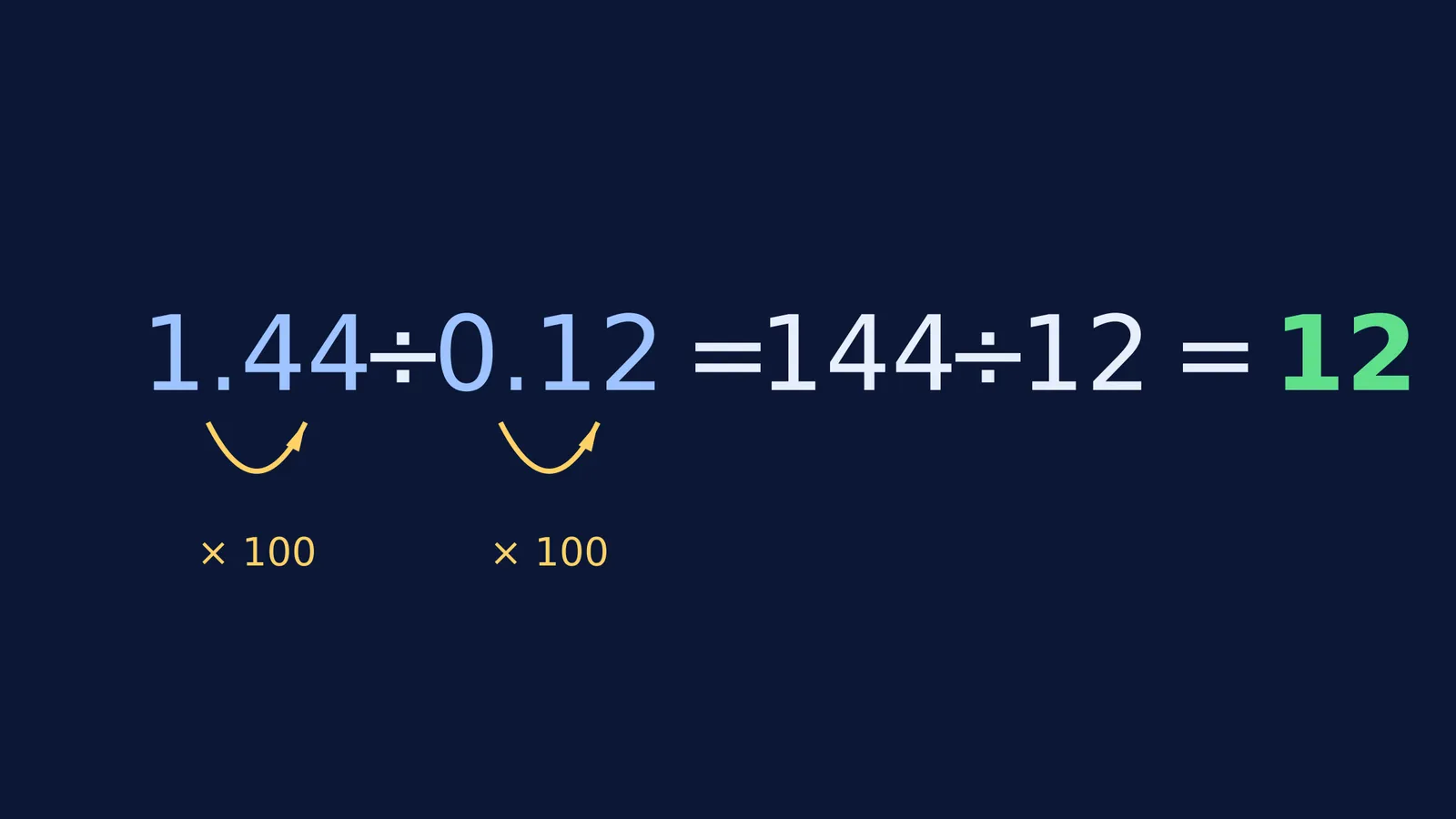
Let's work out 1.44 ÷ 0.12.
Look at the divisor, 0.12. It has two decimal places.
To make 0.12 a whole number, multiply it by 100. (0.12 × 100 = 12).
You must do exactly the same to the dividend, 1.44. Multiply it by 100. (1.44 × 100 = 144).
The new, equivalent problem is 144 ÷ 12.
Since 144 divided by 12 is exactly 12, the answer to the original problem 1.44 ÷ 0.12 is also 12.
Why do you move the decimal point when dividing?
Moving the decimal point is a visual shortcut for multiplying by powers of 10. But why are we allowed to just change the numbers in a division problem?
It works because every division problem can be written as a fraction. For example, 1.44 ÷ 0.12 is the fraction 1.44 / 0.12. A core rule of fractions is that if you multiply both the numerator (top) and the denominator (bottom) by the exact same number, the value of the fraction does not change.
Multiplying both top and bottom by 100 turns 1.44 / 0.12 into 144 / 12. You have not changed the ratio between the two numbers, only how they are written. To brush up on how place values shift, read our guide on Decimals in Class 7: place value, comparing and adding. For more on fraction conversion, see Recurring decimals as fractions using an infinite GP.
A checklist for decimal division
To avoid mechanical errors like moving the decimal by a different number of places on each side, follow this checklist:
Write the problem as a fraction to clearly see the dividend and divisor.
Identify the power of 10 needed to clear the divisor's decimal.
Multiply both numbers by that power of 10.
Rewrite the new whole-number problem clearly before you begin calculating.
Estimate the answer: if the divisor is less than 1, your answer should be larger than your dividend.
When you are working through these steps and want to check your reasoning, the Fermi Problem Library has worked problems with a step-by-step solver that explains the reasoning rather than printing an answer. It keeps you on track without doing the thinking for you.


