

On this page
Have you ever looked at a student's answer sheet and seen them insist that 0.45 is larger than 0.5? It is one of the most common mistakes in primary and middle school maths. To understand why it happens, we have to look at how we teach decimal place value—specifically tenths, hundredths and thousandths.
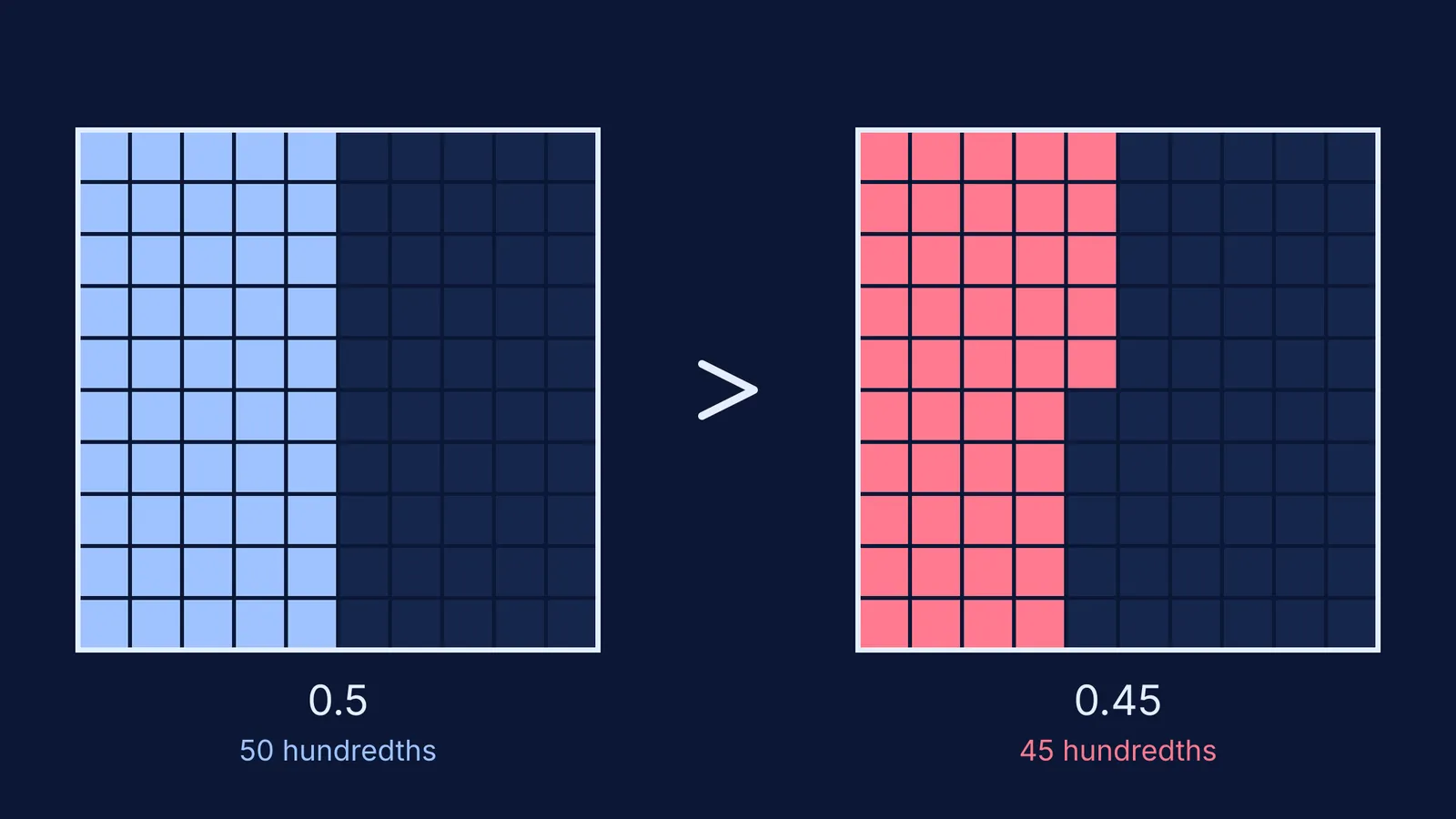
Why is 0.5 larger than 0.45?
When a child learns whole numbers, they learn a simple rule: a longer number is always a larger number. Because 45 is larger than 5, it is completely logical for them to assume that 0.45 must be larger than 0.5.
This is known as the "longer is larger" misconception. A large 2004 study by researchers Kaye Stacey and Vicki Steinle found that up to 40% of Grade 5 students hold this belief, and it can persist well into secondary school. This misconception often masks a student's lack of foundational fraction knowledge. When children view decimals merely as whole numbers separated by a dot, they fail to realise that each position to the right represents a fraction ten times smaller than the one before it.
The most effective way to correct this is to append placeholder zeros so both numbers have the same number of decimal places. When 0.5 is written as 0.50, it becomes obvious that 50 hundredths is larger than 45 hundredths. This gives the student a fair comparison—much like finding a common denominator for fractions.
What is decimal place value?
The decimal point is not a mirror. This is another reason students get confused: they expect a "oneths" column to exist right after the decimal point, to match the ones column before it.
Instead, the place value chart looks like this:
Ones: The whole numbers just left of the point.
The decimal point: The marker that separates wholes from fractions.
Tenths: The first position to the right (1/10).
Hundredths: The second position (1/100).
Thousandths: The third position (1/1000).
If a student has concept gaps, the Fermi Concept Library has lessons to help them see how a single whole is broken down into ten slices (tenths), then a hundred (hundredths), and finally a thousand (thousandths). Using area models—like a grid of 100 squares where 50 are shaded for 0.50—is much more effective than just memorising the column names. (You can also explore similar number relationships, like how to find rational numbers between two rational numbers).
How do you write decimals in expanded form?
Expanded form forces a student to look at the true mathematical value of each digit, breaking the habit of reading decimals as just a string of whole numbers.
Let's take the number 3.405. If a student reads it out loud as "three point four zero five", they are not practising place value. Encourage them to read it correctly: "three and four hundred five thousandths".
To write 3.405 in expanded form, we pull apart the columns:
3 ones = 3
4 tenths = 0.4
0 hundredths = 0
5 thousandths = 0.005
So, the expanded form is 3 + 0.4 + 0.005. Writing numbers this way helps prevent errors when learning other arithmetic tricks, such as squaring numbers ending in 5.
How can you check for understanding?
If you want to know if a student truly grasps decimal place value, give them these four quick comparisons to solve and ask them to explain their reasoning:
Compare 0.7 and 0.70: They should recognise these are exactly equal (7 tenths is the same as 70 hundredths).
Compare 0.3 and 0.125: They should append zeros to make 0.300, showing that 300 thousandths is larger than 125 thousandths.
Compare 0.09 and 0.9: They should explain that 9 tenths is ten times larger than 9 hundredths.
Compare 2.45 and 2.5: They should know to look beyond the 45 and 5, again appending a zero to make 2.50, correctly identifying that 2.5 is the larger number.
If they can explain these without falling back on the "longer is larger" rule, they have mastered the concept.


