On this page
Linear Programming carries 05 marks out of 80 in the CBSE Class XII Mathematics curriculum for 2026-27, limited to the graphical method for two variables with "up to three non-trivial constraints". In the CBSE 2026-27 sample paper, they came as a 2-mark and a 3-mark question.
The NCERT chapter (Reprint 2026-27) has a single exercise (12.1) of ten problems to maximise or minimise Z, and no section on diet or transportation problems, so older guides' long word problems go beyond it.
What LPP terms does the board expect?
From NCERT, in our words:
Objective function: the linear Z = ax + by to maximise or minimise, in decision variables x and y.
Constraints: the linear inequalities on x and y; x ≥ 0, y ≥ 0 are non-negative restrictions.
Feasible region: the region common to all constraints; its points are feasible solutions.
Optimal solution: a feasible point giving the maximum or minimum of Z.
Bounded region: one that fits inside a circle; otherwise it is unbounded.
How does the corner-point method work?
NCERT states two theorems without proof: if Z has an optimal value, it occurs at a corner point; on a bounded region, Z has both a maximum and a minimum, each at a corner. So: draw the region, solve for each corner, evaluate Z, compare. The region is always convex, and if two corners tie, the whole segment joining them is optimal.
Unbounded regions need an extra check. The largest corner value M is the maximum only if no point of the region satisfies ax + by > M; if one does, Z has no maximum. Test the smallest value m against ax + by < m (NCERT, corner point method).
A worked example, solved two ways
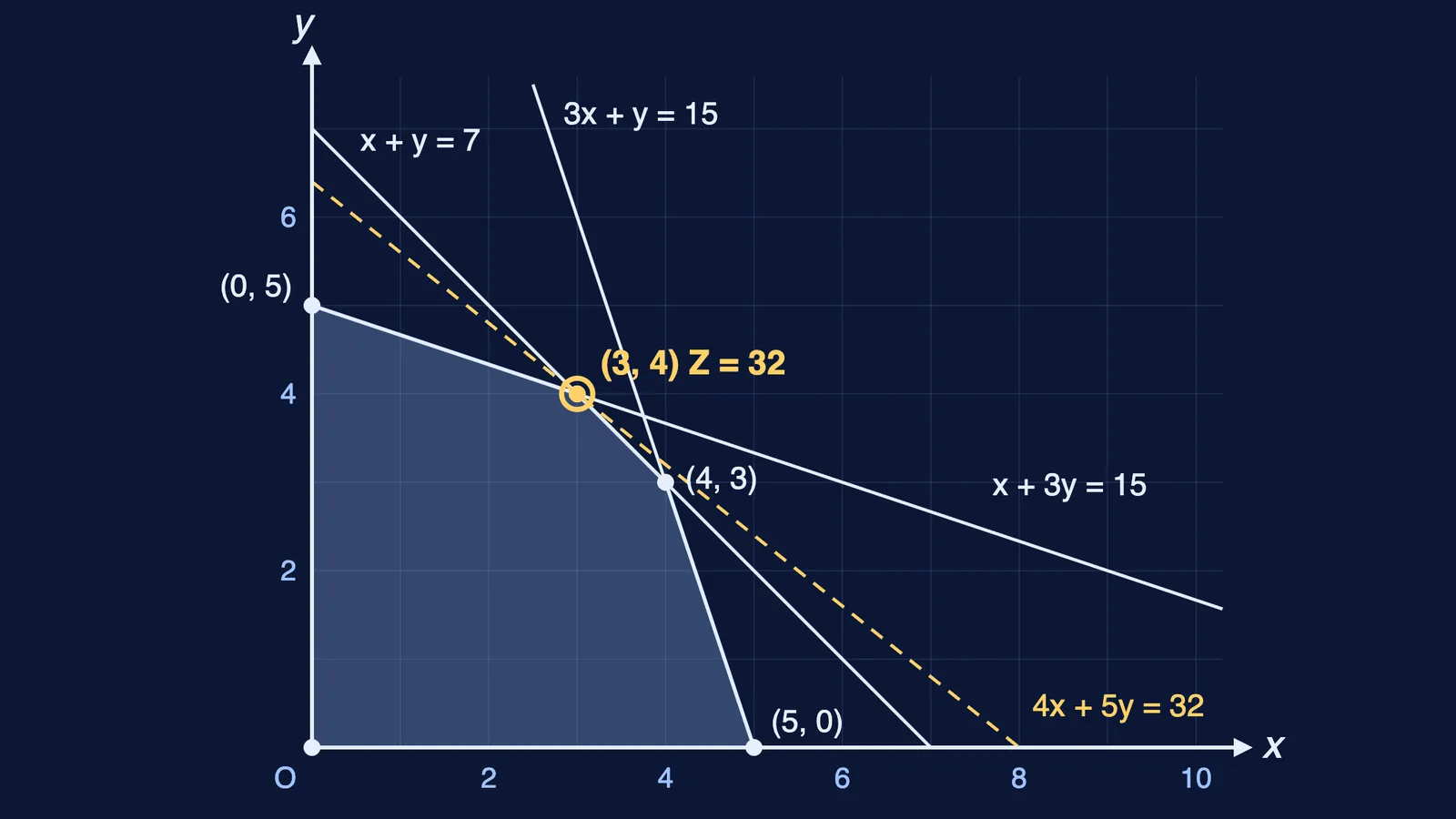
Our own problem, graphed above: maximise Z = 4x + 5y subject to x + y ≤ 7, x + 3y ≤ 15, 3x + y ≤ 15, x ≥ 0, y ≥ 0.
Draw x + y = 7 through (7, 0), (0, 7); x + 3y = 15 through (15, 0), (0, 5); 3x + y = 15 through (5, 0), (0, 15). The origin satisfies all three: shade towards it.
Corners: O(0, 0), (5, 0), (0, 5). Solving x + y = 7 with 3x + y = 15 gives (4, 3); with x + 3y = 15 it gives (3, 4).
Z at the corners: (0, 0) 0, (5, 0) 20, (4, 3) 31, (3, 4) 32, (0, 5) 25.
The region is bounded, so maximum Z = 32 at (3, 4).
Check with an iso-profit line: slide 4x + 5y = k outward. Its slope, −4/5, lies between −1 (x + y = 7) and −1/3 (x + 3y = 15), so it last touches the region where those lines meet: (3, 4). scipy.optimize.linprog returned the same: x = 3, y = 4, Z = 32. Note 31 against 32: skip a corner and you lose the answer.
How do you set out the answer for full marks?
The CBSE 2026-27 marking scheme gives the 3-mark graphical question 1½ for the graph and feasible region, 1 for the corner points and ½ for the values of Z; the 2-mark question gives 1½ for two constraints and ½ for y ≥ 0. Whether the 5 marks come as 2 + 3 or one long question, use one layout:
Restate Z and every constraint.
Draw each line through two labelled points; shade and name the region.
List corners, showing each intersection solved.
Tabulate Z at every corner.
Conclude with value and point; if the region is unbounded, add the half-plane check.
Common errors:
Shading the wrong side (test the origin).
Reading intersections off the graph.
Writing "maximum = 32" without the point.
Misdrawing a boundary like x = 3; see why x = 2 is a line parallel to the y-axis.
If corner points keep slipping, the Fermi Problem Library has worked problems with a step-by-step solver that explains the reasoning rather than printing an answer.
Assertion-reason, case-study traps and a revision plan
The sample paper has two 1-mark assertion-reason questions and three 4-mark case studies, none on this unit, but either format can carry it. A typical trap pairs a false assertion ("Z has a maximum on every feasible region") with a true reason ("an optimal value, if it exists, is at a corner point"). The answer is (D): an unbounded region may have no maximum. In case studies, translate carefully: "at least" is ≥, "at most" is ≤, and non-negativity applies even unstated. See our guide to answering case-based questions in CBSE board exams.
A five-day plan:
Each term and both theorems, one line each.
Exercise 12.1, questions 1 to 5, in the five-step layout.
Questions 6 to 10, including a tie (Q6), an unbounded region (Q9) and an empty one (Q10).
Sample-paper questions 25 and 31, timed and self-marked.
Redo our example from memory.
If time runs short on the day, use a 20-minute triage plan for the board paper.