On this page
Vector algebra is a short chapter that pays well if your answers are set out cleanly. Here is what to practise, how step marks work, and the traps to avoid.
How many marks is vector algebra worth in the CBSE Class 12 exam?
In the CBSE Mathematics curriculum for 2026-27, Unit IV, "Vectors and Three - Dimensional Geometry", carries 14 of the 80 theory marks. Those 14 marks are shared by two chapters, Vector Algebra and Three-dimensional Geometry, and the document says there is no chapter-wise weightage.
In the CBSE 2026-27 sample paper, vectors appear as three 1-mark MCQs (Q13-15), a 2-mark question finding |b| from |a|, a·b and b × a (Q24), and the vector option of a 2-mark internal choice (Q23B). The 3-mark Q30 and the Q36 case study test lines in 3D.
Which vector algebra results should you practise?
Work from the NCERT Vector Algebra chapter (Reprint 2026-27). It stops at the cross product and has no scalar triple product; that belongs to our vector algebra guide for JEE maths.
Position vectors and direction cosines. If r = aî + bĵ + ck̂ has magnitude r, the direction cosines are l = a/r, m = b/r, n = c/r. Practise a unit vector making equal angles with the axes.
Section formula. R divides PQ internally in m : n at (mb + na)/(m + n), and externally at (mb − na)/(m − n), where a and b are the position vectors of P and Q.
Dot product and projection. a·b = |a||b|cos θ, and the projection of a on b is a·b/|b|. See finding the component of a vector along another.
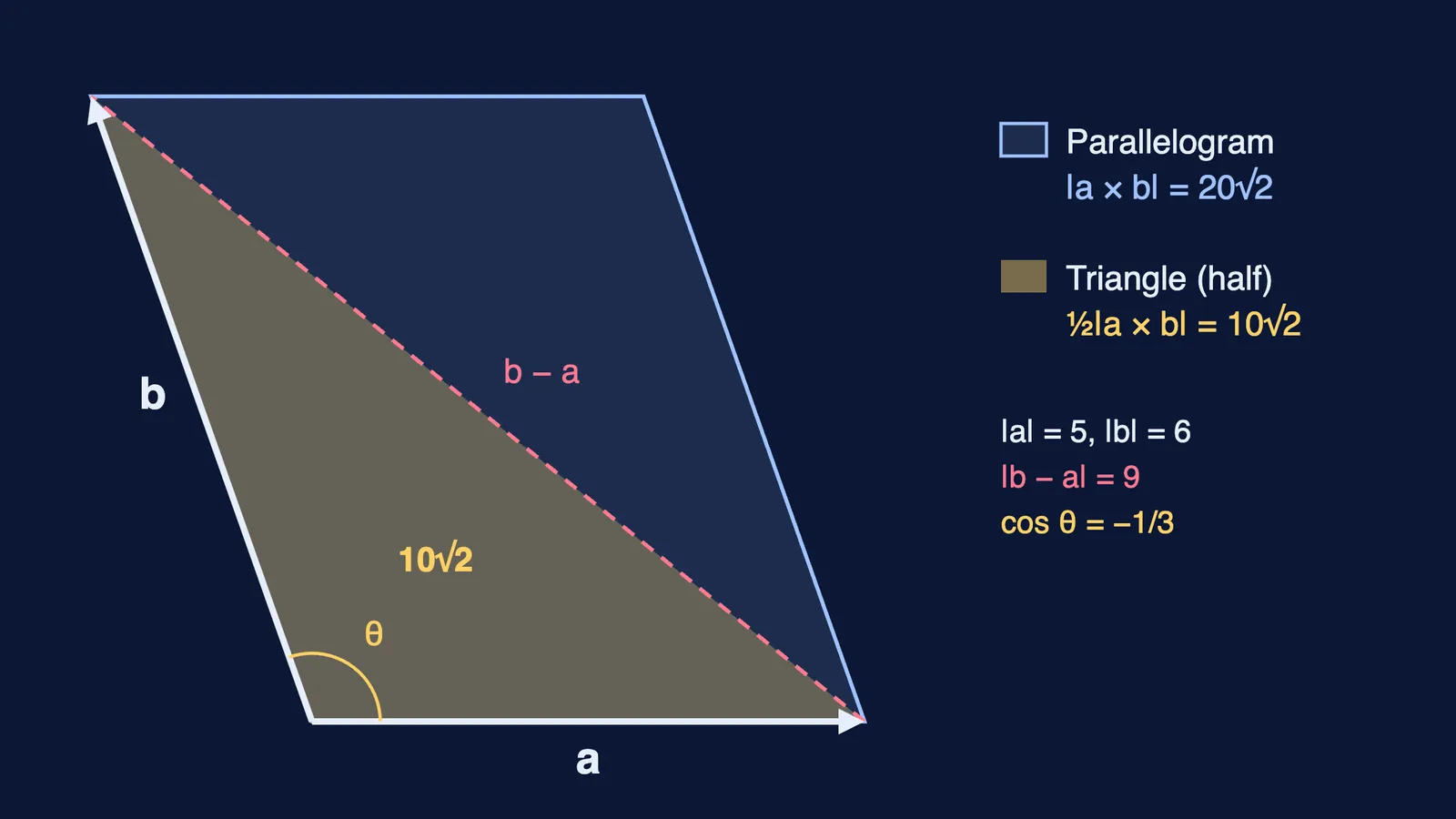
Cross product and area. |a × b| is the area of the parallelogram on a and b; half of it is the area of the triangle.
Unit vectors perpendicular to two vectors. ±(a × b)/|a × b|: NCERT notes there are two.
How do you set out 2-, 3- and 5-mark answers?
The 2026-27 marking scheme gives marks in halves. For the 2-mark vector question, it gives ½ for writing |a × b| = √29, ½ for stating the identity |a × b|² + (a·b)² = |a|²|b|², and 1 for solving to |b| = √5. The formula line earns marks by itself.
2 marks: givens, formula, substitution, answer.
3 marks: add a labelled intermediate result, such as the expanded determinant.
5 marks: number the parts, one result per line, then a check (a perpendicular vector dots to 0 with both originals) and a one-line conclusion.
Worked example: a triangle's area, done two ways
Find the area of triangle ABC: A(1, 0, 2), B(4, 4, 2) and C(3, −4, 6).
Method 1, cross product. AB = 3î + 4ĵ and AC = 2î − 4ĵ + 4k̂. Expanding the determinant, AB × AC = 16î − 12ĵ − 20k̂. Its magnitude is √(256 + 144 + 400) = √800 = 20√2, so the area is ½ × 20√2 = 10√2 square units.
Method 2, Heron's formula. |AB| = 5, |AC| = 6 and BC = −î − 8ĵ + 4k̂, so |BC| = 9. Then s = 10 and the area is √(10 × 5 × 4 × 1) = √200 = 10√2. Both methods agree, and we checked the numbers with numpy.
Bonus. The unit vectors perpendicular to AB and AC are ±(4î − 3ĵ − 5k̂)/(5√2).
What are the common errors and traps?
Writing b × a = a × b. Swapping the order changes the sign.
Treating direction ratios as direction cosines. NCERT notes l² + m² + n² = 1, but a² + b² + c² is not 1 in general.
Dividing by |a| instead of |b| when projecting a on b.
Swapping m and n in the section formula, or dropping the minus sign in the external case.
Giving one sign for a perpendicular unit vector.
Dropping the ½ for a triangle.
Assertion-reason trap. Assertion: |a × b| = |b × a|. Reason: a × b = b × a for all vectors a and b. The assertion is true, the reason is false, so the answer is (C). Students who only check that both statements look familiar pick (A).
Case-study trap. In the sample paper, two of the three case studies have sub-parts worth 1, 1 and 2 marks, and later parts build on earlier ones. Restate the earlier result in each part so one slip does not hide your method.
A two-week revision plan
Days 1-3: redo every NCERT example without looking at the solution.
Days 4-6: one exercise a day; tag each error as sign, formula or arithmetic.
Days 7-8: the sample paper's vector questions, timed, marked against the marking scheme.
Days 9-11: mixed vectors and 3D questions, since they share one unit.
Days 12-14: timed assertion-reason and case-study sets, then your error list.
If a method keeps going wrong, the Fermi Problem Library has worked problems with a step-by-step solver that explains the reasoning rather than printing an answer.