On this page
If a square matrix flips sign when you transpose it, and it has an odd number of rows, its determinant is zero. Every time. Here is the two-line proof, a 3 × 3 check, and how to use it in exams.
What is a skew-symmetric matrix?
A square matrix A is skew-symmetric when its transpose equals its negative, A′ = −A, which means a_ji = −a_ij for every i and j (NCERT Class 12 Mathematics, Chapter 3, Definition 5). NCERT writes the transpose as A′; many books write Aᵀ.
Put i = j and you get a_ii = −a_ii, so 2a_ii = 0. Every diagonal entry of a skew-symmetric matrix is zero, as the same NCERT chapter shows. The entries above the diagonal are mirrored below it with the sign flipped.
Why is the determinant of an odd-order skew-symmetric matrix zero?
You need two facts about determinants.
A matrix and its transpose have the same determinant: det(Aᵀ) = det A (Determinant, Wikipedia).
If A = kB for square matrices of order n, then |A| = kⁿ|B|. NCERT states this for orders 1, 2 and 3 (NCERT Class 12 Mathematics, Chapter 4, Remark (iii)). It holds for every n, because multiplying one row by k multiplies the determinant by k (Determinant, Wikipedia), and each of the n rows carries one factor of k.
Now let A be skew-symmetric of order n, so Aᵀ = −A. Then:
det A = det(Aᵀ), by fact 1.
det(Aᵀ) = det(−A), because Aᵀ = −A.
det(−A) = (−1)ⁿ det A, by fact 2 with k = −1.
So det A = (−1)ⁿ det A. When n is odd, (−1)ⁿ = −1, which gives det A = −det A. Add det A to both sides: 2 det A = 0, so det A = 0.
That is the whole proof. Mathematicians call this result Jacobi's theorem, and it is why every odd-order skew-symmetric matrix is singular (Skew-symmetric matrix, Wikipedia).
How do you check it on a 3 × 3 matrix?
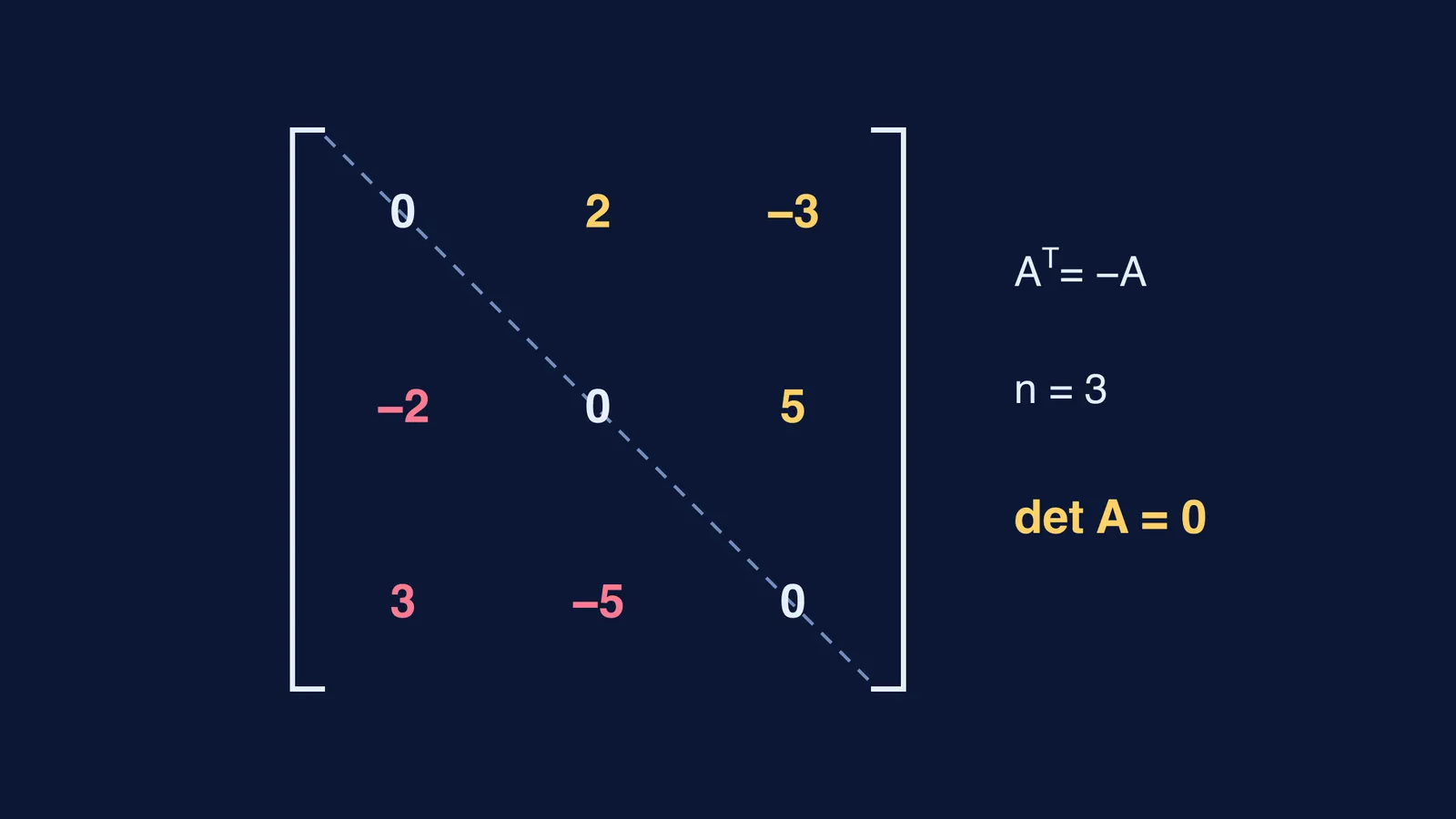
Take the skew-symmetric matrix with rows (0, 2, −3), (−2, 0, 5) and (3, −5, 0). The diagonal is all zeros, and each entry below the diagonal is the negative of its mirror above.
Expand along the first row, with signs +, −, +:
First term: +0 × (anything) = 0.
Second term: −(2) × [(−2)(0) − (5)(3)] = −2 × (−15) = 30.
Third term: +(−3) × [(−2)(−5) − (0)(3)] = (−3) × 10 = −30.
Total: 0 + 30 − 30 = 0.
With letters, let the rows be (0, a, b), (−a, 0, c) and (−b, −c, 0). Expanding along the first row gives 0 − a(0 + bc) + b(ac − 0) = −abc + abc = 0. The two surviving terms are always equal and opposite.
NCERT's own Example 4 in the determinants chapter is a 3 × 3 skew-symmetric determinant with sin α, cos α and sin β entries, and its answer works out to zero (NCERT Class 12 Mathematics, Chapter 4).
What about even order?
Even order is different. The 2 × 2 matrix with rows (0, a) and (−a, 0) has determinant 0 × 0 − (a)(−a) = a², which is zero only when a = 0. So never write "skew-symmetric, so det = 0" without checking that the order is odd. For even n the determinant is the square of the Pfaffian, a polynomial in the entries of the matrix (Skew-symmetric matrix, Wikipedia).
How do you use this in an exam?
Run this three-question check whenever a determinant looks fiddly:
Is the diagonal all zeros? If not, the matrix is not skew-symmetric. Stop and expand normally.
Is every entry the negative of its mirror across the diagonal? Check all three pairs in a 3 × 3, not just one.
Is the order odd? If yes, the determinant is 0, and the matrix has no inverse.
This also settles questions about A − A′. NCERT proves that A − A′ is skew-symmetric for any square matrix A with real entries (NCERT Class 12 Mathematics, Chapter 3, Theorem 1), so for any 3 × 3 real matrix A, |A − A′| = 0 without a single multiplication. We prove the companion results in why AA′, A + A′ and A − A′ are symmetric or skew-symmetric, and the definitions are laid out in symmetric and skew-symmetric matrices in Class 12 maths.
Our guide to the cyclic determinant with rows a b c, b c a, c a b uses the same habit: spot the structure first, expand last.
To practise, work through problems in the Fermi Problem Library, where a step-by-step solver explains the reasoning rather than printing an answer. If transposes and determinant rules still feel shaky, the Fermi Concept Library has a lesson for each concept in mathematics, matrices included.