On this page
Each row of this determinant is the row above it shifted one place to the left: a b c, then b c a, then c a b. So every row and every column holds a, b and c exactly once. That pattern lets the problem collapse to a few lines. Call the determinant Δ; the goal is the factored form, which shows at a glance when Δ is zero or negative.
What is the determinant with rows a b c, b c a, c a b?
Δ = 3abc − a³ − b³ − c³ = −(a³ + b³ + c³ − 3abc).
You can confirm this by plain expansion along the first row: a(cb − a²) − b(b² − ac) + c(ab − c²) = abc − a³ − b³ + abc + abc − c³. Expansion works, but the middle minus sign is easy to drop and the answer comes out unfactored. If you want a refresher on that diagonal-style expansion, see our guide to Sarrus' rule for 3×3 determinants.
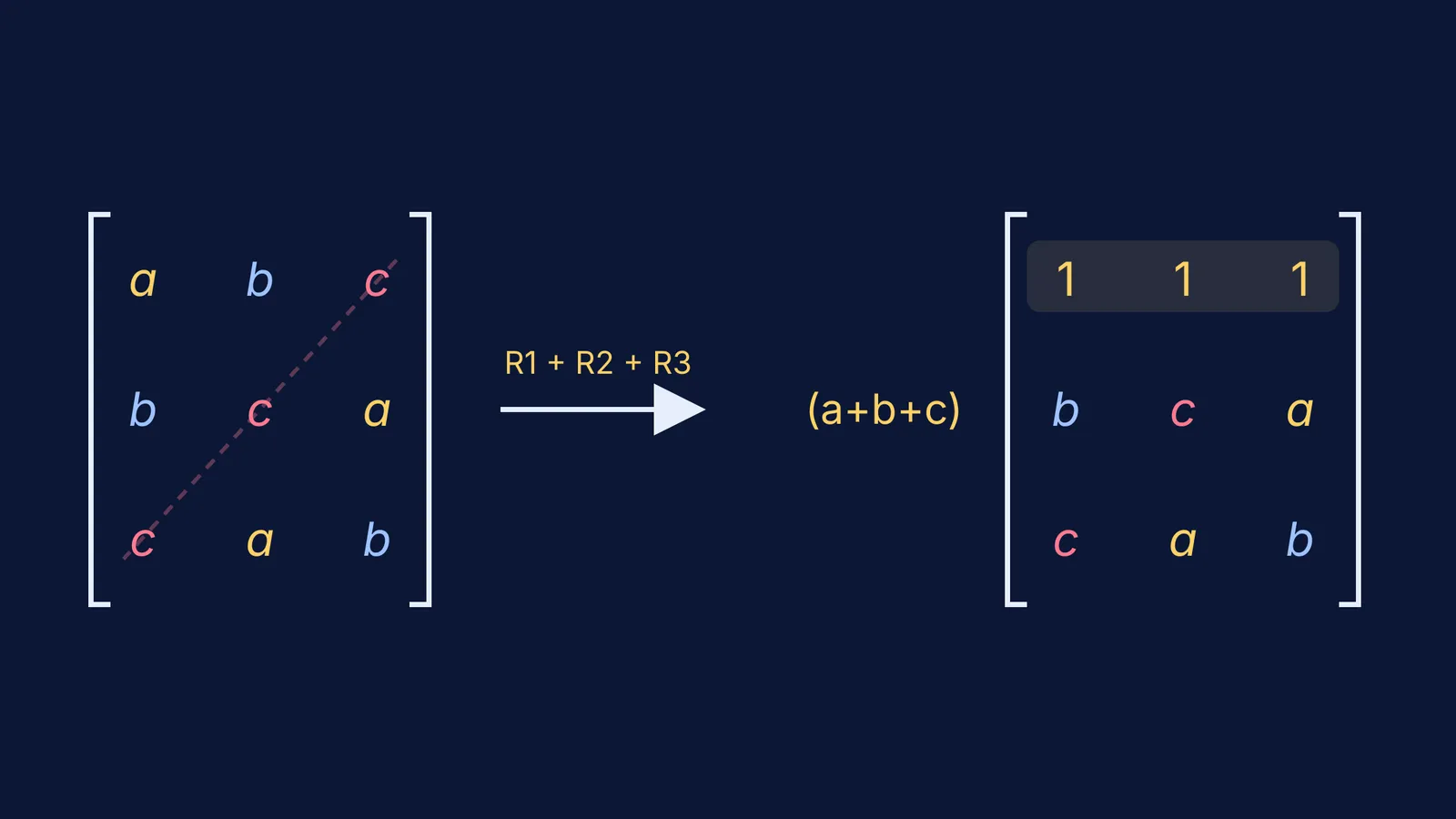
How do you evaluate it using row operations?
Three rules do the work. Adding a multiple of one row to another leaves a determinant unchanged, multiplying a row by λ multiplies the determinant by λ, and swapping two rows multiplies it by −1, as stated on ProofWiki's page on elementary row operations.
Replace R1 with R1 + R2 + R3. Every entry of the new first row is a + b + c, and Δ does not change.
Take the common factor (a + b + c) out of R1. The first row becomes 1, 1, 1.
Expand along that row of 1s: 1(bc − a²) − 1(b² − ac) + 1(ab − c²) = ab + bc + ca − a² − b² − c².
So Δ = (a + b + c)(ab + bc + ca − a² − b² − c²) = −(a + b + c)(a² + b² + c² − ab − bc − ca).
Apply the identity x³ + y³ + z³ − 3xyz = (x + y + z)(x² + y² + z² − xy − xz − yz), listed on Wikipedia's factorization page. That turns step 4 into Δ = −(a³ + b³ + c³ − 3abc).
Step 1 is the move to remember: when every row has the same total, sum the rows first. Our piece on evaluating determinants quickly with properties shows the same trick on other patterns.
Wolfram MathWorld's circulant determinant page factorises the 3×3 circulant as (x₁ + x₂ + x₃)(x₁ + ωx₂ + ω²x₃)(x₁ + ω²x₂ + ωx₃), with ω a complex cube root of unity. The last two factors multiply to the quadratic factor above, and the row swap supplies the −1.
How can you check your answer quickly?
Put in small numbers. Take a = 1, b = 2, c = 3.
Direct: 3abc − a³ − b³ − c³ = 18 − 1 − 8 − 27 = −18.
Factored: −(a + b + c)(a² + b² + c² − ab − bc − ca) = −6 × (14 − 11) = −18.
Edge case: if a = b = c, all three rows are equal, so Δ must be 0, and the factored form gives 0 too.
If your formula gives +18 here, you have written the circulant answer and lost the sign.
When is the determinant negative or zero?
Expanding three squares shows a² + b² + c² − ab − bc − ca = ½[(a − b)² + (b − c)² + (c − a)²]. For real numbers this is never negative, and it is zero only when a = b = c.
That gives you three quick results for real a, b, c:
If a, b, c are positive and not all equal, Δ is negative.
Δ = 0 exactly when a + b + c = 0 or a = b = c.
If a + b + c is negative and the numbers are not all equal, Δ is positive.
"If a, b, c are positive and unequal, show the determinant is negative" is the first result in disguise.
If the sign keeps flipping, write each cofactor with its position sign before simplifying; our guide to minors and cofactors and the sign checkerboard walks through that habit. For more practice, the Fermi Problem Library has worked problems with a step-by-step solver that explains the reasoning rather than printing an answer, so you can see which line went wrong.
Try the same five steps on the determinant with rows a b c, c a b, b c a. You should get +(a³ + b³ + c³ − 3abc).