

On this page
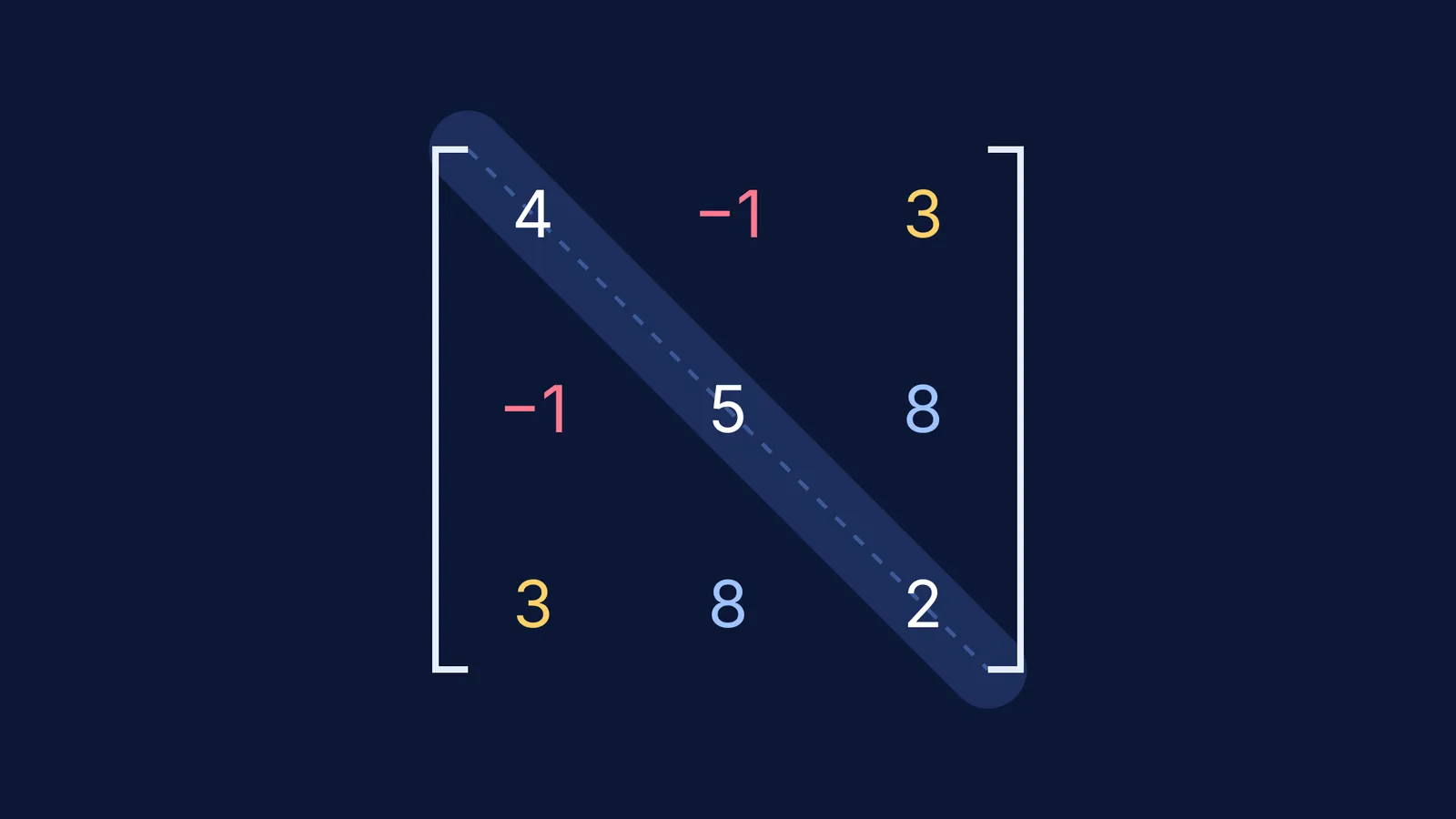
When working with matrices, a common exam question asks you to prove that combining a matrix A with its transpose A′ produces a specific type of matrix. Whether it is matrix multiplication (AA′) or matrix addition (A + A′), these operations reliably generate symmetric matrices.
But why does this happen? The proofs rely entirely on the core properties of the transpose, particularly the reversal law. Here is exactly how to structure these proofs.
What are symmetric and skew-symmetric matrices?
Before we prove anything, we need the definitions. According to the NCERT Class 12 Mathematics textbook, a square matrix is:
Symmetric if taking its transpose leaves it unchanged (A′ = A).
Skew-symmetric if taking its transpose gives its negative (A′ = −A).
You also need three essential properties of the transpose to solve these problems:
Double transpose: (A′)′ = A
Sum property: (A + B)′ = A′ + B′
Reversal law of multiplication: (AB)′ = B′A′
The reversal law is the engine behind most of these proofs. When you transpose a product, you must swap the order of the matrices.
How do you prove that AA′ is symmetric?
To prove that AA′ is symmetric, we must show that transposing the entire expression gives back the original product AA′.
Let P = AA′.
Take the transpose of both sides: P′ = (AA′)′.
Apply the reversal law of multiplication, treating the first A as the first term and A′ as the second term: P′ = (A′)′ A′.
Apply the double transpose rule ((A′)′ = A) to the first term: P′ = A A′.
Since P′ = P, the matrix AA′ is symmetric.
If you want to test this out with larger matrices or check your arithmetic, the Fermi Problem Library has worked problems with a step-by-step solver that explains the reasoning rather than printing an answer.
How do you prove that A + A′ is symmetric?
The addition proof is even more straightforward because matrix addition does not involve the reversal law.
Let S = A + A′.
Take the transpose of both sides: S′ = (A + A′)′.
Apply the sum property: S′ = A′ + (A′)′.
Apply the double transpose rule: S′ = A′ + A.
Matrix addition is commutative, so A′ + A = A + A′.
Therefore, S′ = S, meaning A + A′ is symmetric.
This is true for any square matrix. If you forget these properties while studying, the Fermi Concept Library has every concept in physics, chemistry, biology, mathematics and computing, each with its own lesson and its place in the map.
How do you prove that A − A′ is skew-symmetric?
To prove a matrix is skew-symmetric, we need to show that taking its transpose results in the exact negative of the original matrix.
Let K = A − A′.
Take the transpose of both sides: K′ = (A − A′)′.
Apply the sum/difference property: K′ = A′ − (A′)′.
Apply the double transpose rule: K′ = A′ − A.
Factor out a negative sign: K′ = −(A − A′).
Therefore, K′ = −K. This proves that A − A′ is skew-symmetric.
These two results are often used to prove another major mathematical theorem: any square matrix can be written as the sum of a symmetric and a skew-symmetric matrix using the formula A = ½(A + A′) + ½(A − A′).
These structural properties of matrices come up everywhere in linear algebra. Just as understanding coordinate geometry lets you find the area of a triangle using determinants, mastering the reversal law lets you manipulate matrix equations with confidence. You can even use similar algebraic logic when finding Aⁿ for a matrix by spotting the pattern.


