On this page
Inverse trigonometric functions look like a one-week chapter, and that is why they cost marks. Most errors come from one habit: treating sin⁻¹(sin x) as x for every x, or using an identity without checking its condition. This guide fixes the branches first, then works through the traps with original examples you can check on a calculator.
Is inverse trigonometry in the JEE Main 2027 syllabus?
Yes. The official Syllabus for JEE (Main) 2027, linked as "Syllabus" on the NTA JEE Main website, lists inverse trigonometrical functions and their properties under Mathematics Unit 14, Trigonometry, of Paper 1 (B.E./B.Tech.). The same document's Unit 7 also lists differentiation of inverse trigonometric functions, so the topic returns in calculus.
In school, the topic is Chapter 2, Inverse Trigonometric Functions, of NCERT Class 12 Mathematics Part I (Reprint 2026-27). The rationalised chapter states only basic relations such as sin⁻¹(sin x) = x on the principal branch, says similar results hold "for suitable values" of the domain, and does not list identities such as sin⁻¹x + cos⁻¹x = π/2 or the tan⁻¹ addition formula. The identities below go one step further, so learn each one with its condition.
What are the principal value branches?
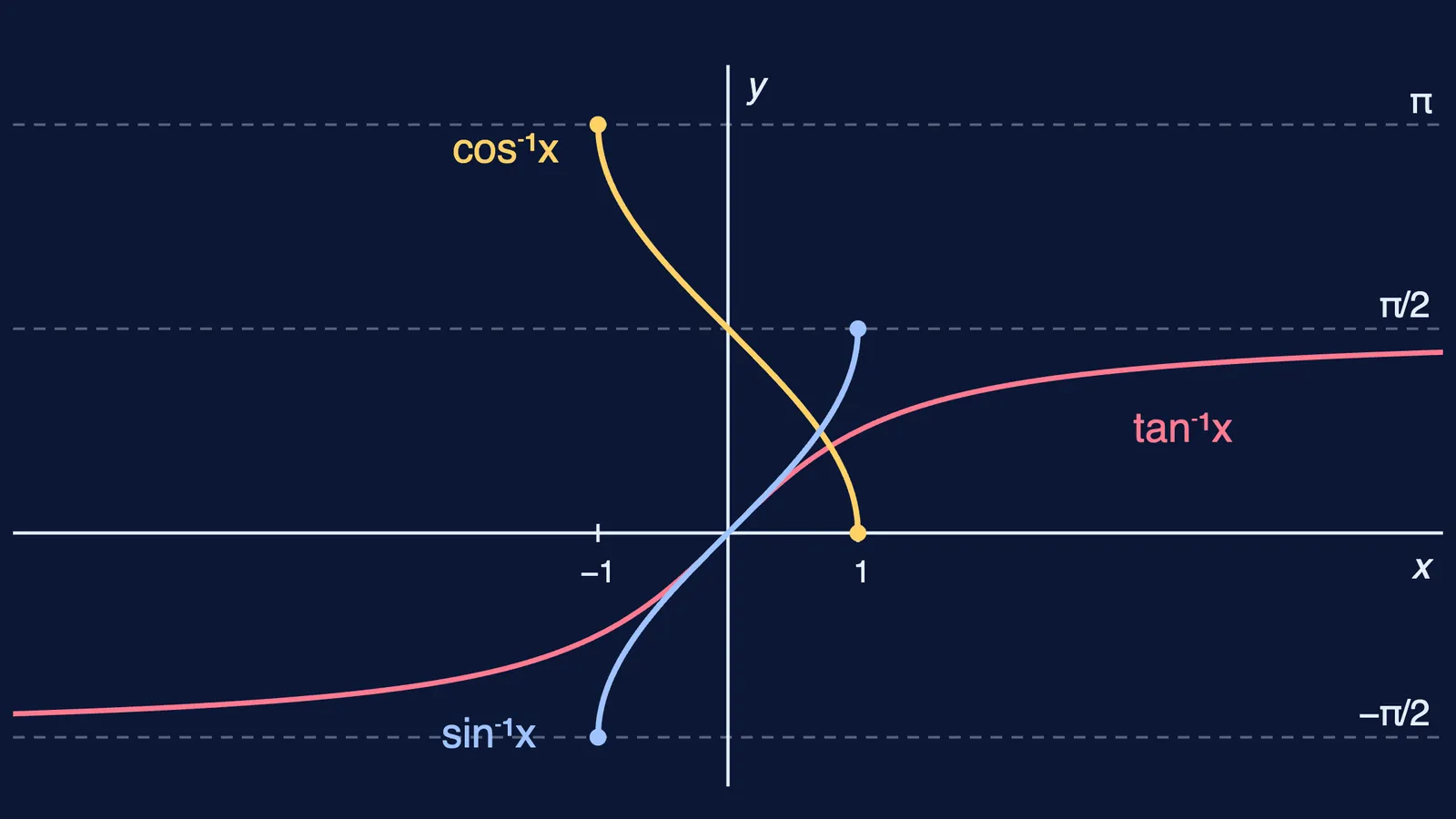
Sine, cosine and tangent repeat, so each inverse picks one branch where the function is one-one. The NCERT chapter summary gives these domains and ranges:
sin⁻¹x: domain [−1, 1], range [−π/2, π/2]
cos⁻¹x: domain [−1, 1], range [0, π]
tan⁻¹x: domain all real numbers, range (−π/2, π/2), open at both ends
Two quick tests. sin⁻¹ and tan⁻¹ give negative answers for negative inputs; cos⁻¹ never does. And sin⁻¹x is not (sin x)⁻¹, which is 1/sin x.
How do you evaluate sin⁻¹(sin x) outside the branch?
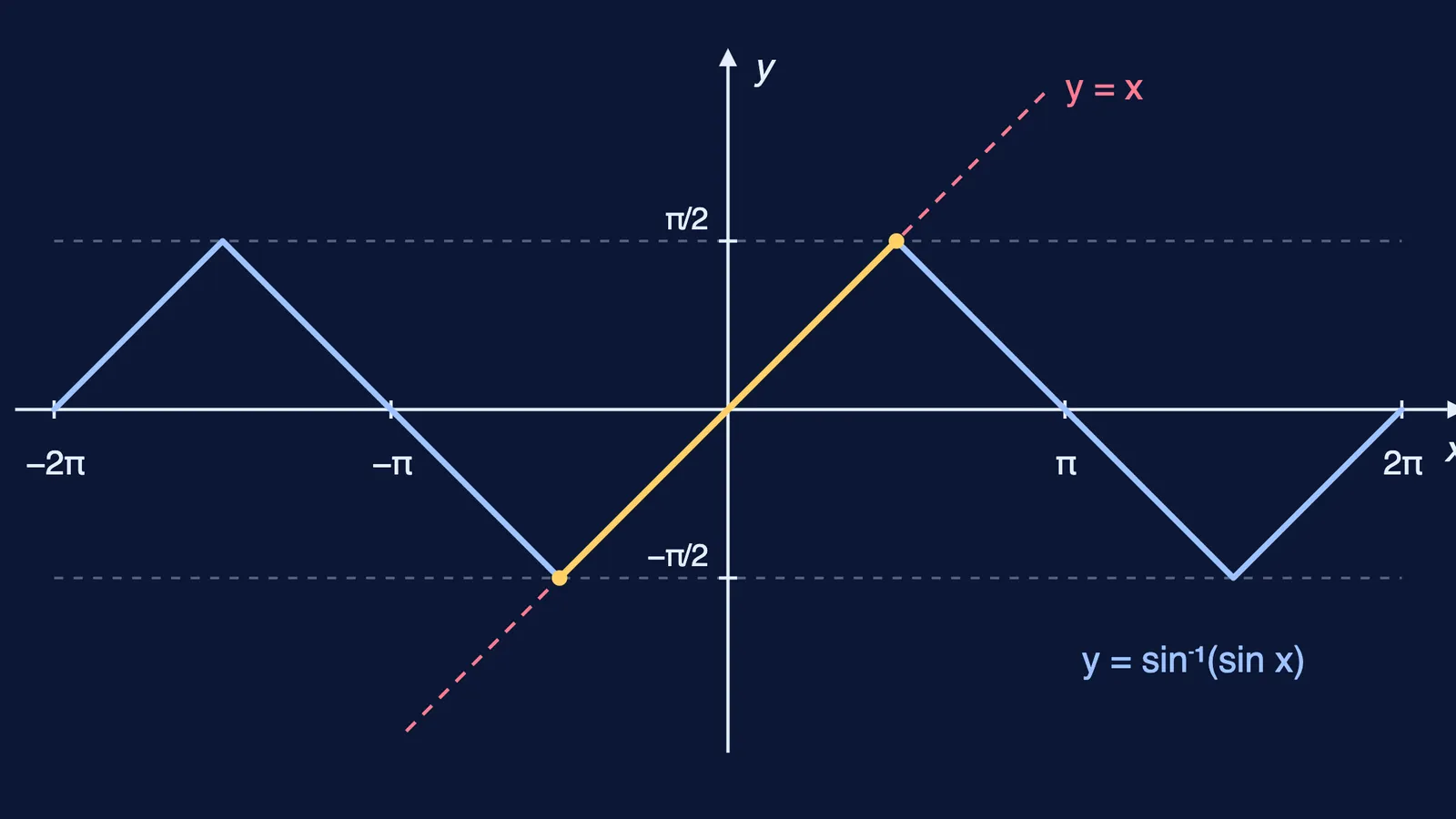
sin⁻¹(sin x) = x only when x lies in [−π/2, π/2]. Outside that interval, find the angle in the branch with the same sine. The hero graph shows the result: a zigzag that matches y = x only on the principal branch, then turns back.
Example 1: sin⁻¹(sin 5). Since 3π/2 ≈ 4.712 and 5π/2 ≈ 7.854, the number 5 (in radians) lies between them, where sin⁻¹(sin x) = x − 2π. So the answer is 5 − 2π ≈ −1.283, which is inside [−π/2, π/2]. A calculator gives sin⁻¹(sin 5) ≈ −1.283 too.
Example 2: sin⁻¹(sin 2). Here 2 lies between π/2 and 3π/2, where sin(π − x) = sin x and π − x is in the branch. The answer is π − 2 ≈ 1.142, not 2.
Which identities do students misuse?
Each identity below is true only on its stated domain.
cos⁻¹(−x) = π − cos⁻¹x, for x in [−1, 1]. Example: cos⁻¹(−1/√2) = π − π/4 = 3π/4. The common slip is writing −cos⁻¹x, which is negative and so outside [0, π]. In contrast, sin⁻¹(−x) = −sin⁻¹x and tan⁻¹(−x) = −tan⁻¹x.
sin⁻¹x + cos⁻¹x = π/2, for x in [−1, 1]. Example: solve sin⁻¹x = 2cos⁻¹x. Replace sin⁻¹x with π/2 − cos⁻¹x to get 3cos⁻¹x = π/2, so cos⁻¹x = π/6 and x = √3/2. Check: sin⁻¹(√3/2) = π/3, which is twice π/6.
tan⁻¹x + tan⁻¹y = tan⁻¹((x + y)/(1 − xy)), only when xy < 1. Example: tan⁻¹(1/4) + tan⁻¹(3/5). Here xy = 3/20 < 1, and (17/20)/(17/20) = 1, so the sum is tan⁻¹1 = π/4.
Now the trap. For tan⁻¹2 + tan⁻¹3, xy = 6 > 1. The formula gives tan⁻¹(5/(−5)) = −π/4, but two positive angles cannot add to a negative one. When x > 0, y > 0 and xy > 1, add π: the sum is π − π/4 = 3π/4. A calculator gives 1.107 + 1.249 = 2.356, which is 3π/4.
How should you practise inverse trigonometric functions?
A five-day plan that fits around other chapters:
Day 1: Draw the graphs of sin⁻¹x, cos⁻¹x and tan⁻¹x from memory, with endpoints marked open or closed.
Day 2: Evaluate sin⁻¹(sin x) and cos⁻¹(cos x) for x = 3, 4, 6 and −5. Check each on a calculator in radian mode.
Day 3: Practise the three identities above, writing the condition before each step.
Day 4: Mixed equations. Our walkthroughs on solving tan⁻¹ equations and rejecting the wrong root and using the π/2 identity in sin⁻¹ and cos⁻¹ equations give you two more to try.
Day 5: Link it to calculus with the derivatives of all six inverse trig functions and their signs.
Keep a mistake log with one line per error: "used xy formula when xy > 1" is more useful than "silly mistake".
If you keep losing the same step, the Fermi Problem Library has worked problems with a step-by-step solver that explains the reasoning rather than printing an answer. If the branches themselves feel shaky, the Fermi Concept Library covers every concept in mathematics, each with its own lesson.
Start with Day 1 tonight: three graphs, no book.