

On this page
If you are revising calculus for CBSE boards or JEE Main, the inverse trig derivatives look like six formulas to memorise. They are really three formulas and one sign rule.
What are the derivatives of the six inverse trig functions?
The list below agrees with Theorem 3.13 in OpenStax Calculus Volume 1, section 3.7 and equations 4.24.7 to 4.24.12 in the NIST Digital Library of Mathematical Functions.
d/dx sin⁻¹x = 1/√(1 − x²), for −1 < x < 1
d/dx cos⁻¹x = −1/√(1 − x²), for −1 < x < 1
d/dx tan⁻¹x = 1/(1 + x²), for all x
d/dx cot⁻¹x = −1/(1 + x²), for all x
d/dx sec⁻¹x = 1/(|x|√(x² − 1)), for |x| > 1
d/dx cosec⁻¹x = −1/(|x|√(x² − 1)), for |x| > 1
Read the list in pairs. Each 'co' function has its partner's expression with a minus sign, so you need to learn only three: 1/√(1 − x²), 1/(1 + x²) and 1/(|x|√(x² − 1)).
Why do the 'co' functions get a minus sign?
Because each pair adds up to a constant. With the standard principal values (cot⁻¹x between 0 and π, cosec⁻¹x between −π/2 and π/2, not 0):
sin⁻¹x + cos⁻¹x = π/2, for −1 ≤ x ≤ 1
tan⁻¹x + cot⁻¹x = π/2, for all x
sec⁻¹x + cosec⁻¹x = π/2, for |x| ≥ 1
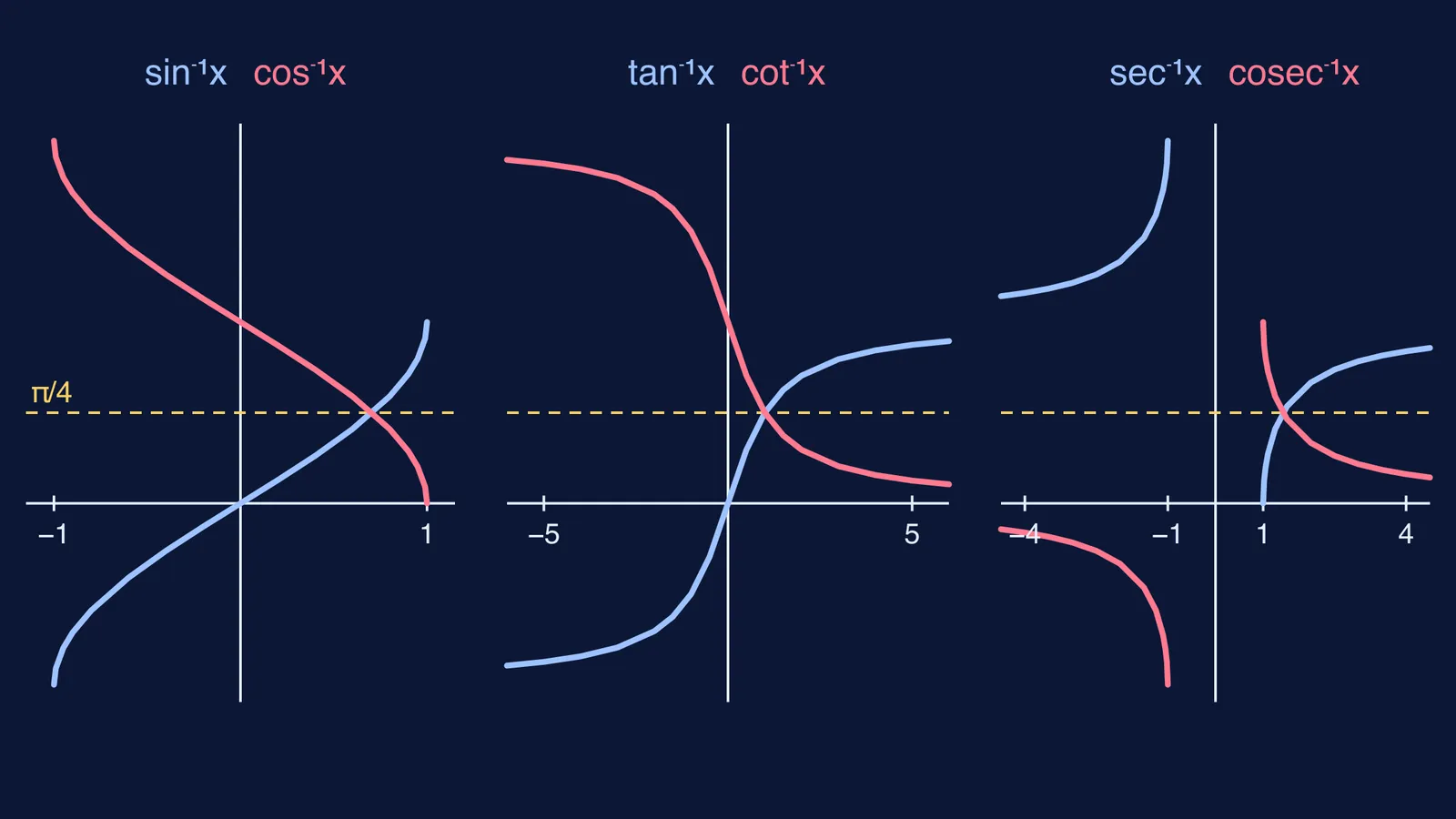
Differentiate both sides. The right side is a constant, so its derivative is zero, which forces the two derivatives on the left to be negatives of each other. In the diagram at the top, each 'co' curve mirrors its partner in the line y = π/4: where one rises, the other falls just as fast.
For one pair derived from scratch, see our walk-through of the derivative of tan⁻¹x and cot⁻¹x and where its minus sign comes from.
Why is there |x| in the derivative of sec⁻¹x?
Derive it once and the modulus stops being a mystery.
Let y = sec⁻¹x, so sec y = x, with y between 0 and π and y ≠ π/2.
Differentiate: sec y tan y · dy/dx = 1, so dy/dx = 1/(sec y tan y).
tan²y = sec²y − 1 = x² − 1, so tan y = ±√(x² − 1).
Now the sign. For x > 1, y lies between 0 and π/2, where tan y is positive. For x < −1, y lies between π/2 and π, where tan y is negative.
So sec y tan y equals x√(x² − 1) when x > 1, and −x√(x² − 1) when x < −1. Both cases are |x|√(x² − 1).
So the derivative is always positive: sec⁻¹x rises on both pieces, as the right-hand panel shows. At x = −2 the formula gives 1/(2√3), about 0.29; writing x instead of |x| would give −0.29, a falling graph, which is wrong.
The NIST library states the same fact without a modulus, as +1/(x√(x² − 1)) for positive x and −1/(x√(x² − 1)) for negative x (DLMF equation 4.24.11). The modulus comes back when you integrate, which is why the integral of 1/(x√(x² − 1)) is sec⁻¹|x|.
How do you differentiate sin⁻¹(2x) with the chain rule?
Replace x by the inside function u, then multiply by u′. OpenStax Example 3.64 uses the same pattern on sin⁻¹(2x³).
Inside function: u = 2x, so u′ = 2.
Outer derivative: 1/√(1 − u²) = 1/√(1 − (2x)²) = 1/√(1 − 4x²).
Multiply: dy/dx = 2/√(1 − 4x²).
Domain: you need |2x| < 1, so −1/2 < x < 1/2.
Check it at x = 1/4: 2/√(1 − 1/4) = 2/(√3/2) = 4/√3, about 2.31.
Three slips to watch for:
Dropping the factor 2: 1/√(1 − 4x²).
Squaring only x: 2/√(1 − 2x²).
Keeping the old domain |x| < 1 instead of |x| < 1/2.
Now try four yourself before reading the answers: cos⁻¹(3x), tan⁻¹(x²), sec⁻¹(2x) and sin⁻¹(√x).
−3/√(1 − 9x²), for |x| < 1/3
2x/(1 + x⁴)
1/(|x|√(4x² − 1)), for |x| > 1/2
1/(2√x) × 1/√(1 − x) = 1/(2√(x(1 − x))), for 0 < x < 1
How can you make the list stick before an exam?
Use this ten-minute drill on three different days in a week.
Minutes 0 to 2: write the three base expressions from memory, then the 'co' partners with minus signs.
Minutes 2 to 5: derive sec⁻¹x with |x| on blank paper.
Minutes 5 to 9: redo the four practice problems and mark them.
Minute 10: note any slip in one line, such as 'forgot u′ in cos⁻¹(3x)'.
If a chain-rule problem keeps going wrong and you cannot see where, the Fermi Problem Library has worked problems with a step-by-step solver that explains the reasoning rather than printing an answer. For gaps in the inverse functions themselves, the Fermi Concept Library gives each concept its own lesson.
Once differentiation feels automatic, run it backwards: the antiderivative of arcsin x by parts starts from the first formula on this list.


