

On this page
If you are doing Class 12 integration or JEE practice, you have met this integrand: 1/(x√(x²−1)). It is a derivative you already know, read backwards. The catch is a modulus sign that is easy to drop.
What is the derivative of sec⁻¹x?
OpenStax Calculus Volume 1 states the derivative of the inverse secant as d/dx sec⁻¹x = 1/(|x|√(x²−1)) (OpenStax Calculus Volume 1, Theorem 3.13). The formula holds for |x| > 1, where the root is real and non-zero.
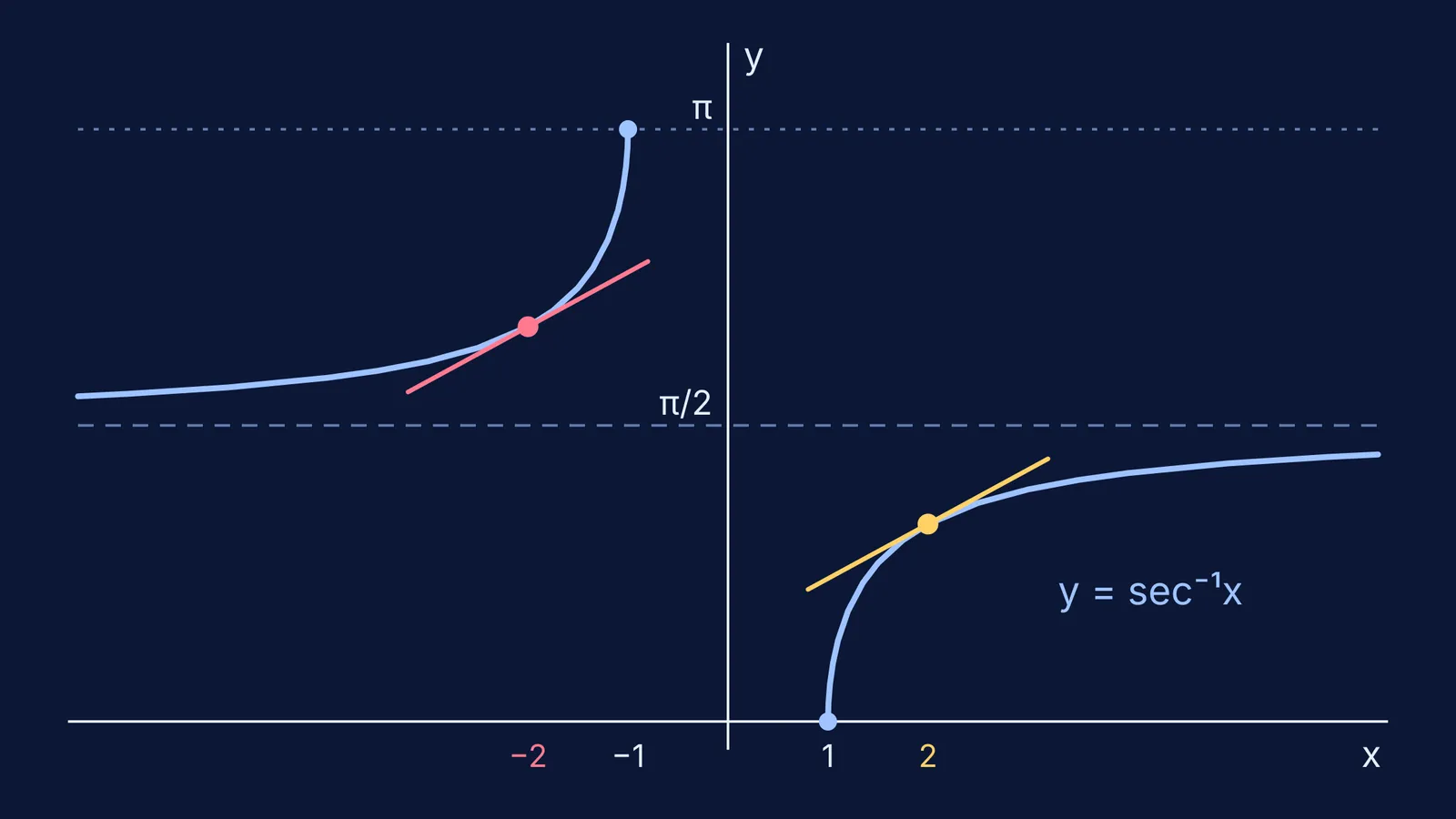
The |x| comes from the graph. sec⁻¹x takes values from 0 to π, skipping π/2, and both branches rise, as the diagram above shows. So the slope is positive even when x is negative, and a plain x in the denominator would get that wrong.
Read backwards, the derivative gives the standard form:
∫ dx/(x√(x²−1)) = sec⁻¹|x| + C
Check it by differentiating. For x > 1, sec⁻¹|x| is just sec⁻¹x, and its derivative is 1/(x√(x²−1)). For x < −1, sec⁻¹|x| = sec⁻¹(−x), and the chain rule gives −1/(|x|√(x²−1)), which equals 1/(x√(x²−1)) because x = −|x| there. Both branches match.
The general version, for a > 0, is ∫ du/(u√(u²−a²)) = (1/a) sec⁻¹(|u|/a) + C (OpenStax Calculus Volume 1, section 5.7).
The current NCERT Class 12 Mathematics Part II (reprint 2026-27) lists standard integrals for sin⁻¹, cos⁻¹ and tan⁻¹, and its section 7.4 list of particular integrals has no sec⁻¹ entry (NCERT Class 12 Mathematics Part II, Chapter 7). So either you remember this form, or you rebuild it in four lines with x = sec θ.
How does the substitution x = sec θ work?
For integrands containing √(x²−a²), OpenStax uses x = a sec θ, so dx = a sec θ tan θ dθ, with θ in [0, π/2) or (π/2, π] (OpenStax Calculus Volume 2, section 3.3). With a = 1:
Put x = sec θ, so dx = sec θ tan θ dθ and x² − 1 = tan²θ.
For x > 1, θ lies between 0 and π/2, so tan θ > 0 and √(x²−1) = tan θ.
The integral becomes ∫ sec θ tan θ dθ / (sec θ tan θ) = ∫ dθ = θ + C = sec⁻¹x + C.
For x < −1, θ lies between π/2 and π, so tan θ < 0 and √(x²−1) = −tan θ. The integral becomes −θ + C = −sec⁻¹x + C.
Step 4 looks different from sec⁻¹|x|, but it isn't. Since sec(π − θ) = −sec θ, we get sec⁻¹(−x) = π − sec⁻¹x. So for x < −1, −sec⁻¹x = sec⁻¹|x| − π, and the −π joins the constant. The same OpenStax section makes the point directly: for x ≤ −a, √(x²−a²) equals −a tan θ, not a tan θ.
Why is sec⁻¹x + C sometimes marked wrong?
Because it fails on the negative branch. A definite integral shows it clearly.
On [√2, 2]: ∫ dx/(x√(x²−1)) = sec⁻¹2 − sec⁻¹√2 = π/3 − π/4 = π/12.
On [−2, −√2], x is negative, so the integrand is negative and the answer must be negative. With sec⁻¹|x| you get sec⁻¹√2 − sec⁻¹2 = π/4 − π/3 = −π/12. Correct. With sec⁻¹x you get sec⁻¹(−√2) − sec⁻¹(−2) = 3π/4 − 2π/3 = +π/12. Wrong sign.
The habit that catches this is the one in our post on checking an integral by differentiating, plugging in and testing limits. It is the same modulus story as why the integral of 1/x is ln|x|.
Which related integrals reduce to sec⁻¹?
The spotting rule: something outside the root whose derivative you can find in the numerator, and "square minus constant" inside the root.
∫ dx/(x√(x²−9)). Here a = 3, so the answer is (1/3) sec⁻¹(|x|/3) + C.
∫ dx/(x√(4x²−1)). Put u = 2x, so dx = du/2 and x = u/2. The halves cancel and you get sec⁻¹|2x| + C. Check for x > 1/2: the derivative of sec⁻¹(2x) is 2/(2x√(4x²−1)) = 1/(x√(4x²−1)).
∫ dx/√(e²ˣ−1). Multiply top and bottom by eˣ to get ∫ eˣ dx / (eˣ√(e²ˣ−1)). With u = eˣ, this is sec⁻¹(eˣ) + C. No modulus is needed because eˣ > 0.
Not every √(x²−a²) is an arcsec. With nothing outside the root, NCERT's section 7.4 gives ∫ dx/√(x²−a²) = log|x + √(x²−a²)| + C (NCERT Class 12 Mathematics Part II, Chapter 7). With x in the numerator, ∫ x dx/√(x²−a²) is a plain substitution u = x² − a², giving √(x²−a²) + C.
A three-step check before you move on
Is there an x (or a function of x) outside the root, matching the inside? Then expect sec⁻¹.
Did you write |x|, or |x|/a, inside the sec⁻¹?
Differentiate your answer at one negative value of x and compare signs with the integrand.
And sec⁻¹x means the inverse function, not 1/sec x; see is sin⁻¹x the same as 1/sin x.
If you keep picking the wrong form, the Fermi Problem Library has worked problems with a step-by-step solver that explains the reasoning rather than printing an answer. If the inverse secant itself feels shaky, the Fermi Concept Library gives each concept its own lesson and its place in the map.


