

On this page
You meet sin⁻¹x in Class 12, and years of algebra tell you that a −1 power means "one over". With trigonometric functions that instinct is wrong, and the slip can cost marks in board exams and JEE Main.
Is sin⁻¹x the same as 1/sin x?
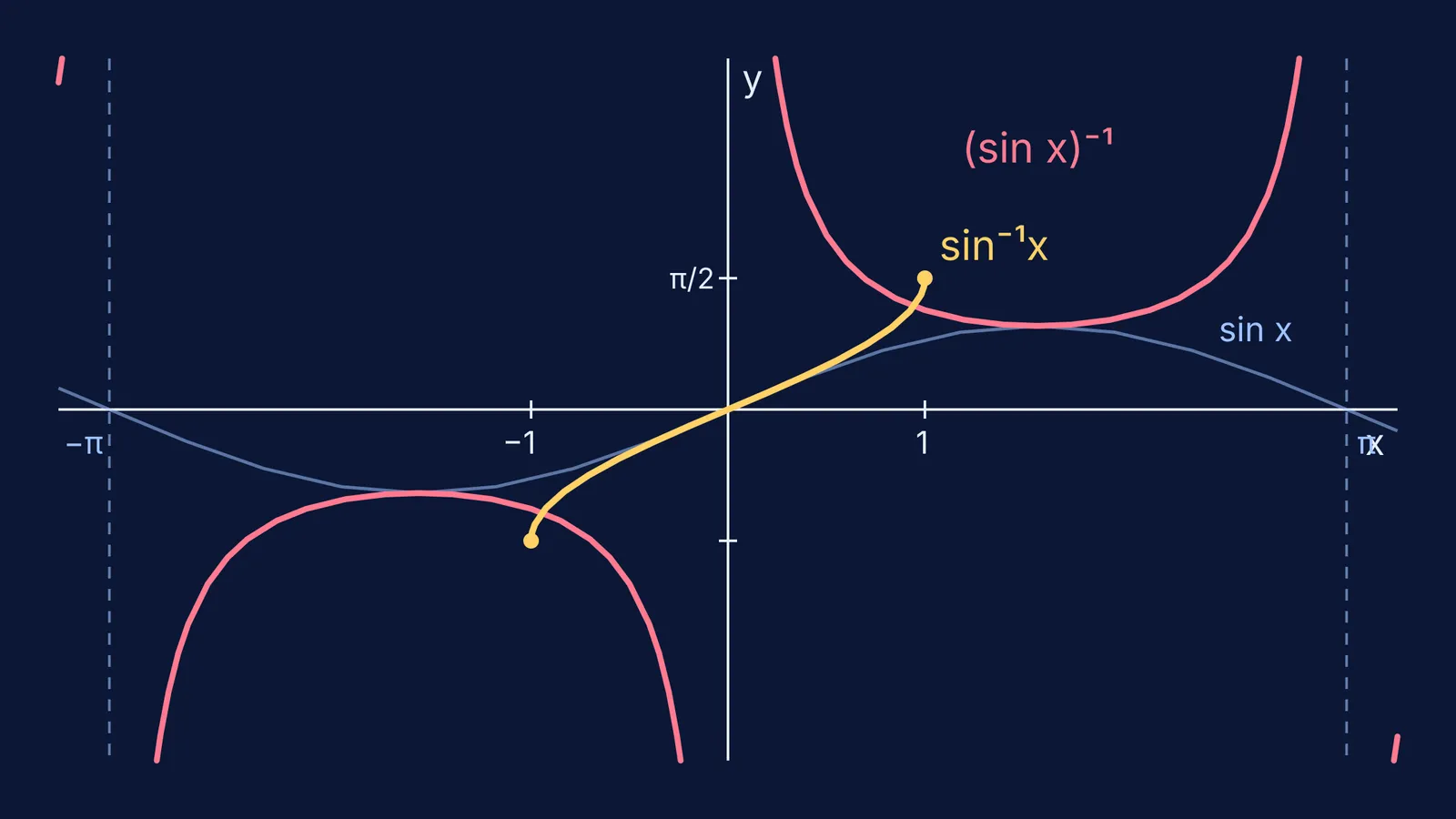
No. The NCERT Class 12 mathematics textbook, in its chapter on inverse trigonometric functions, says it directly: "sin⁻¹x should not be confused with (sin x)⁻¹. In fact (sin x)⁻¹ = 1/sin x and similarly for other trigonometric functions."
So two different objects share almost the same symbol:
sin⁻¹x (arc sine) is the inverse function, the angle whose sine is x. In the same NCERT chapter, its principal value branch has domain [−1, 1] and range [−π/2, π/2].
(sin x)⁻¹ is the reciprocal, 1/sin x, which is cosec x. NCERT defines it wherever sin x ≠ 0, and its values never lie strictly between −1 and 1.
The same rule holds for the other five functions: cos⁻¹x is an angle, while (cos x)⁻¹ is sec x. If the reciprocal functions themselves feel shaky, our guide to the domain and range of sec x, cosec x and cot x works through them.
Why does sin²x mean (sin x)² but sin⁻¹x does not mean 1/sin x?
Because of convention, not logic. Writing sin²x for (sin x)² is standard shorthand, as in sin²x + cos²x = 1. The −1 superscript breaks that pattern. Wikipedia's article on inverse trigonometric functions notes that the sin⁻¹ notation "conflicts with the common syntax sin²(x)" and "may result in confusion between notation for the reciprocal (multiplicative inverse) and inverse function". The same article credits the superscript notation to John Herschel, in 1813.
The other common name, arcsin x, avoids the clash. Python's math library documentation describes math.asin(x) as returning "the arc sine of x, in radians", with a result between −π/2 and π/2.
A close cousin of this trap is sin²x versus sin x², which we unpack in the mathematical difference between sin²x and sin x².
Which calculator button gives sin inverse?
On a typical scientific calculator, sin⁻¹ has no key of its own. The Casio fx-115ES PLUS/fx-991ES PLUS C user's guide explains that pressing SHIFT followed by a second key "performs the alternate function of the second key", shown by "the text printed above the key", and its illustration shows sin⁻¹ printed above the sin key. The reciprocal, x⁻¹, is a separate function in the same guide.
So SHIFT + sin gives arc sine, never cosec. This calculator has no cosec key, so for cosec x you type 1 ÷ sin x.
The same guide lists the allowed input for sin⁻¹x as 0 ≤ |x| ≤ 1, and gives "your input exceeds the allowable input range" as a cause of Math ERROR. Treat that error as an alarm: you may have pressed SHIFT when you meant a reciprocal.
Worked example: one input, three answers
Set the calculator to radian mode and take x = 0.5, then x = 2.
sin⁻¹(0.5) = π/6 ≈ 0.5236, the angle (30°) whose sine is 0.5. Keys: SHIFT, sin, 0.5, =.
(sin 0.5)⁻¹ = 1/sin 0.5 ≈ 1/0.4794 ≈ 2.086. Keys: 1, ÷, sin, 0.5, =.
sin²(0.5) = (sin 0.5)² ≈ 0.2298.
sin⁻¹(2) has no value, because no angle has a sine of 2, so the calculator shows Math ERROR. But (sin 2)⁻¹ = cosec 2 ≈ 1/0.9093 ≈ 1.100.
The same 0.5 gives 0.5236, 2.086 or 0.2298, depending only on how you read the superscript.
How do you avoid the mix-up in an exam?
Use this checklist:
Read sin⁻¹x aloud as "the angle whose sine is x". The words stop you reading it as a fraction.
Check the input. sin⁻¹ and cos⁻¹ only accept values from −1 to 1.
Check the output. A principal value of sin⁻¹ lies in [−π/2, π/2], and of cos⁻¹ in [0, π].
When you mean a reciprocal, write cosec x, sec x or cot x. If you must use a power, add brackets: (sin x)⁻¹.
Treat positive superscripts as powers. sin²x and sin³x are powers of sin x; the −1 is the one that means something else.
On the calculator, SHIFT + sin means arc sine. A Math ERROR can mean a wrong key or an impossible input.
Once the notation is clear, the next trap is composition: sin⁻¹(sin x) is not always x, which we explain in why sin⁻¹(sin x) is not always x.
If the symbol keeps tripping you, the gap is usually the idea of an inverse function, not the notation. The Fermi Concept Library gives every concept in mathematics its own lesson and its place in the map, so you can revisit inverse functions first. To practise, the Fermi Problem Library has worked problems with a step-by-step solver that explains the reasoning rather than printing an answer, so you can see which reading of the notation each step uses.
Next time you see a −1 on a trig function, ask one question: angle or fraction?


