

On this page
When you study trigonometry in Class 11, sine, cosine, and tangent receive most of the focus. But in competitive exams like JEE Main, questions frequently test reciprocal ratios: secant, cosecant, and cotangent. Understanding these functions requires two foundational concepts: identifying where denominators vanish to define the domain, and inverting bounded values to determine the range.
Where are sec x, cosec x and cot x undefined?
The domain of any reciprocal trigonometric function contains all real numbers except those that cause division by zero. Chapter 3 of the NCERT Class 11 Mathematics curriculum defines these functions on the unit circle x² + y² = 1, where any angle x specifies coordinates (cos x, sin x).
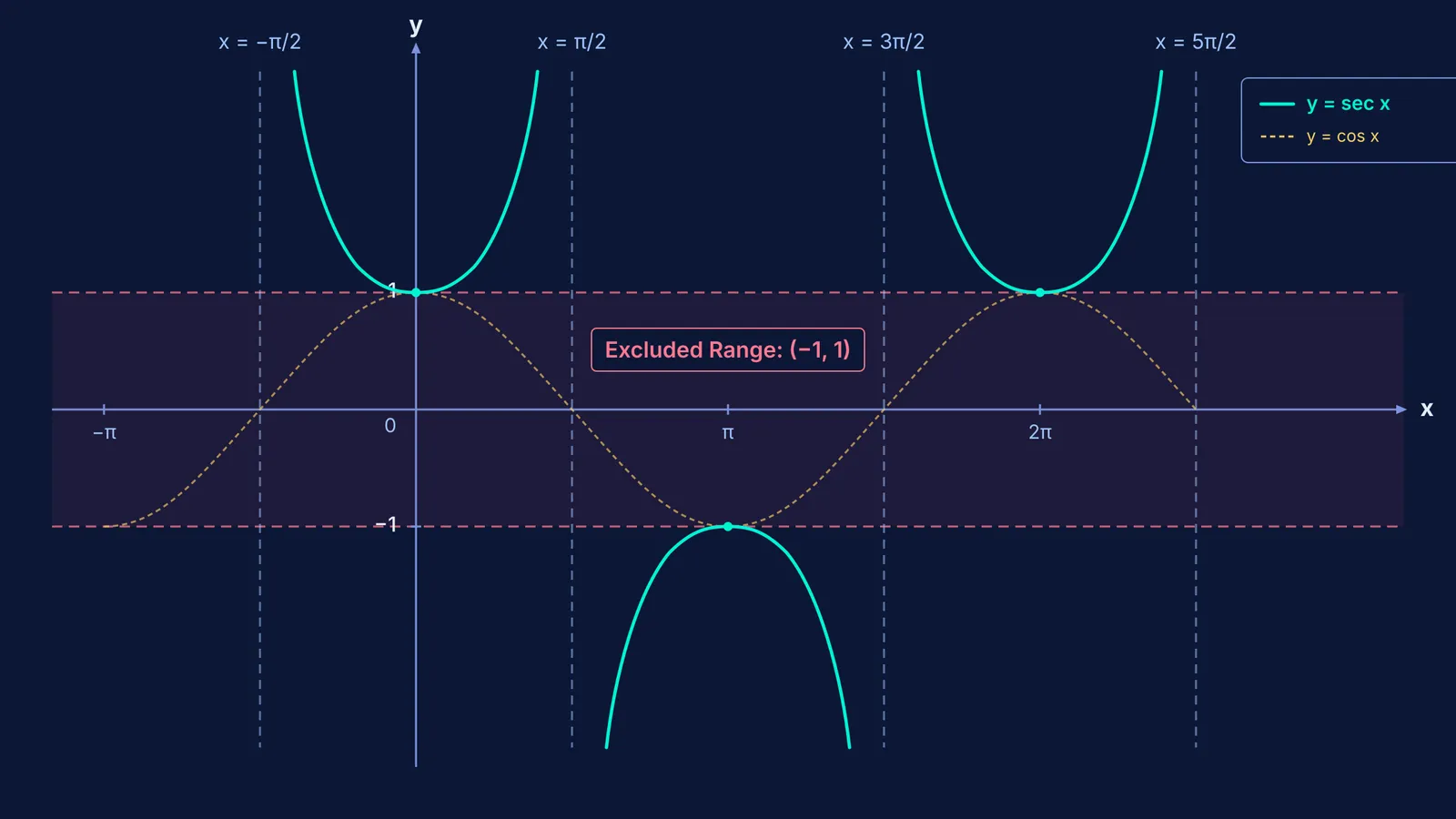
The secant function is defined as sec x = 1 / cos x. On the unit circle, cos x = 0 at (0, 1) and (0, −1), corresponding to odd multiples of π/2. According to Wolfram MathWorld, sec x is undefined at x = (2n + 1)π/2 for any integer n ∈ Z. Its domain is R \ {(2n + 1)π/2 : n ∈ Z}. As noted in OpenStax Precalculus, vertical asymptotes occur at each excluded value.
In contrast, cosecant (cosec x = 1 / sin x) and cotangent (cot x = cos x / sin x) have sin x in their denominators. The sine function vanishes along the horizontal axis at (1, 0) and (−1, 0), which are integer multiples of π. Both cosec x and cot x are undefined at x = nπ for n ∈ Z, giving domain R \ {nπ : n ∈ Z}.
Why does the range of sec x and cosec x exclude (−1, 1)?
A common exam trap is assuming that because cos x and sin x lie in [−1, 1], their reciprocals remain near zero. In fact, taking the reciprocal turns the interval inside out.
For all valid inputs, cosine is bounded by −1 ≤ cos x ≤ 1. Removing points where cos x = 0 yields 0 < |cos x| ≤ 1. Inverting this inequality reverses its direction: |sec x| = 1 / |cos x| ≥ 1. This splits into two rays: sec x ≥ 1 or sec x ≤ −1.
No real input can yield −1 < sec x < 1. A value like sec x = 0.5 would require cos x = 2, which is impossible because cosine cannot exceed 1. Both sec x and cosec x have the range (−∞, −1] ∪ [1, ∞), often written as R \ (−1, 1).
Why does cot x not exclude (−1, 1)? Unlike secant, cot x = cos x / sin x is a ratio of two varying coordinates. At x = π/2, cot x = 0. Near multiples of π, it tends to ±∞. Because its numerator can be zero while its denominator is non-zero, cot x spans all real numbers: (−∞, ∞).
How do the reciprocal trigonometric functions compare?
The domain, range, and vertical asymptotes of the three reciprocal functions follow clear structural patterns:
Secant (sec x = 1 / cos x): Domain is R \ {(2n + 1)π/2 : n ∈ Z}; range is (−∞, −1] ∪ [1, ∞); vertical asymptotes are x = (2n + 1)π/2; fundamental period is 2π.
Cosecant (cosec x = 1 / sin x): Domain is R \ {nπ : n ∈ Z}; range is (−∞, −1] ∪ [1, ∞); vertical asymptotes are x = nπ; fundamental period is 2π.
Cotangent (cot x = cos x / sin x): Domain is R \ {nπ : n ∈ Z}; range is (−∞, ∞); vertical asymptotes are x = nπ; fundamental period is π.
These output ranges become the domains when you define inverse trigonometric functions in Class 12, where sec⁻¹ x and cosec⁻¹ x only accept arguments with |x| ≥ 1. To evaluate their signs across quadrants, review trigonometric ratios of allied angles in Class 11.
How do you find the domain and range of transformed reciprocal functions?
In examinations, reciprocal functions often appear with linear arguments. Consider finding the domain and range of f(x) = 3 sec(2x − π/4) + 1:
Domain: Set 2x − π/4 = (2n + 1)π/2 for n ∈ Z. Solving gives 2x = nπ + 3π/4, so x = nπ/2 + 3π/8. The domain is R \ {nπ/2 + 3π/8 : n ∈ Z}.
Range: Start with parent bounds sec(2x − π/4) ≥ 1 or sec(2x − π/4) ≤ −1. Multiply by 3 to get values ≥ 3 or ≤ −3. Adding 1 shifts the boundaries to ≥ 4 or ≤ −2. The range is (−∞, −2] ∪ [4, ∞).
Tracking domain exclusions is crucial when determining the domain and range of composite functions. The Fermi Problem Library has worked problems with a step-by-step solver that explains the reasoning rather than printing an answer. If you want to review prerequisite concepts, the Fermi Concept Library covers every concept in physics, chemistry, biology, mathematics and computing. When you encounter challenging multi-step problems, Fermi's AI tutor notices where a student is stuck and decides whether to explain, ask or show, ensuring you build confidence with trigonometric bounds.


