

On this page
Trigonometry is full of tiny notations that completely change the meaning of a problem. One of the most common places where students drop marks in calculus and algebra is misreading the small "2" in a sine function.
While sin²x and sin x² look almost identical on the page, they represent two entirely different sequences of operations. Knowing which function happens first is the key to getting the right value and the right derivative.
What is the difference between sin squared x and sin x squared?
The difference comes down to the order of operations. Mathematics is built on function composition, and these two expressions build their compositions in opposite directions.
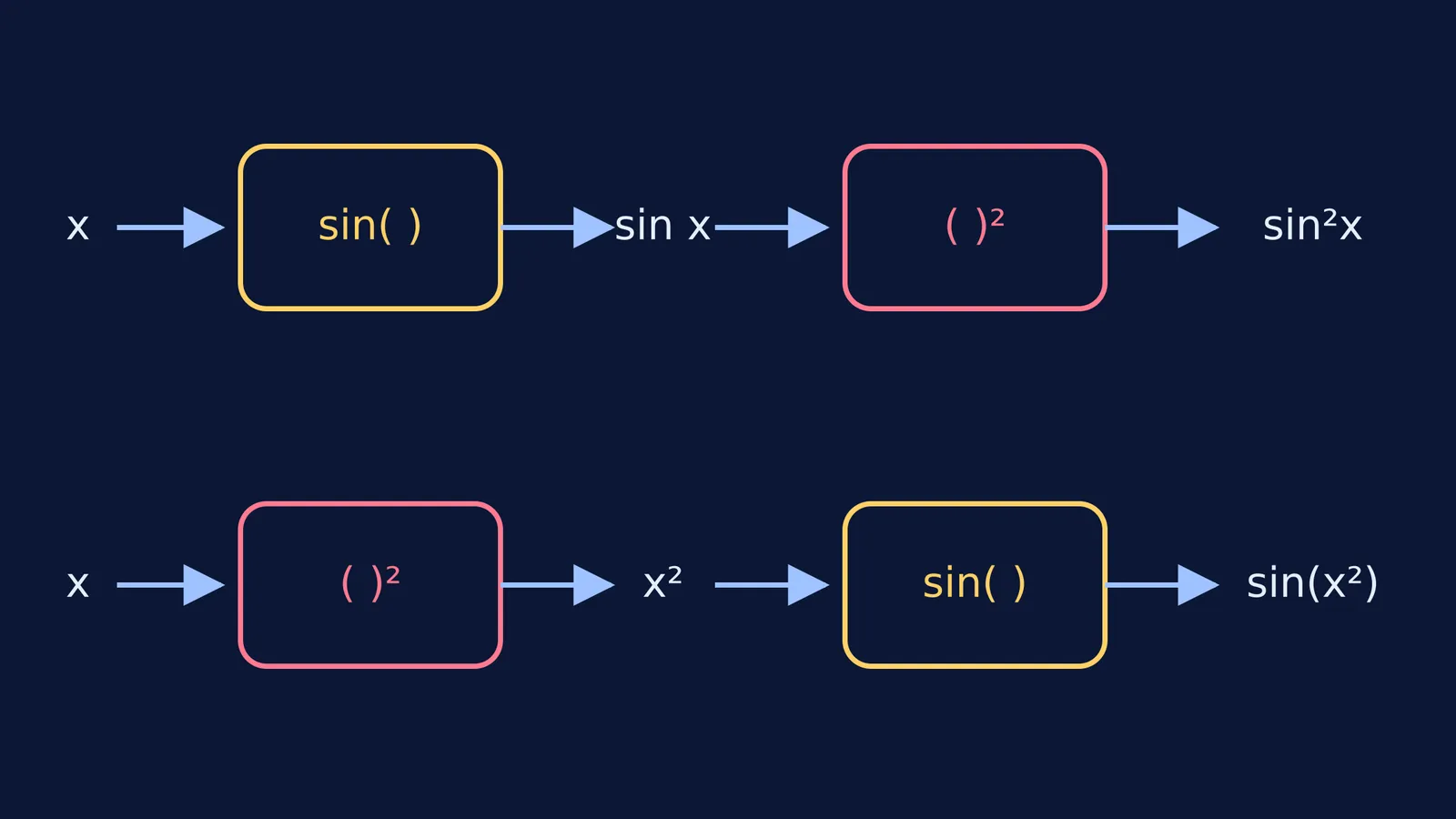
When you write sin²x, you are squaring the sine. The standard mathematical convention for trigonometric functions states that a positive integer superscript written directly after the function name means you apply the exponent to the function's result. In other words, sin²x is simply a shorthand for (sin x)².
If we let x = 30°, you first find that sin 30° = 0.5. Then, you square that result: 0.5 × 0.5 = 0.25. The trigonometric ratio itself is what gets multiplied by itself.
When you write sin x², you are squaring the angle. Here, the exponent is attached directly to the variable x. This means you calculate the square of the input first, and then apply the sine function to that new, much larger angle. The expression sin x² is exactly the same as sin(x²).
If we again let x = 30°, you first square the angle. The calculation becomes 30 × 30 = 900°. Then, you take the sine of that large angle. Since 900° is equivalent to two full circles (720°) plus 180°, sin 900° = sin 180° = 0.
As you can see, the outputs of 0.25 and 0 are not the same. This distinction matters deeply when you are plotting these functions on a graph. The curve for sin²x oscillates smoothly between 0 and 1, never dipping into negative numbers. On the other hand, sin(x²) creates a pattern that swings wildly between -1 and 1, oscillating faster and faster as the angle grows larger.
Why do we use this confusing notation?
If writing (sin x)² is perfectly clear, why did mathematicians invent sin²x?
Historically, mathematicians found it tedious to wrap the entire sine expression in brackets every time they wrote an identity like sin²x + cos²x = 1. Moving the exponent to the function name saved time and ink.
However, this is an exception to the rules of general function notation. In most areas of mathematics, writing f²(x) usually means you apply the function twice, as f(f(x)). Trigonometry breaks this rule. The superscript indicates a power, not a repeated function, which makes it an easy trap for students who have just learned algebraic function notation.
How do their derivatives come out differently?
Because they are built differently, their derivatives require applying the chain rule in different orders. The chain rule states that the derivative of an outer function containing an inner function is the derivative of the outer function, evaluated at the inner function, multiplied by the derivative of the inner function. Getting this order wrong is a classic algebraic mistake.
Let us break down the step-by-step calculus for each.
The derivative of sin²x Here, the outer function is the power of 2, and the inner function is the sine.
Apply the power rule to the outside function: pull down the 2, leaving the inside alone to get 2(sin x)¹.
Multiply by the derivative of the inside function: the derivative of sin x is cos x.
Multiply them together to get the final result: 2 sin x cos x. (Using trigonometric identities, this can also be simplified and written as sin(2x)).
The derivative of sin x² Here, the outer function is the sine, and the inner function is the algebraic square (x²).
Differentiate the outside function: the derivative of a sine is a cosine. You leave the inside angle alone to get cos(x²).
Multiply by the derivative of the inner function: the derivative of x² is 2x.
Bring the algebraic term to the front for clarity, giving a final result of 2x cos(x²).
This exact same sequence logic applies whether you are differentiating parametric functions or calculating second-order derivatives.
How do you map out complex functions?
If you are unsure whether to apply the power rule first or the trigonometric rule first, the Fermi Concept Library breaks down every concept in mathematics, each with its own lesson and its place in the map.
When you bring a calculus assignment to Fermi's AI tutor, it holds a line of reasoning across a whole session. It notices where a student is stuck—such as applying a rule to the wrong part of an expression—and decides whether to explain the order of operations, ask a guiding question, or show the next step on the board.
If you need more practice unpicking complex derivatives, you can review how this works when differentiating one expression with respect to another.


