

On this page
AI tools write integrals fluently, and fluent is not the same as correct. In a 2024 PLOS ONE study by Zachary Pardos and Shreya Bhandari, ChatGPT-generated hints for algebra and statistics problems failed quality checks on 32% of problems before the researchers applied an error-reduction technique called self-consistency. If you want to know why this happens, read why AI makes maths mistakes.
The good news: differentiation undoes integration, so you can check the answer yourself in about a minute. Below are three checks, each with a worked case where the AI slipped. We built the examples from common slips. They are not transcripts of any one chatbot.
How do you check an indefinite integral from AI?
Differentiate the answer. OpenStax Calculus Volume 1 defines it this way: F is an antiderivative of f if F'(x) = f(x) for all x in the domain of f. If differentiating the AI's answer does not give back exactly the function inside the integral, the answer is wrong. For a faster version, compare F'(x) and f(x) at one value of x, such as x = 0.
Case 1: the missing quarter. You ask for ∫ x·e^(2x) dx. The AI replies (x/2)·e^(2x) − (1/2)·e^(2x) + C.
Use the product rule. The derivative of (x/2)·e^(2x) is (1/2)·e^(2x) + x·e^(2x), and the derivative of −(1/2)·e^(2x) is −e^(2x). Together that gives x·e^(2x) − (1/2)·e^(2x). There is an extra term, so the answer fails. At x = 0 the integrand is 0, but the AI's derivative gives −1/2.
The slip was in integration by parts: the leftover integral ∫ (1/2)·e^(2x) dx is (1/4)·e^(2x), because the 2 in the exponent divides again. The correct answer, (x/2 − 1/4)·e^(2x) + C, differentiates to exactly x·e^(2x). For more practice, see integration by parts and the LIATE rule.
How do you check a definite integral without redoing it?
A definite integral is a single number, so check its sign and size instead. If the function is positive on the interval, so is the answer. And the answer can never exceed the function's highest value times the width of the interval.
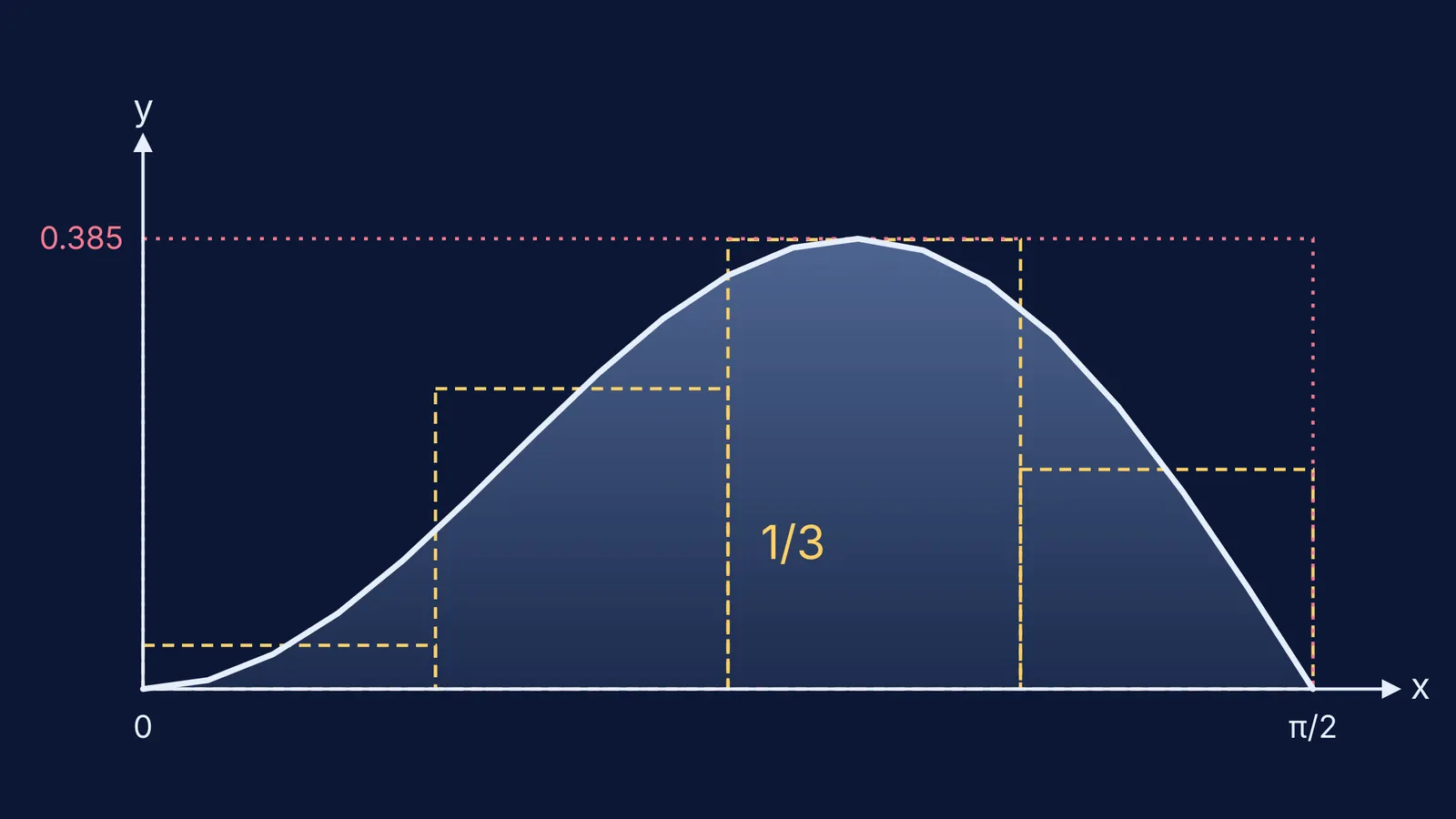
Case 2: limits left behind. You ask for ∫ sin²x·cos x dx from 0 to π/2. The AI substitutes u = sin x, which turns the integral into u³/3. Then it puts the original x-limits into the u-expression and reports (π/2)³/3 ≈ 1.29.
On this interval the function never exceeds about 0.385, and the interval is π/2 ≈ 1.571 wide. So the true value is below 0.385 × 1.571 ≈ 0.60, and 1.29 is impossible. For a closer estimate, split the interval into 4 equal strips, add the function's values at the strip midpoints and multiply by the width π/8. You get about 0.340.
The rule the AI broke appears in OpenStax's section on substitution: when you change the variable in a definite integral, the limits change too. Here u runs from sin 0 = 0 to sin(π/2) = 1, so the answer is 1/3 ≈ 0.333, which agrees with the estimate. Our guide to properties of definite integrals has more shortcuts like this.
What does checking limits mean for an AI answer?
Many answers contain a constant, such as a or b. Set the constant to a value where you already know the answer, and see whether the formula agrees.
Case 3: sine and cosine swapped. You ask for ∫ e^(−ax)·cos(bx) dx from 0 to ∞, with a > 0. The AI answers b/(a² + b²).
Set b = 0. Then the integrand is just e^(−ax), whose integral from 0 to ∞ is 1/a. The AI's formula gives 0, which cannot be right because the integrand is positive everywhere. The correct answer, a/(a² + b²), gives 1/a. To confirm it, differentiate the antiderivative e^(−ax)·(b·sin bx − a·cos bx)/(a² + b²), which gives back e^(−ax)·cos(bx).
A 60-second checklist before you copy an AI integral
Indefinite: differentiate the answer, or compare F'(x) with f(x) at one x.
Sign: a positive function gives a positive definite integral.
Size: no bigger than the highest value times the width.
Estimate: four midpoint strips should land close to the AI's number.
Limits: after a substitution, were the limits converted? Test constants at values like 0.
Details: ln|x| needs the absolute value; indefinite integrals need + C.
If a check fails, do not just ask again. Send this: "Differentiate your answer step by step and show that it equals the integrand. If it does not, find the step where it goes wrong." Then follow every line yourself.
If you still cannot find the faulty step, the Fermi Problem Library has worked problems with a step-by-step solver that explains the reasoning rather than printing an answer. Fermi's AI tutor notices where you are stuck and decides whether to explain, ask or show, so you fix the method, not just one answer.
Next time an AI hands you an integral, spend one minute checking it before it goes into your notebook.


