On this page
This is a classic inverse-trigonometry question for Class 12 and JEE Main practice, and the trap in it is a common one. The algebra gives you two roots, and only one of them satisfies the original equation. Below is the full solution, the reason one root fails, and a short check you can run on any equation of this type.
How do you solve tan⁻¹2x + tan⁻¹3x = π/4?
Start with the range. The principal value branch of tan⁻¹ is the open interval (−π/2, π/2), as the NCERT Class 12 chapter on inverse trigonometric functions defines it. The same chapter warns that its properties are valid only within the principal value branches, and that some results hold only for some values of x.
The tool you need comes from the tangent addition formula. Wikipedia's article on inverse trigonometric functions states that tan⁻¹u + tan⁻¹v = tan⁻¹((u + v)/(1 − uv)) only up to a multiple of π. In practice, the version without any correction is safe when uv < 1.
Now work through it:
Put u = 2x and v = 3x, so u + v = 5x and uv = 6x².
Take tan of both sides: tan(tan⁻¹2x + tan⁻¹3x) = tan(π/4) = 1.
Expand with the addition formula: 5x/(1 − 6x²) = 1.
Cross-multiply: 5x = 1 − 6x², so 6x² + 5x − 1 = 0.
Factorise: (6x − 1)(x + 1) = 0, so x = 1/6 or x = −1.
Step 2 is where extra roots sneak in. Taking tan of both sides keeps every true solution, but tan repeats every π. So the quadratic also picks up any x where the left side equals π/4 + π or π/4 − π.
Why is x = −1 rejected?
At x = −1, the two arguments are 2x = −2 and 3x = −3. Their product is uv = 6, which breaks the uv < 1 condition, so the plain formula no longer applies.
The sign argument makes it obvious. Both tan⁻¹(−2) and tan⁻¹(−3) lie between −π/2 and 0. Their sum has to be negative, so it can never equal the positive number π/4.
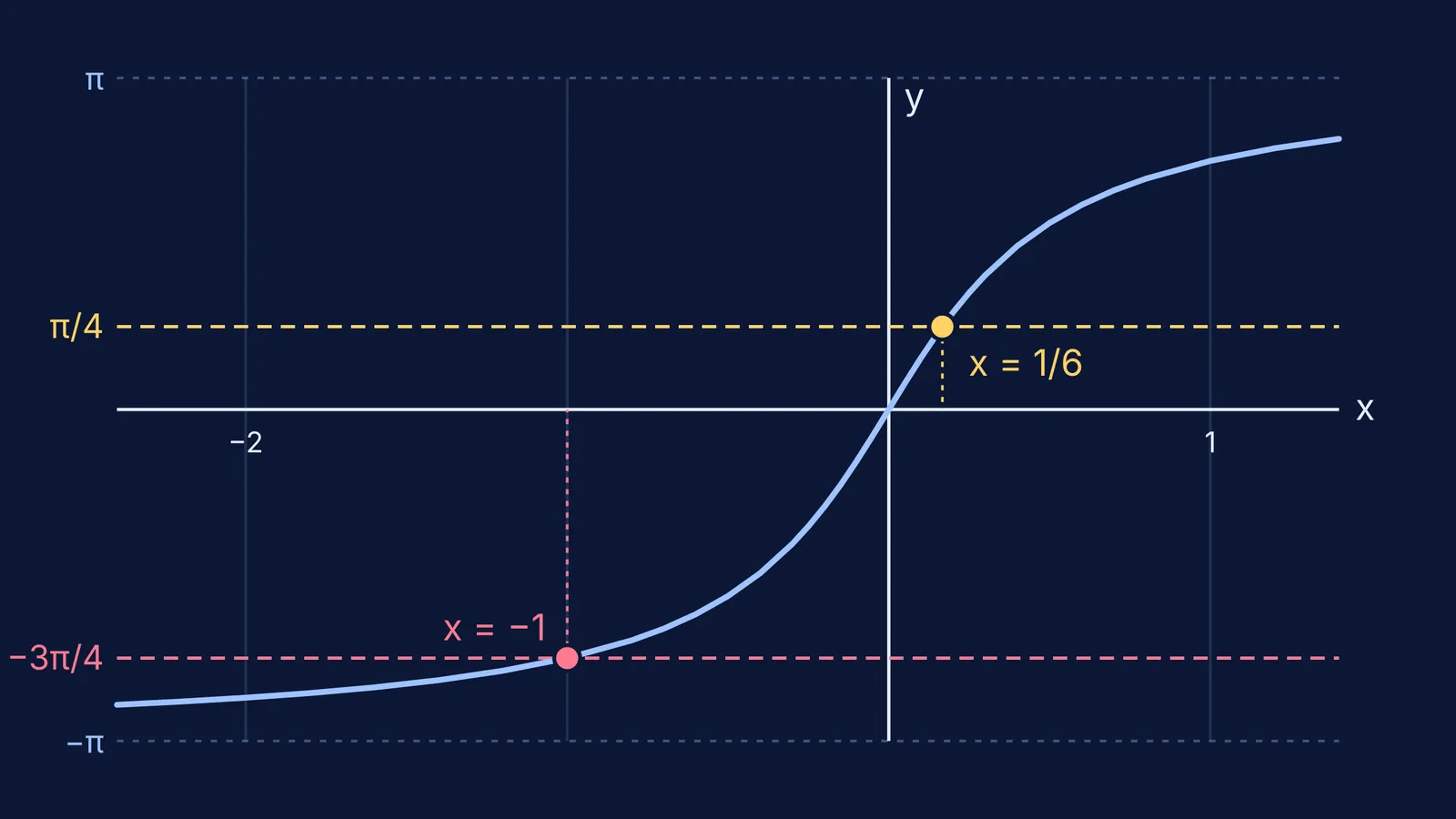
The left side actually equals π/4 − π = −3π/4. That is exactly the shift by π that the Wikipedia statement of the formula allows for. You can see both roots in the graph at the top of this post: the curve y = tan⁻¹2x + tan⁻¹3x meets the line y = π/4 only once, at x = 1/6.
How do you check that x = 1/6 is correct?
At x = 1/6, the arguments are 2x = 1/3 and 3x = 1/2. Their product is 1/6, which is less than 1, so the formula holds with no correction. Substitute: (1/3 + 1/2)/(1 − 1/6) = (5/6)/(5/6) = 1, and tan⁻¹1 = π/4.
This identity is famous in its own right. The Machin-like formula article on Wikipedia lists π/4 = tan⁻¹(1/2) + tan⁻¹(1/3) as Euler's 1737 formula, also known to John Machin in 1706. The same article gives a second check using complex numbers: (2 + i)(3 + i) = 5 + 5i, and a number with equal real and imaginary parts has angle π/4.
So your final answer is x = 1/6 alone.
A four-step check for any tan⁻¹ sum equation
Use this whenever a question asks you to solve tan⁻¹(something) + tan⁻¹(something) = a constant:
Before solving, note the sign of the right-hand side. If it is positive, any root that makes both arguments negative is out.
Solve the equation you get after taking tan, and list every root.
For each root, compute the product of the two arguments. If it is less than 1, the formula holds as written. If it is more than 1, the true sum is shifted by π, so test the root directly.
Substitute the surviving root back into the original equation, not the quadratic.
Step 3 is one multiplication, and it is the step that is easiest to skip under time pressure. For a longer list of equations where one root has to go, see our guide to rejecting extra roots in arctan equations. For what the formula becomes once the product is more than 1, read how to handle a tan⁻¹ sum when xy exceeds 1. And if you want to see the same formula used over and over, try tan⁻¹ telescoping series.
If you keep getting the algebra right and still choosing the wrong root, the Fermi Problem Library has worked problems with a step-by-step solver that explains the reasoning rather than printing an answer. If the shakier part is principal values themselves, the Fermi Concept Library gives each mathematics concept its own lesson.