

On this page
When you prepare for competitive exams like JEE Main or CBSE Class 12 board examinations, equations involving inverse trigonometric functions look like elementary algebra at first glance. A typical problem presents an equation with arctan(x − 1) and arctan(x + 1), such as arctan(x − 1) + arctan(x + 1) = arctan(8/31). The instinctive reaction is to take the tangent of both sides, apply the compound angle expansion, and solve the resulting polynomial. Yet this mechanical sequence contains a dangerous mathematical trap: one of the two solutions produced by the algebra is completely false.
Why does taking tan of both sides introduce extraneous roots?
The root of the problem lies in the distinction between logical equivalence and logical implication. In algebra, when you perform an invertible operation on both sides of an equality, the solution set remains unchanged. However, applying a non-injective (many-to-one) operation turns an equivalence into a one-way implication. As Kenneth R. Manning highlighted in his historical study of extraneous solutions in The Mathematics Teacher, transforming equations through non-equivalent steps inevitably inflates the solution set with spurious roots.
The tangent function is periodic with a fundamental period of π radians. Stating that tan A = tan B does not mean that A = B; it only guarantees that A = B + kπ for some integer k. In contrast, the principal value branch of the arctan function is defined strictly on the interval (−π/2, π/2). When you take the tangent of both sides of an arctan equation, you erase every multiple of π. Angles whose sum lands outside the principal range suddenly produce identical tangent ratios, creating phantom roots that satisfy the converted algebraic equation but violate the original statement.
Understanding domain and principal value restrictions in inverse trigonometric functions is therefore not optional bookkeeping; it is a foundational logical requirement.
How do you solve arctan(x − 1) + arctan(x + 1) = arctan(8/31) step by step?
Let us trace the complete solution for the canonical problem: arctan(x − 1) + arctan(x + 1) = arctan(8/31).
Take the tangent of both sides:
tan(arctan(x − 1) + arctan(x + 1)) = tan(arctan(8/31))
Expand the left-hand side using the tangent addition formula, tan(A + B) = (tan A + tan B) / (1 − tan A tan B):
((x − 1) + (x + 1)) / (1 − (x − 1)(x + 1)) = 8/31
Simplify the numerator and denominator:
2x / (1 − (x² − 1)) = 8/31 2x / (2 − x²) = 8/31
Cross-multiply and collect terms into a standard quadratic equation:
62x = 8(2 − x²) 62x = 16 − 8x² 8x² + 62x − 16 = 0 4x² + 31x − 8 = 0
Factor the quadratic:
(4x − 1)(x + 8) = 0 This yields two algebraic roots: x = 1/4 and x = −8.
In exams administered by the National Testing Agency, options often tempt candidates to mark "two real roots." But stopping here loses marks.
How can you test and reject false roots without heavy calculation?
You do not need a scientific calculator in an exam hall to filter out extraneous roots. Two quick inspections identify the genuine solution directly.
First, perform a direct sign inspection. The right-hand side is arctan(8/31). Because 8/31 > 0, the target angle lies strictly in the first quadrant, (0, π/2). Now examine the candidate root x = −8:
arctan(x − 1) becomes arctan(−9)
arctan(x + 1) becomes arctan(−7)
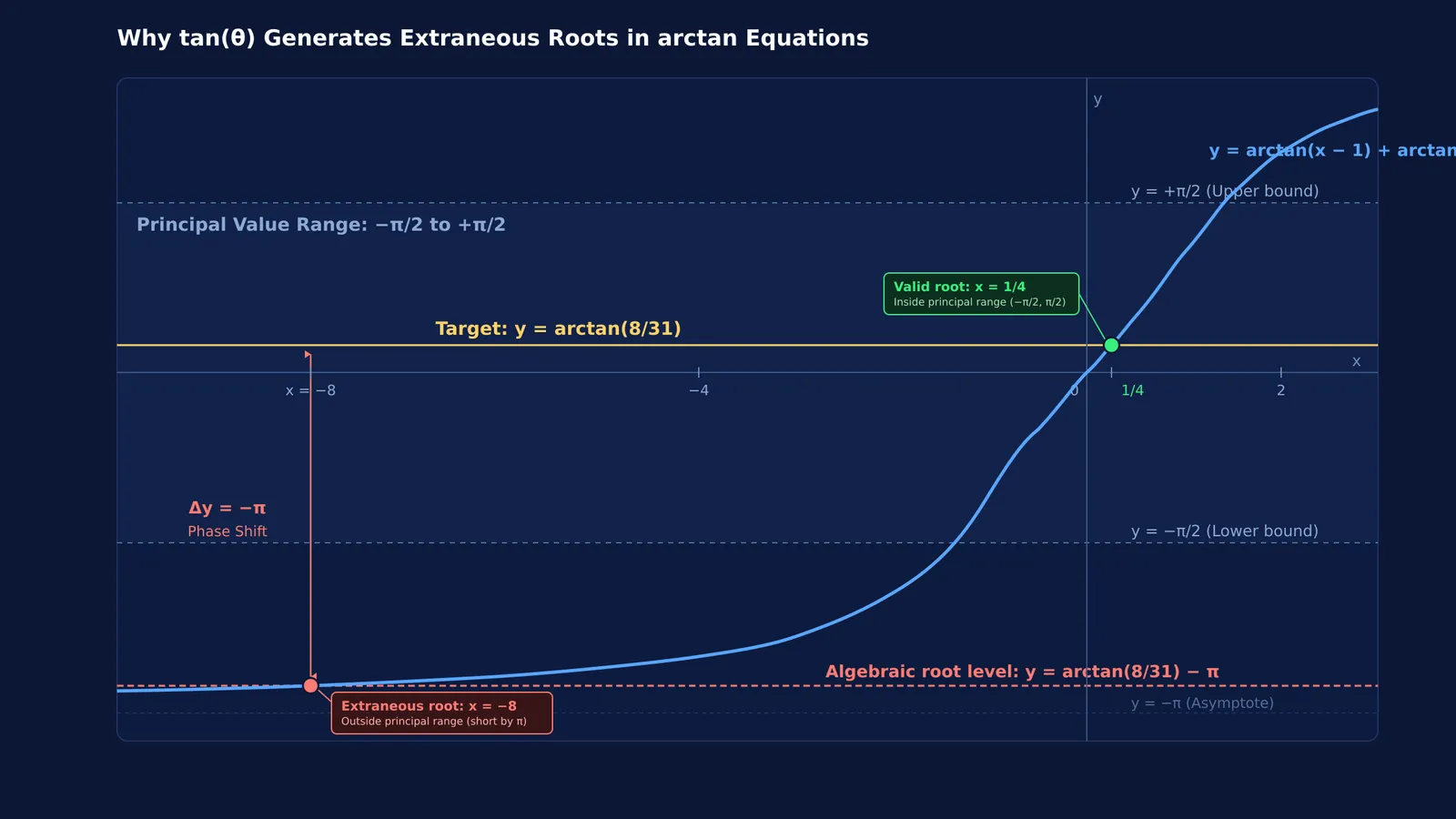
Because arctan is an odd, monotonically increasing function, arctan(−9) and arctan(−7) are both negative angles lying in (−π/2, 0). Their sum is strictly negative, falling between −π and −π/2. A negative angle in the third quadrant can never equal a positive angle in the first quadrant. Hence, x = −8 is immediately rejected.
Now check x = 1/4:
arctan(1/4 − 1) = arctan(−3/4)
arctan(1/4 + 1) = arctan(5/4)
Because 5/4 > 3/4, the positive component outweighs the negative component, producing a net positive angle that matches arctan(8/31). Thus, x = 1/4 is the sole legitimate solution.
The Fermi Problem Library has worked problems with a step-by-step solver that explains the reasoning rather than printing an answer, highlighting where extraneous roots enter and showing how to verify each stage.
What does the NCERT addition formula require for principal values?
The official NCERT Class 12 Mathematics curriculum and the CBSE Senior School Mathematics syllabus specify that the standard identity arctan(u) + arctan(v) = arctan((u + v) / (1 − uv)) holds if and only if uv < 1.
As Eleftherios Gkioulekas emphasized in mathematics education research on algebraic solution restrictions in the International Journal of Mathematical Education in Science and Technology, applying operations without tracking their governing domain restrictions creates non-equivalent steps that admit extraneous roots. When uv > 1 and both arguments are negative, the identity requires an explicit phase shift: arctan(u) + arctan(v) = −π + arctan((u + v) / (1 − uv)).
For x = −8, u = −9 and v = −7. Their product is uv = 63 > 1. The identity actually evaluates to: arctan(−9) + arctan(−7) = −π + arctan(8/31)
This shows exactly why algebra generated x = −8: the tangent of −π + arctan(8/31) is 8/31, but the angle itself is short by π radians. Pair your algebra with graphical reasoning, such as finding trigonometric equation solutions graphically and counting solutions of a trigonometric equation in an interval, to see that the function f(x) = arctan(x − 1) + arctan(x + 1) is strictly increasing and crosses y = arctan(8/31) exactly once.
The Fermi Concept Library maps every concept in physics, chemistry, biology, mathematics and computing, each with its own lesson and its place in the map, helping you trace how domain and range boundaries dictate valid solutions.
What is the 4-step checklist for inverse trigonometric equations?
Whenever you encounter an equation with multiple inverse tangent terms, follow this systematic procedure:
State argument boundaries: Note whether the target value on the right-hand side is positive, negative, or zero.
Convert and solve: Apply tan to both sides and factor the resulting polynomial.
Run a quadrant check: Plug each candidate root into the original arctan terms and confirm that the sum has the correct sign.
Verify the product condition: Check that uv < 1 for the arguments to ensure no hidden ±π phase boundary was crossed.


