

On this page
"How many solutions does sin 2x = 1/2 have in [0, 2π]?" When you get a count like this wrong, it is usually because of the bracket, a denominator or a squaring step, not the trigonometry. Here are the tools that keep the count honest, and the traps.
Why does a trig equation have so many solutions in an interval?
Because trig functions repeat. OpenStax Precalculus puts it simply: every 2π units the values of sine repeat, so to find all solutions "we must add 2πk, where k is an integer." The same source notes that the period of tangent is π, not 2π.
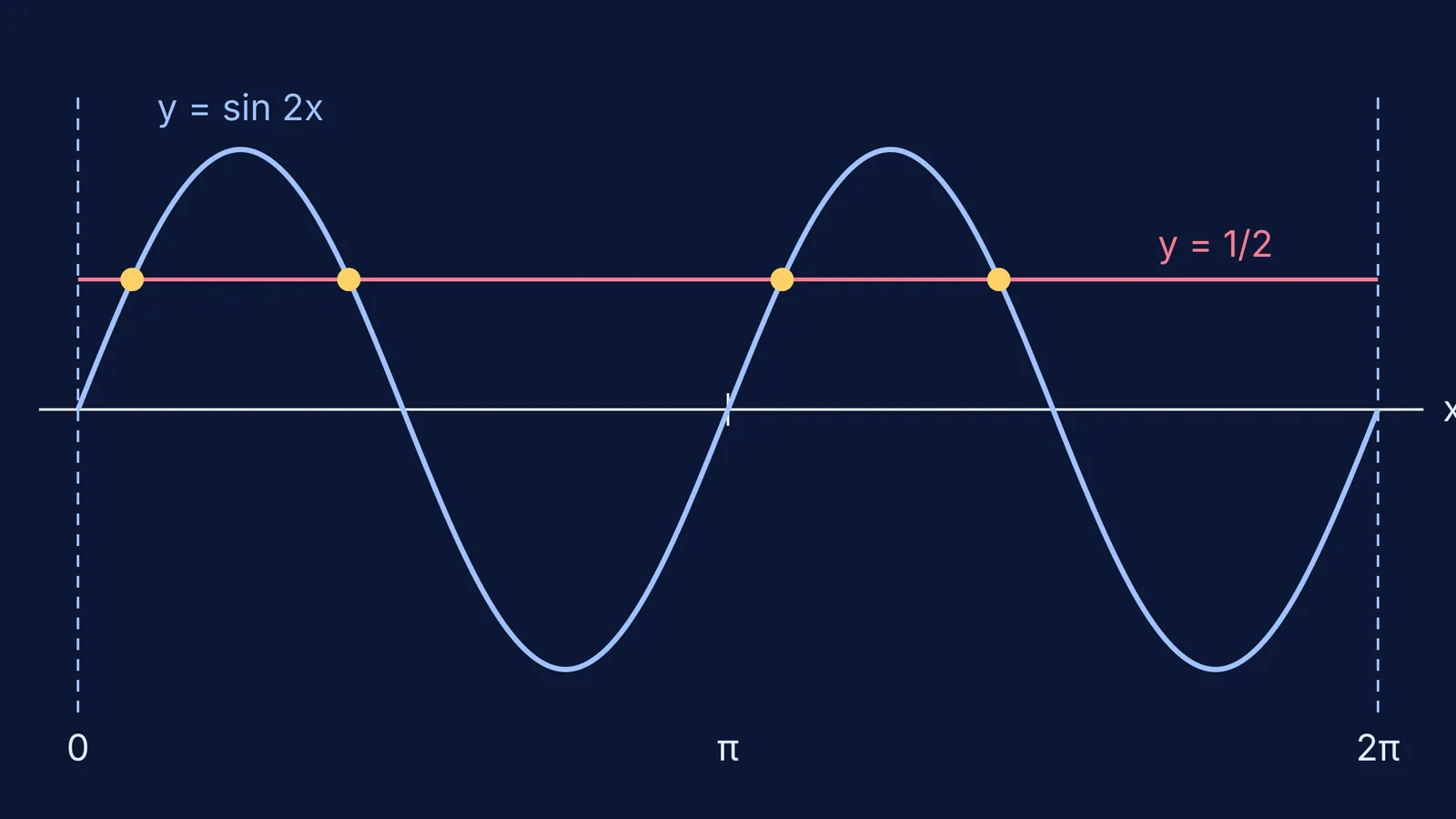
That gives you a quick estimate before any algebra. For −1 < c < 1, sin x = c has two solutions in each full period. The function sin 2x has period π, so [0, 2π] holds two full periods, and you should expect four solutions of sin 2x = 1/2.
How do you count solutions using the general solution?
The general solution of sin x = 1/2 can be written as x = nπ + (−1)ⁿ·π/6, where n is any integer, as in this LibreTexts precalculus chapter/20%3A_Trigonometric_Equations/20.02%3A_Equations_involving_trigonometric_functions). Cosine and tangent work the same way. A Massey University worked example gives cos x = 0 as x = ±π/2 + 2kπ and tan x = 0 as x = kπ.
Worked example: count the solutions of sin 2x = 1/2 in [0, 2π].
Apply the general solution to the angle 2x: 2x = nπ + (−1)ⁿ·π/6.
Divide by 2: x = nπ/2 + (−1)ⁿ·π/12.
Even n, so x = nπ/2 + π/12. From 0 ≤ x ≤ 2π you get −1/6 ≤ n ≤ 23/6, so n = 0 or 2.
Odd n, so x = nπ/2 − π/12. From 0 ≤ x ≤ 2π you get 1/6 ≤ n ≤ 25/6, so n = 1 or 3.
The solutions are π/12, 5π/12, 13π/12 and 17π/12. That is four, which matches the estimate.
If finding the base angle is slow, our guide to allied angles and the ASTC rule shows which quadrant gives each sign.
How do you count solutions by graphing both sides?
Some equations mix trigonometry with algebra, so there is no neat general solution. Take sin x = x/10. Draw y = sin x and the line y = x/10, then count where they cross.
The line meets the sine curve only where −1 ≤ x/10 ≤ 1, so you only need to look between −10 and 10.
x = 0 is one solution.
Between π/2 and π the falling sine curve crosses the line once, near x = 2.85.
Between π and 2π, sine is negative and the line is positive, so they never meet.
Between 2π and 3π (about 6.28 to 9.42), sine rises to 1 at 5π/2, about 7.85, where the line is only at 0.785. So there are two crossings.
After 3π, sine stays negative until 4π, about 12.57, which is past 10. No more crossings.
That makes three positive solutions. Both sides are odd functions, so there are three negative ones too, and 3 + 3 + 1 = 7 in total. For faster sketching, see graph transformations for JEE.
What are the endpoint and domain traps?
Endpoints. On [0, 2π], sin x = 0 has three solutions: 0, π and 2π. On [0, 2π) it has two, and on (0, 2π) only one. Read the bracket before you count.
Domain. Count the solutions of cos x · tan x = 0 in [0, 2π]. It is tempting to set each factor to zero and get π/2, 3π/2, 0, π and 2π, which makes five. But OpenStax reminds you that the domain of tangent leaves out odd multiples of π/2, so π/2 and 3π/2 are not allowed. The answer is three.
Squaring. Solve sin x + cos x = 1 in [0, 2π] by squaring and you get sin 2x = 0, which gives 0, π/2, π, 3π/2 and 2π. Put each back into the original equation: π gives −1 and 3π/2 gives −1, so both are extra roots that squaring added. Three solutions remain.
A checklist before you write the count
Read the bracket: closed, open or half-open.
List every restriction in the original equation before you simplify.
Estimate the count from the period.
Write the general solution, split it by even and odd n where (−1)ⁿ appears, and solve the inequalities.
Sketch both sides to confirm the count.
Substitute every root back, especially after squaring or cancelling.
If your count keeps coming out one off, the Fermi Problem Library has worked problems with a step-by-step solver that explains the reasoning rather than printing an answer, so you can spot the step where a root slipped in or out.
Try it now: count the solutions of cos 3x = 0 in [0, π], then check against a sketch.


