

On this page
When you add two inverse tangents, the standard algebraic formula you learn is:
tan⁻¹x + tan⁻¹y = tan⁻¹((x + y)/(1 - xy))
But if x and y are positive, and their product xy is greater than 1, using this formula directly gives you a negative answer. To fix this, you must add π (or 180°).
In short When xy > 1 for positive x and y, their angle sum crosses into the second quadrant, beyond 90°. However, the inverse tangent function is strictly defined to only return values between −90° and +90° (MathWorld). Adding π (180°) manually shifts the formula's negative result back into the correct positive quadrant.
Why does the standard formula break?
Let's test the standard trigonometric formula with x = 2 and y = 3. Notice that their product, xy = 6, is strictly greater than 1.
tan⁻¹2 + tan⁻¹3 = tan⁻¹((2 + 3) / (1 - 2 × 3)) tan⁻¹2 + tan⁻¹3 = tan⁻¹(5 / -5) tan⁻¹2 + tan⁻¹3 = tan⁻¹(-1)
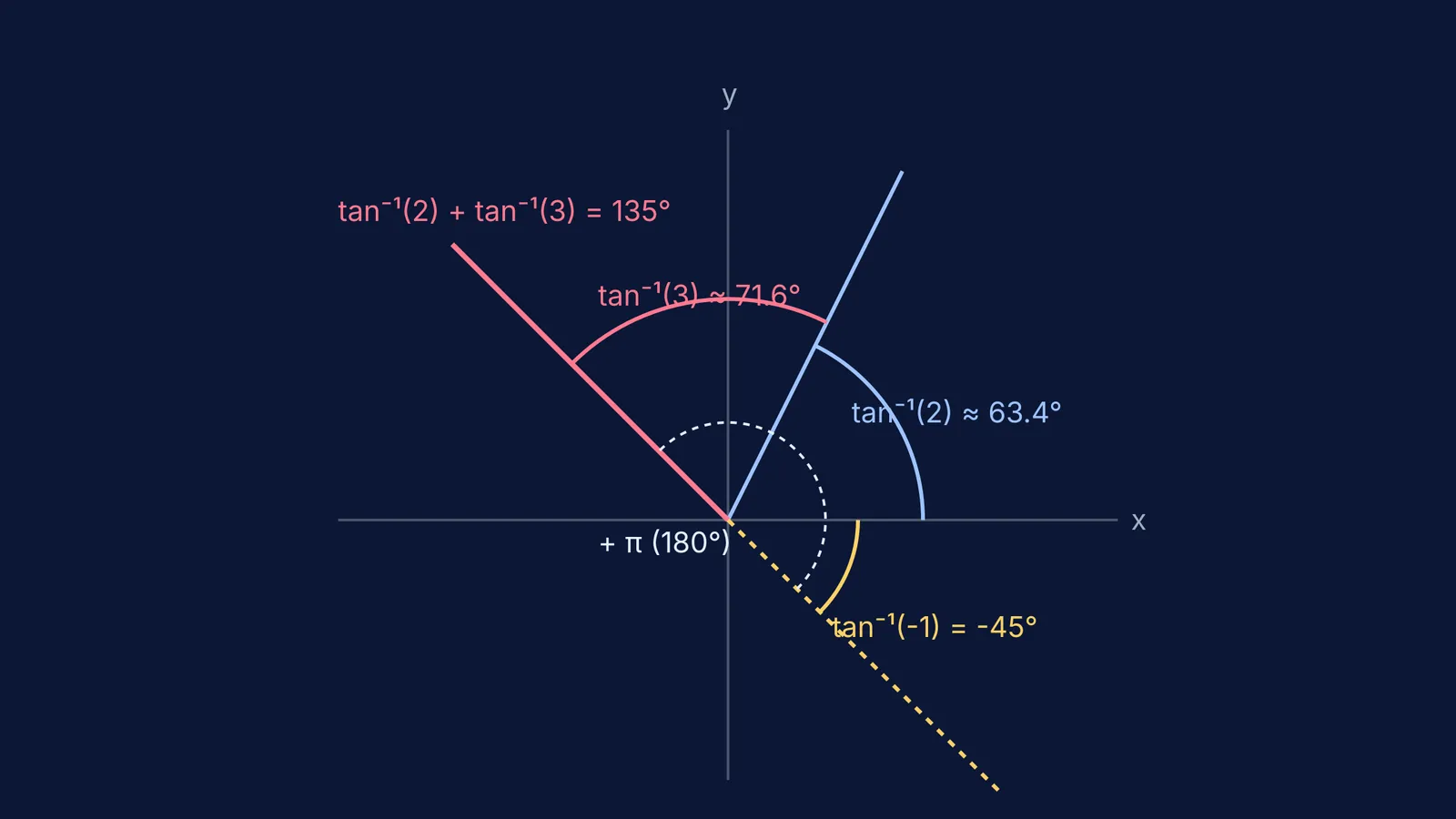
The principal value of tan⁻¹(-1) is −π/4 (or −45°).
But wait. Both tan⁻¹2 and tan⁻¹3 are positive angles residing in the first quadrant. How can the sum of two positive angles possibly be negative? It can't. The standard formula has given us a physically impossible answer because it lost track of the original quadrant.
Why does the angle jump into the negative?
The inverse tangent function, tan⁻¹θ, is strictly defined to return an angle in its principal range, which is constrained between −π/2 and π/2 (MathWorld).
Let α = tan⁻¹2 and β = tan⁻¹3. Because 2 > 0 and 3 > 0, both α and β are between 0 and π/2. When you add them, their sum α + β must be somewhere between 0 and π (up to 180°).
If xy > 1, the denominator (1 - xy) becomes negative, making the entire fraction (x + y)/(1 - xy) negative. This tells us the combined angle has a negative tangent.
An angle between 0 and π with a negative tangent can only live in the second quadrant (between π/2 and π).
But when you ask a calculator or use the unadjusted formula to find tan⁻¹(-1), it cannot give you an angle in the second quadrant. It is forced by its mathematical definition to return an angle in the fourth quadrant (between −π/2 and 0).
How do you fix the quadrant by adding π?
Because the tangent function repeats every π radians (180°), the incorrect negative angle (in the fourth quadrant) and the correct positive angle (in the second quadrant) point along the exact same straight line, just pointing in opposite directions.
To get to the true geometric sum, you simply turn 180° by adding π to the formula:
tan⁻¹x + tan⁻¹y = π + tan⁻¹((x + y) / (1 - xy))
Let's re-run our check with x = 2 and y = 3 using the corrected rule:
Sum = π + tan⁻¹(-1) Sum = π - π/4 Sum = 3π/4 (or 135°)
Now the answer makes perfect sense. The angle tan⁻¹2 is about 63.4°, and tan⁻¹3 is about 71.6°. Add them together, and you get exactly 135°. The mystery of the negative angle is cleanly resolved.
What if both x and y are negative?
There is a mirrored version of this quadrant trap. If x < 0 and y < 0, both of your starting angles reside in the fourth quadrant (between −π/2 and 0).
When you add two negative angles together, their sum can push past −90° and cross into the third quadrant (between −π/2 and −π). However, since x and y are negative, their product xy is still mathematically positive. If xy > 1, the fraction (x + y)/(1 - xy) becomes positive (a negative numerator divided by a negative denominator).
Because the fraction is positive, the uncorrected formula tan⁻¹((x + y) / (1 - xy)) will output a positive angle in the first quadrant. Your actual sum has landed in the third quadrant, but your formula insists the answer is in the first quadrant.
To fix this, you apply the exact same logic but in reverse. Since you need to shift the first-quadrant answer backwards into the negative third quadrant, you subtract π:
tan⁻¹x + tan⁻¹y = -π + tan⁻¹((x + y) / (1 - xy))
For example, testing x = -2 and y = -3 gives a product of 6. The uncorrected formula yields tan⁻¹((-5) / (-5)) = tan⁻¹(1) = π/4 (or 45°). Subtracting π gives π/4 - π = -3π/4 (or -135°), which accurately reflects the sum of two negative angles.
How to spot these shifts faster
Inverse trigonometry is full of quadrant traps. You will see similar shifts when finding arg z in each quadrant for complex numbers, or when mapping sin⁻¹(sin x) beyond its principal range.
If you frequently lose marks to sign errors and principal value restrictions, the Fermi Problem Library can help. When you work through inverse trig equations, Fermi's AI tutor holds a line of reasoning across a session and notices where you are stuck. Instead of just printing an answer, it writes on a board, draws the figure to show you where your logic flipped quadrants, and checks understanding as it goes.
Before applying any inverse trig formula, always check the product of your variables. If xy > 1, remember that you have crossed the 90° boundary, and π is the bridge back to the right answer.


