On this page
An equation with both sin⁻¹x and cos⁻¹x in it looks like it has two unknown angles. It has only one. Once you swap cos⁻¹x for π/2 − sin⁻¹x, the equation is about a single angle, and the only thing left to watch is whether that angle is one sin⁻¹ can actually give you.
Below is the full working for sin⁻¹x − cos⁻¹x = π/6, the check that catches false answers, and three variations of the same idea.
Why does sin⁻¹x + cos⁻¹x equal π/2?
The identity depends on the principal value ranges. In the NCERT Class 12 Mathematics chapter on inverse trigonometric functions, sin⁻¹ maps [−1, 1] to [−π/2, π/2] and cos⁻¹ maps [−1, 1] to [0, π].
Now let θ = sin⁻¹x, so sin θ = x and θ lies in [−π/2, π/2]. Then cos(π/2 − θ) = sin θ = x, and π/2 − θ lies in [0, π], which is exactly the range of cos⁻¹. So cos⁻¹x = π/2 − θ, which means sin⁻¹x + cos⁻¹x = π/2 for every x in [−1, 1].
The NIST Digital Library of Mathematical Functions lists the same fact as arccos z = π/2 − arcsin z, equation 4.23.16.
If the ranges themselves feel shaky, read our guide to principal values and the standard inverse trig identities first.
How do you solve sin⁻¹x − cos⁻¹x = π/6?
Write the equation and the identity one under the other:
sin⁻¹x − cos⁻¹x = π/6
sin⁻¹x + cos⁻¹x = π/2
Add them: 2 sin⁻¹x = π/6 + π/2 = 2π/3, so sin⁻¹x = π/3.
Take sine of both sides: x = sin(π/3) = √3/2.
You can also substitute instead of adding. Put cos⁻¹x = π/2 − sin⁻¹x into the equation: sin⁻¹x − π/2 + sin⁻¹x = π/6, so 2 sin⁻¹x = 2π/3 again. Pick whichever you will not get wrong under time pressure.
How do you check the answer against principal values?
Two quick checks, in this order:
Is the angle in range? sin⁻¹x = π/3, and π/3 sits inside [−π/2, π/2]. If it had fallen outside, there would be no solution at all.
Does the original equation hold? sin⁻¹(√3/2) = π/3 and cos⁻¹(√3/2) = π/6, both principal values. π/3 − π/6 = π/6. It holds.
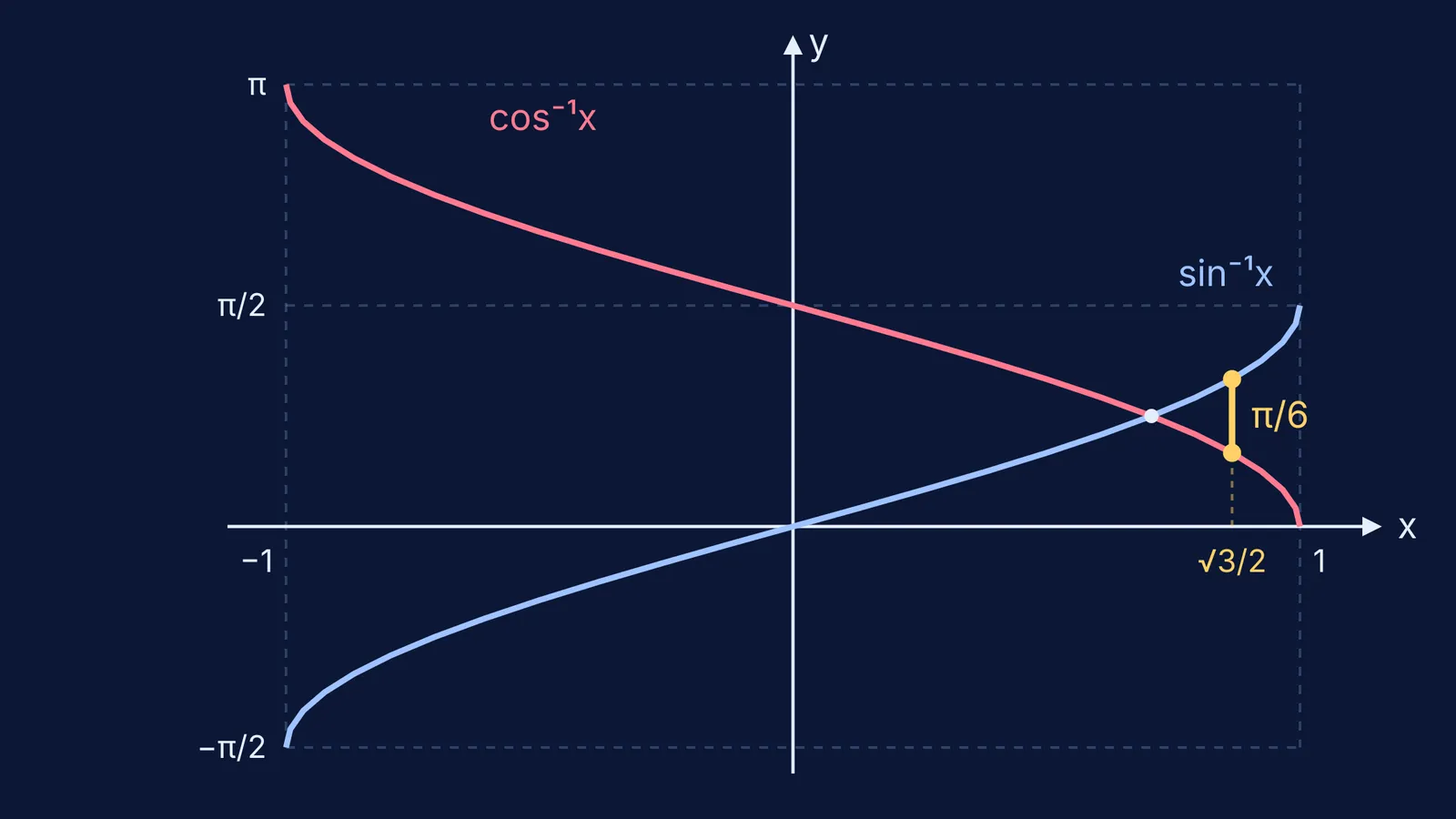
So x = √3/2 is the only solution. The hero graph above shows it: at x = √3/2 the sin⁻¹x curve sits exactly π/6 above the cos⁻¹x curve.
What if the right-hand side is different?
Here is the trap in action. Try sin⁻¹x − cos⁻¹x = 3π/4. Adding the identity gives 2 sin⁻¹x = 5π/4, so sin⁻¹x = 5π/8.
If you skip the check, you write x = sin(5π/8), about 0.924, and move on. But 5π/8 is bigger than π/2, so sin⁻¹ can never equal it. In fact sin⁻¹(0.924) is 3π/8. There is no solution.
You can see this coming before you start. Since sin⁻¹x − cos⁻¹x = 2 sin⁻¹x − π/2, and sin⁻¹x runs from −π/2 to π/2, the left side can only take values from −3π/2 to π/2. Any right-hand side outside that interval has no solution.
The same reduction handles other forms:
cos⁻¹x = 2 sin⁻¹x. Write π/2 − s = 2s with s = sin⁻¹x, so s = π/6 and x = 1/2. Check: cos⁻¹(1/2) = π/3 = 2 × π/6.
sin⁻¹x · cos⁻¹x = π²/18. This becomes s(π/2 − s) = π²/18, a quadratic in s with roots π/6 and π/3. Both are in range, so x = 1/2 or x = √3/2.
sin⁻¹x > cos⁻¹x. This means 2 sin⁻¹x > π/2, so sin⁻¹x > π/4 and x lies in (1/√2, 1]. The curves in the graph cross at x = 1/√2.
When the argument is something like 2x − 1 instead of x, find where it is allowed first; our post on the domain of sin⁻¹(2x − 1) shows how.
A four-step routine for any sin⁻¹ and cos⁻¹ equation
Reduce. Replace cos⁻¹x with π/2 − sin⁻¹x (or the other way round), so only one inverse function is left.
Solve for the angle. Call it s and treat it like any unknown: linear, quadratic or an inequality.
Range check. Keep only values of s in [−π/2, π/2] (or [0, π] if you solved for cos⁻¹x).
Back-substitute. Find x, then put it into the original equation using principal values only.
Step 3 is the easiest one to skip, and skipping it is how false roots get through. The same habit matters when you meet sin⁻¹(sin x) outside −π/2 to π/2, where the range decides the answer.
If you keep getting an answer and cannot see which step went wrong, the Fermi Problem Library has worked problems with a step-by-step solver that explains the reasoning rather than printing an answer. If the gap is in principal values themselves, the Fermi Concept Library gives each concept in mathematics its own lesson.