On this page
Cell Cycle and Cell Division is short, but school exams ask you to name stages from clues, track DNA and chromosome counts, and explain why each division matters.
What does CBSE examine from this chapter in 2026-27?
In the CBSE Biology curriculum for 2026-27, this is Chapter 10 in Unit III, Cell: Structure and Function, which carries 15 of the 70 theory marks. Those 15 marks are shared with Cell: The Unit of Life and Biomolecules; CBSE gives no separate figure for this chapter. The topic line reads: "Cell cycle, mitosis, meiosis and their significance".
The curriculum's one Class XI box of topics "assessed only formatively" lists only Digestion and Absorption, so all of this chapter counts in the theory paper. In the practical exam, the same curriculum lists mitosis in onion root tip and grasshopper cells, from permanent slides, as a spotting item; "Spotting Part B" as a whole carries 7 Marks.
Study Chapter 10 of the NCERT Class 11 Biology textbook (Reprint 2026-27): 10.1 Cell Cycle, 10.2 M Phase, 10.3 Significance of Mitosis, 10.4 Meiosis and 10.5 Significance of Meiosis. Preparing for the entrance exam instead? Our guide to cell cycle and cell division for NEET covers that angle.
What happens in each phase of the cell cycle?
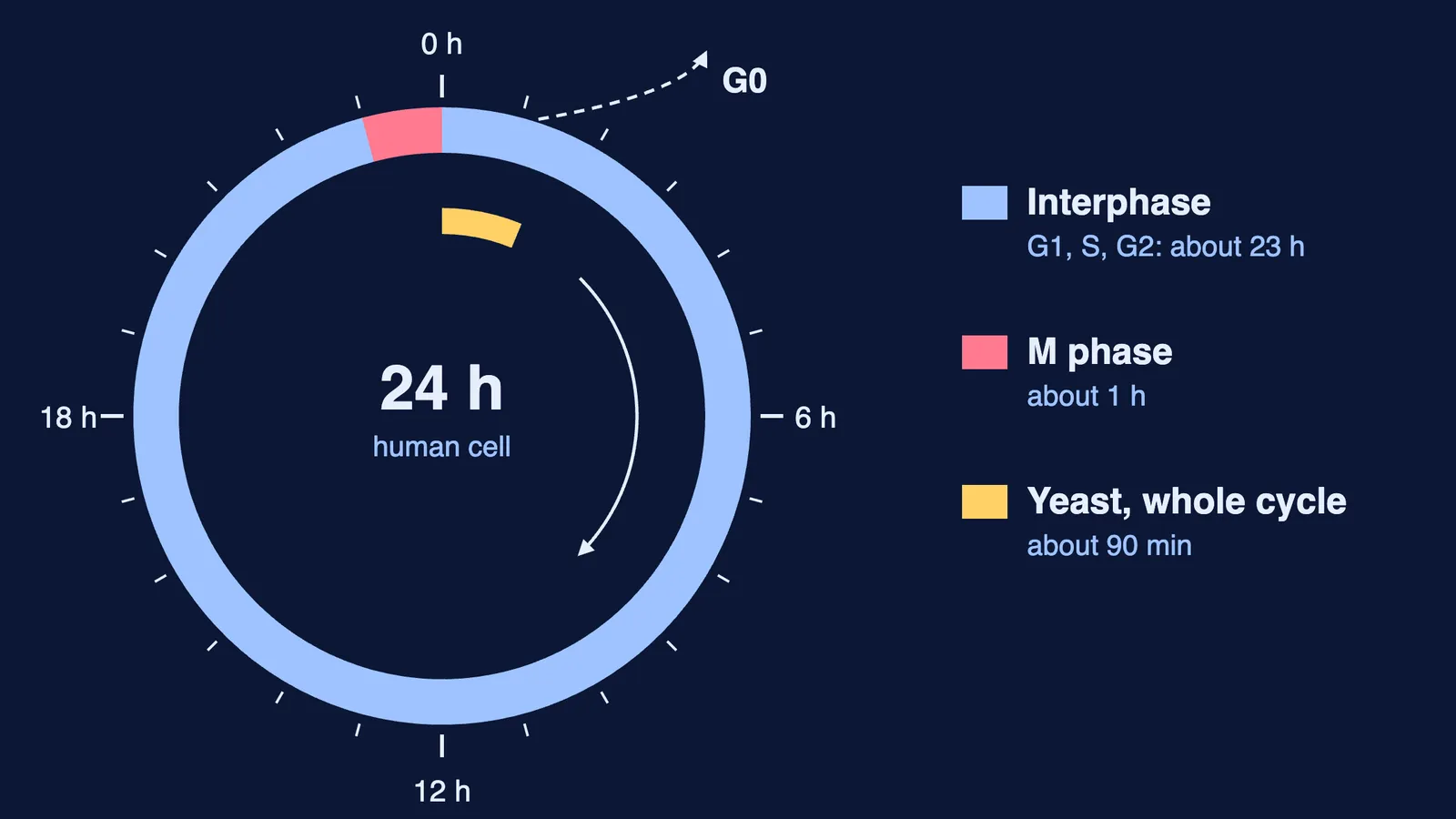
NCERT uses human cells in culture, which divide about once every 24 hours; division itself takes about an hour, and interphase lasts more than 95% of the cycle. Yeast can complete a cycle in about 90 minutes.
G1: the cell grows and is metabolically active, but DNA is not copied.
S: DNA is replicated, so DNA per cell goes from 2C to 4C while chromosome number stays 2n. In animal cells the centriole also duplicates.
G2: proteins for mitosis are made; growth continues.
G0: cells that stop dividing, such as heart cells, leave G1 for this quiescent stage. They stay metabolically active.
M phase: karyokinesis (nuclear division), usually followed by cytokinesis.
How do you identify the stages of mitosis and meiosis?
Learn one clue per stage; questions give the clue.
Prophase: chromosomes condense, each with two chromatids; centrosomes move to opposite poles.
Metaphase: chromosomes line up on the metaphase plate, with spindle fibres attached at kinetochores.
Anaphase: centromeres split and chromatids move to opposite poles.
Telophase: chromosomes decondense, and the nuclear envelope, nucleolus, Golgi and ER re-form.
Cytokinesis: a furrow in animal cells, a cell plate growing outward in plant cells.
Prophase I: leptotene, chromosomes start to show; zygotene, homologues pair on a synaptonemal complex; pachytene, recombination nodules mark crossing over; diplotene, the complex dissolves and chiasmata show; diakinesis, chiasmata terminalise.
Metaphase I: bivalents line up at the equator.
Anaphase I: homologous chromosomes separate; sister chromatids stay joined.
Telophase I: a dyad of cells. Interkinesis follows, with no DNA replication.
Meiosis II: like mitosis; centromeres split in anaphase II and a tetrad of four haploid cells forms.
Why do mitosis and meiosis matter?
Per NCERT sections 10.3 and 10.5, mitosis gives diploid daughter cells with identical genetic material. It drives growth, restores the nucleo-cytoplasmic ratio, and repairs tissue (epidermis, gut lining, blood cells). Mitosis in apical and lateral meristems lets plants grow all their lives.
Meiosis keeps a species' chromosome number constant across generations, even though it halves the number, and it increases genetic variation. For n and 2n examples, see haploid vs diploid cells.
Worked example. Start with 2n = 18 and 4 pg of DNA in G1.
G2: 18 chromosomes, 8 pg.
Mitosis: 36 chromosomes and 8 pg at anaphase; 18 and 4 pg per daughter cell.
Meiosis I: 9 bivalents (8 pg) at metaphase I; then 9 chromosomes and 4 pg per cell.
Meiosis II: 9 chromosomes and 2 pg in each of four cells.
What board-style questions should you practise?
These are our own questions; the mark labels are our suggestion, not CBSE's.
(1 mark) Chiasmata are visible and the synaptonemal complex has just dissolved. Name the sub-stage.
(1 mark) An adult heart cell no longer divides but stays metabolically active. Name its stage.
(2 marks) Coconut's liquid endosperm has many nuclei in one cytoplasm. Which step was skipped, and what is the condition called?
(2 marks) A cell has 2n = 14 and 3 pg of DNA in G1. Give its chromosome number and DNA content in G2 and after meiosis II.
(3 marks) A cycle lasts 20 hours, with 1 hour of M phase. What percentage is interphase, and in which stage does DNA go from 2C to 4C?
(5 marks) Order and name the prophase I sub-stages from these clues: chiasmata terminalise; chromosomes first show; recombination nodules appear; the synaptonemal complex dissolves; homologues pair.
Answers: (1) Diplotene. (2) G0, the quiescent stage. (3) Cytokinesis did not follow karyokinesis; a syncytium. (4) G2: 14 and 6 pg; after meiosis II: 7 and 1.5 pg. (5) 95%; S phase, with chromosome number still 2n. (6) Leptotene, zygotene, pachytene, diplotene, diakinesis (clues 2, 5, 3, 4, 1).
Which stage still trips you up? Fermi's AI tutor works out what you already know and builds a plan for the session.