On this page
Cell: The Unit of Life is Chapter 8 of the NCERT Class 11 Biology textbook, and for 2026-27 it sits in Unit III, Cell: Structure and Function. This guide is for your CBSE school exam. For the entrance exam, read our separate guide to preparing Cell: The Unit of Life for NEET.
How many marks is Cell: The Unit of Life in Class 11?
The CBSE Class XI Biology curriculum for 2026-27 gives Unit III, Cell: Structure and Function, 15 marks out of 70 in the theory paper. That 15 is shared by three chapters: Cell: The Unit of Life, Biomolecules, and Cell Cycle and Cell Division. CBSE prints no separate figure for Chapter 8, so treat any per-chapter number you see elsewhere as a guess.
The curriculum keeps the whole chapter. It lists cell theory, prokaryotic and eukaryotic cells, plant and animal cells, the cell envelope, membrane and wall, the endomembrane system, mitochondria, ribosomes, plastids, microbodies, the cytoskeleton, cilia, flagella, centrioles and the nucleus. No topic from this chapter is excluded. The only Class XI topic marked as formative-only is Digestion and Absorption, which will be "assessed only formatively to reinforce understanding without adding to summative assessments", as the same curriculum prints it. That note does not apply to this chapter.
What does the current NCERT chapter cover?
Work from the current NCERT chapter (Reprint 2026-27).
Cell theory: Schleiden (1838) and Schwann (1839) proposed it; Rudolf Virchow (1855) added that new cells come from pre-existing cells.
Firsts and names: Leeuwenhoek first saw a live cell, Robert Brown described the nucleus (1831), Camillo Golgi observed Golgi bodies (1898), George Palade saw ribosomes (1953), and Singer and Nicolson proposed the fluid mosaic model (1972).
Numbers NCERT gives: in the human erythrocyte membrane protein makes up about 52 per cent and lipid about 40 per cent, plant vacuoles can take up as much as 90 per cent of the cell's volume, and 80S ribosomes split into 60S and 40S while 70S split into 50S and 30S.
Prokaryotic vs eukaryotic cell: which differences score?
Write comparisons as matched pairs, one feature per line, from the NCERT text.
Nucleus: prokaryotes have no nuclear membrane, so the DNA is naked; eukaryotes have an organised nucleus with a nuclear envelope.
Organelles: prokaryotes have no membrane-bound organelles; eukaryotes have ER, Golgi, lysosomes, mitochondria, microbodies and vacuoles.
Ribosomes: 70S in prokaryotes; 80S in the eukaryotic cytoplasm, with 70S inside mitochondria and chloroplasts.
DNA: prokaryotes have one circular genomic DNA, often with extra plasmids; eukaryotic genetic material is organised into chromosomes inside the nucleus.
Special features: the mesosome and inclusion bodies belong to prokaryotes.
Then the plant vs animal pair: plant cells have a cell wall, plastids and a large central vacuole; animal cells have centrioles, which almost all plant cells lack. Revise with our list of cell organelles and their functions.
How big are cells and organelles?
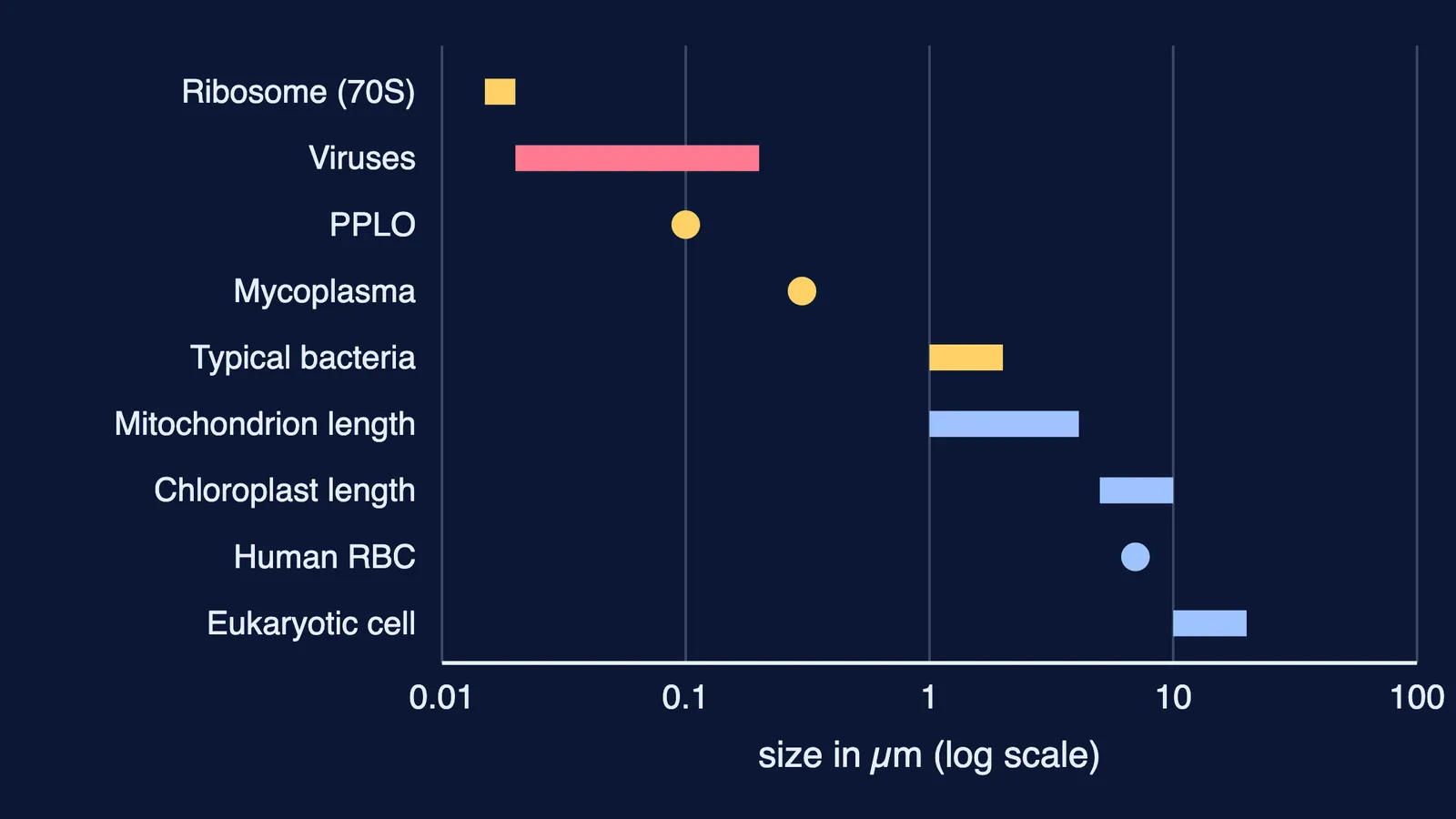
The chart above puts the chapter's sizes on one scale. A worked example with our own pairing: a mitochondrion can be 4.1 µm long and a prokaryotic ribosome about 20 nm, so the mitochondrion is 4100 nm divided by 20 nm, or about 205 times longer. A second one: 15 µm divided by 0.3 µm means about 50 Mycoplasma cells could line up across a 15 µm eukaryotic cell. Convert to the same unit first (1 µm = 1000 nm), as the NCERT chapter mixes µm and nm.
Which questions should you practise?
The marks in brackets are our suggestion for a typical school paper, not CBSE's. The curriculum prints a question-paper design only for Class XII, so ask your teacher how your school sets the Class 11 paper.
State the two points of the modern cell theory and name the scientist who added the second. (2 marks)
Give three differences between a prokaryotic and a eukaryotic cell. (3 marks)
Why are mitochondria and chloroplasts kept out of the endomembrane system? (2 marks)
Assertion: rough ER is extensive in cells that secrete proteins. Reason: ribosomes on rough ER make proteins. Choose the correct option. (1 mark)
Describe the 9+2 arrangement of a cilium and compare it with a centriole. (5 marks)
A chromosome has one extremely short arm and one very long arm. Name its type and sketch where its centromere lies. (2 marks)
For questions 5 and 6, our guide to drawing cell diagrams that score marks shows how to label cleanly.
How should you revise this chapter in a week?
Day 1: cell theory and the overview; write the dates from memory.
Day 2: prokaryotic cell, cell envelope, mesosome, flagellum parts.
Day 3: membrane, wall and transport (passive, osmosis, active).
Day 4: ER, Golgi, lysosomes, vacuoles.
Day 5: mitochondria, plastids, ribosomes, cytoskeleton.
Day 6: cilia, centrioles and the nucleus with chromosome types.
Day 7: answer the six questions above under time, then mark them against NCERT.
Struggling to keep cristae, cisternae and thylakoids apart? Fermi's AI tutor works out what you already know and builds a plan for the session, so you start from the gap.