On this page
Cell: The Unit of Life opens the cell unit of NEET biology, and later chapters assume you know it.
Is Cell: The Unit of Life in the NEET 2026 syllabus?
Yes. The NMC syllabus for NEET (UG) 2026, dated 22-12-2025, places it in Biology Unit 3, Cell Structure and Function. It lists cell theory, prokaryotic and eukaryotic cells, membranes, walls, organelles, the cytoskeleton and the nucleus.
NTA posts the same document on its NEET (UG) syllabus page. No 2027 syllabus is posted yet; recheck that page when it is.
The matching text is Chapter 8 of NCERT Class 11 Biology, Reprint 2026-27.
What does NCERT expect you to know?
Learn the NCERT chapter in five blocks.
Cell theory. Schleiden (1838) found that plants are built of cells. Schwann (1839) studied animal cells and proposed that both animals and plants are made of cells and their products, and the two are credited jointly. Virchow (1855) added that new cells come only from cells that already exist (omnis cellula e cellula). Today's theory has two parts: living things are made of cells and cell products, and every cell comes from an earlier cell.
Prokaryotes. No membrane-bound nucleus or organelles; their ribosomes are 70S (50S plus 30S). Many bacteria also carry plasmids, small rings of DNA outside the main chromosome that can give traits such as antibiotic resistance. The mesosome, an infolding of the plasma membrane, helps with wall formation, DNA replication and distribution, respiration and secretion.
Membrane. Singer and Nicolson proposed the fluid mosaic model in 1972: a phospholipid bilayer in which proteins can drift sideways because the lipid is quasi-fluid. Know passive versus active transport (the Na+/K+ pump).
Organelles. The ER, Golgi complex, lysosomes and vacuoles form the endomembrane system because their work is coordinated. Mitochondria, chloroplasts and peroxisomes are membrane-bound but sit outside it. Eukaryotic cytoplasmic ribosomes are 80S (60S plus 40S), while mitochondria and chloroplasts hold their own 70S ribosomes and circular DNA.
Cytoskeleton and nucleus. Microtubules, microfilaments and intermediate filaments give support, shape and movement. A cilium or flagellum has a 9+2 core: nine outer microtubule doublets around a central pair. A centriole has nine evenly spaced tubulin triplets; in its proximal region a protein hub joins them through radial spokes, which gives the cartwheel look. NCERT gives the centriole no formula, but many other books label it 9+0 (nine triplets, no central pair), so recognise it but do not expect it in NCERT. The nucleolus has no membrane and is where ribosomal RNA is made.
Which diagrams should you practise for NEET?
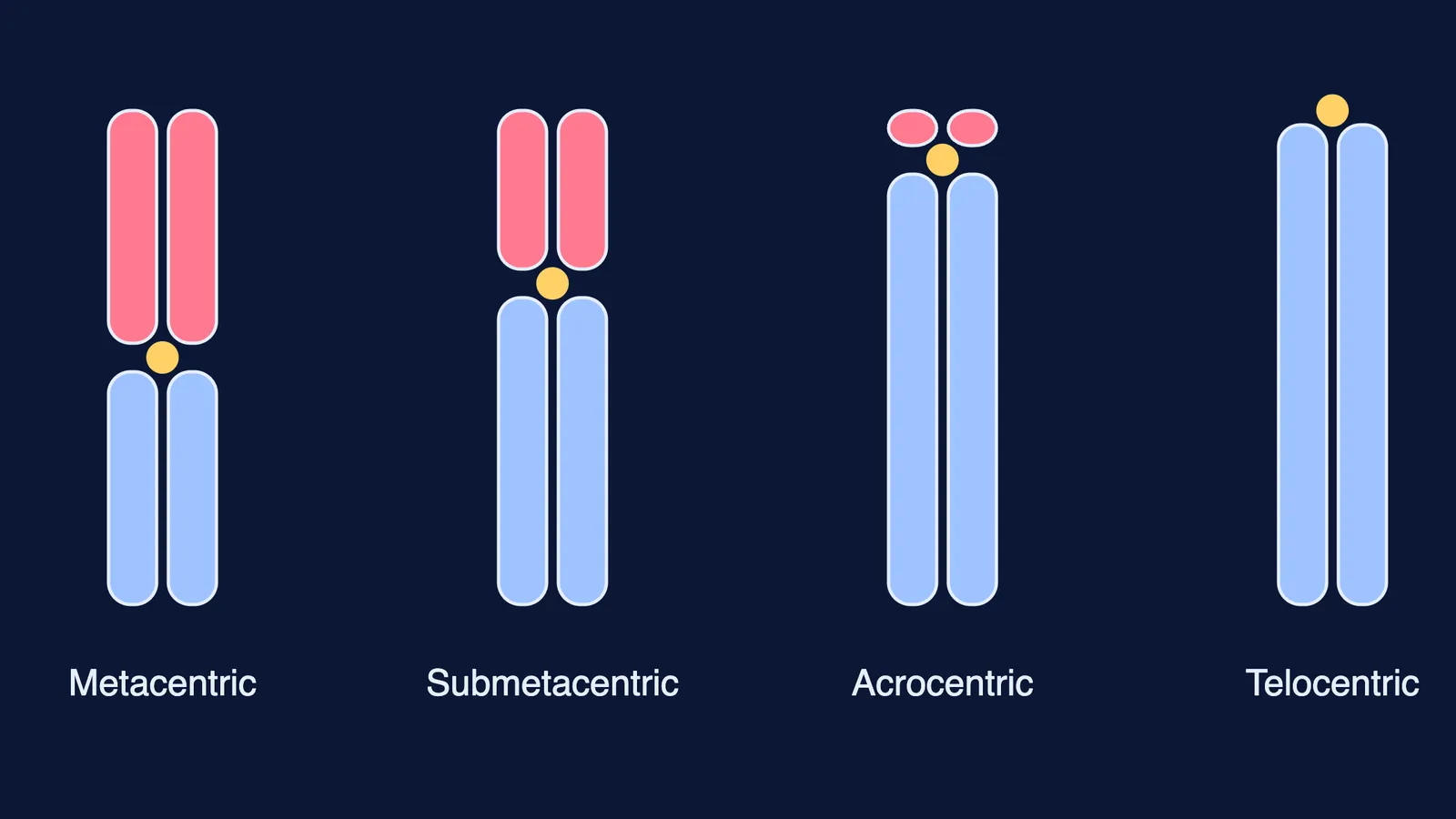
Practise seven drawings: a bacterial cell, the fluid mosaic membrane, a mitochondrion, a chloroplast, a cilium in cross-section, a centriole and the four chromosome types. NCERT's figures 8.4, 8.7, 8.8, 8.10 and 8.13 are the answer key for the membrane, mitochondrion, chloroplast, cilium and chromosome types; for the bacterial cell and the centriole, which have no figure of their own, check your drawing against the text of sections 8.4 and 8.5.9.
Learn the chromosome types as one line with a moving centromere:
Metacentric: centromere in the middle, two equal arms.
Submetacentric: slightly off-centre, one shorter and one longer arm.
Acrocentric: near one end, one very short and one very long arm.
Telocentric: at the very end.
If a structure will not stick, the Fermi Concept Library gives every biology concept its own lesson and its place in the map.
What are the common traps in this chapter?
Robert Brown did not discover the cell: Leeuwenhoek was the first to see a living cell, and Brown described the nucleus (1831).
Mycoplasma is the prokaryote with no cell wall.
S stands for the sedimentation coefficient, so learn the ribosome pairs as pairs: 70S from 50S and 30S, 80S from 60S and 40S.
Mitochondria and chloroplasts have membranes but are not part of the endomembrane system.
Ribosomes and the nucleolus have no membrane.
Centrioles are absent in almost all plant cells; see how plant cells build a spindle without centrioles.
Bacterial flagella are built differently from eukaryotic ones, so 9+2 applies only to eukaryotes.
Mature red blood cells of many mammals and sieve tube cells of vascular plants lack a nucleus.
How should you plan practice for Cell: The Unit of Life?
Days 1-2: Read sections 8.1 to 8.4 slowly. Write a prokaryote versus eukaryote comparison in your notebook.
Days 3-4: Sections 8.5.1 to 8.5.3. Draw the membrane and sort every organelle into endomembrane or not.
Days 5-6: Mitochondria, plastids, ribosomes, cytoskeleton, cilia and centrioles. Draw the 9+2 and the cartwheel.
Day 7: Nucleus and chromosome types, all four drawn from memory.
Days 8-9: Solve the NCERT exercises and past NEET questions, tagging each wrong answer by trap type.
Day 10: Redo the wrong questions and redraw any weak diagram.
Rather not plan alone? Fermi's AI tutor works out what you already know and builds a plan for the session, so you sit down to a clear next step.
Unit 3 continues with Biomolecules for NEET and cell cycle and cell division for NEET. Both build on this one.