On this page
Wave Optics is the second chapter of the Optics unit, and board marks sit on steps: the principle stated, the diagram labelled, the formula written before the numbers.
What does the CBSE 2026-27 syllabus include in Wave Optics?
The CBSE Class XII Physics curriculum 2026-27 gives Unit VI, Optics, 18 marks out of 70, shared between Ray Optics and Wave Optics. For Wave Optics it lists:
wavefronts, Huygens' principle, and proofs of the laws of reflection and refraction using it
Young's double-slit experiment and the fringe width expression (final expression only, no derivation)
coherent sources and sustained interference
single-slit diffraction, with the width of the central maximum treated qualitatively
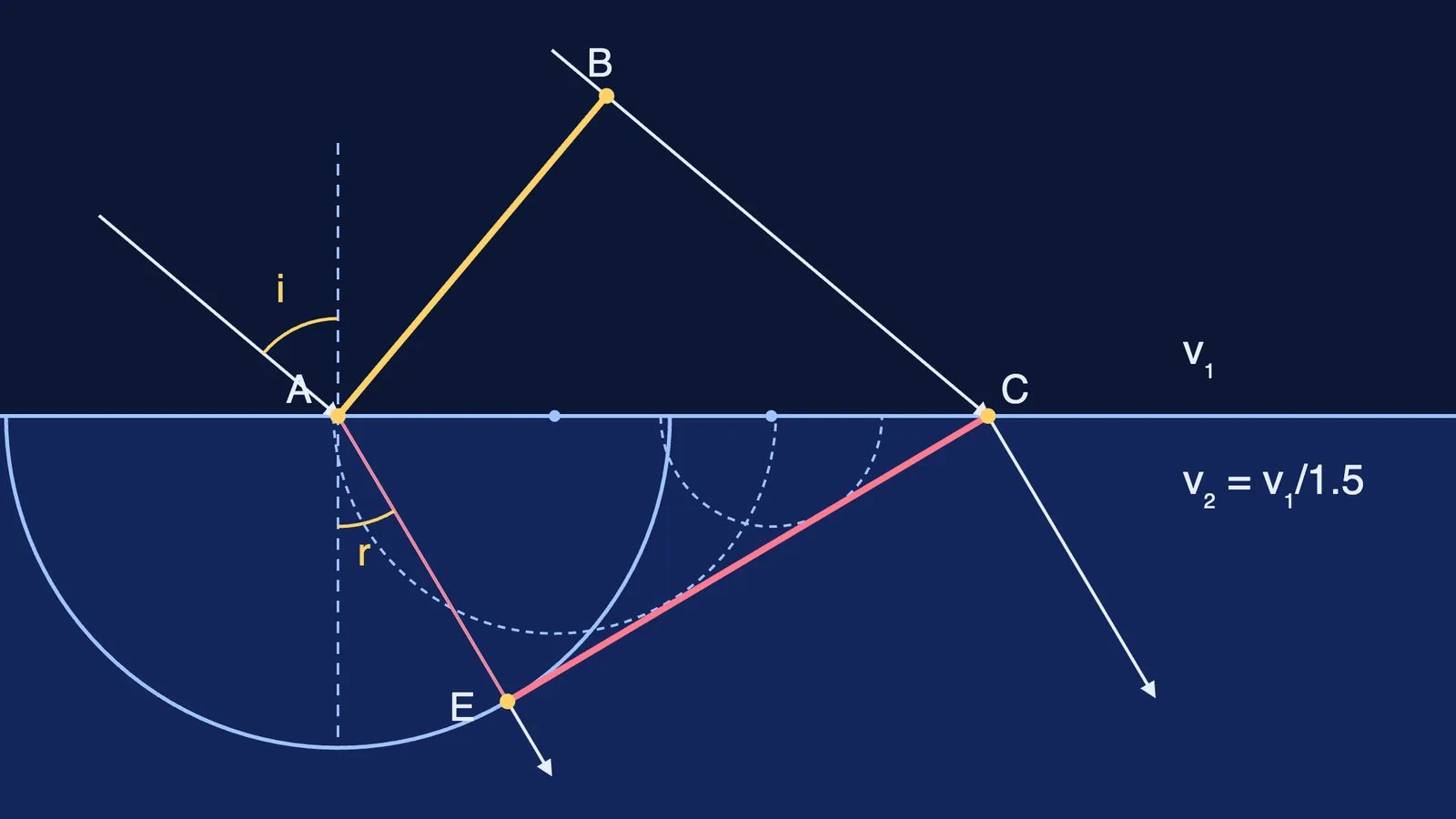
Your textbook is NCERT Class 12 Physics Chapter 10 (Reprint 2026-27). In its Fig. 10.4, where v2 < v1, sin i = BC/AC = v1τ/AC and sin r = AE/AC = v2τ/AC, so sin i/sin r = v1/v2. Bright fringes sit at x = nλD/d and dark fringes at x = (n + 1/2)λD/d, so the fringe width is β = λD/d. For a slit of width a, minima are at θ ≈ nλ/a (n = ±1, ±2...).
NCERT keeps Section 10.7 on polarisation, with Malus' law, but the CBSE list above does not name polarisation, and Brewster's law is not in the chapter at all. Read 10.7 once; ask your teacher how your school treats it.
How should you set out 2-, 3- and 5-mark answers?
The CBSE 2026-27 sample paper has 16 one-mark questions (four of them assertion-reason), five 2-mark, seven 3-mark, two 4-mark case studies and three 5-mark long answers.
2 marks: a relation plus its reason. "Wavelength decreases in a denser medium because speed falls while frequency stays the same" is the shape to aim for.
3 marks: the derivation. The sample paper asks for Snell's law from Huygens' theory plus the prediction later confirmed (light is slower in water). Its marking scheme gives a mark each to the principle, the triangle geometry, and the result with that prediction. Label the figure first.
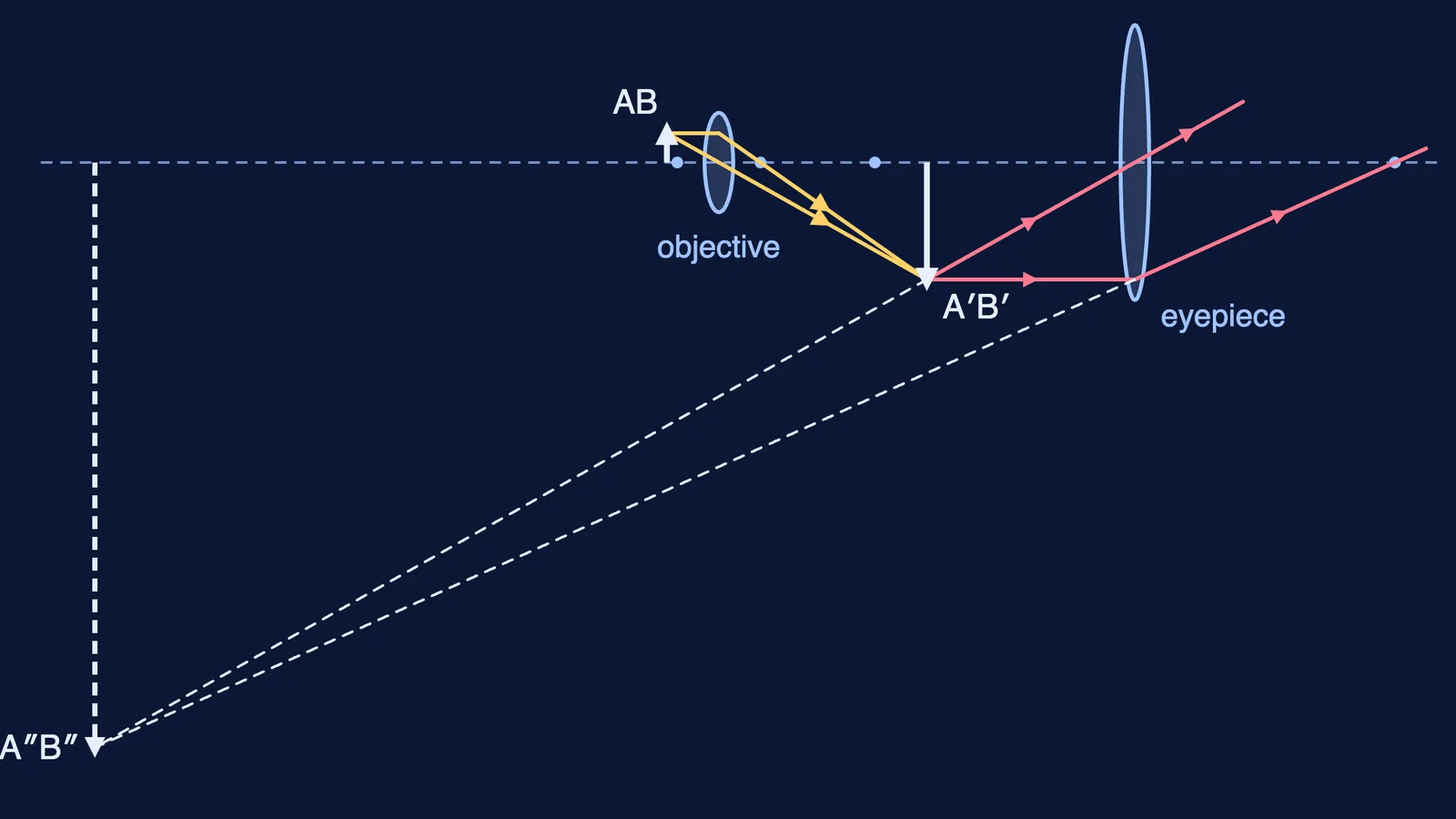
5 marks: long answers come in parts; the sample paper's Optics question (a Ray Optics microscope problem) is marked 2 + 2 + 1. Number your parts to match.
For step marks on numericals, use the layout in our guide on how to write numericals in board exams, and pace yourself with the minute-per-mark plan.
A board numerical, done twice
Question (3 marks). In Young's experiment, light of wavelength 640 nm falls on slits 0.32 mm apart, with the screen 1.2 m away. Find (a) the fringe width, (b) the distance of the second dark fringe from the centre, (c) the fringe width with 480 nm light.
First pass, full layout. Bare answers risk every step mark.
Given: λ = 640 × 10⁻⁹ m, d = 0.32 × 10⁻³ m, D = 1.2 m.
(a) β = λD/d = (640 × 10⁻⁹ × 1.2)/(0.32 × 10⁻³) = 2.4 × 10⁻³ m = 2.4 mm.
(b) Dark fringes: x = (n + 1/2)λD/d. Second dark fringe, n = 1: x = 1.5β = 3.6 mm.
(c) β ∝ λ, so β' = 2.4 mm × 480/640 = 1.8 mm.
Second pass, a different route:
(a) Angular fringe width λ/d = 2 × 10⁻³ rad; across 1.2 m that is 2.4 mm.
(b) The second dark fringe sits midway between bright fringes 1 and 2: (2.4 + 4.8)/2 = 3.6 mm.
(c) Count fringes in a 7.2 mm strip: 3 at 640 nm, so 4 at 480 nm, each 7.2/4 = 1.8 mm.
Calculators are not allowed, so board numbers divide cleanly. For harder variations, see our Wave Optics for JEE Main guide.
Which assertion-reason and case-study traps cost marks?
Swapped proportionality. The sample paper's fringe width item pairs a correct assertion with a reason that makes β proportional to d: "A true, R false."
Interference versus diffraction. NCERT shows double-slit fringes equally spaced. In single-slit diffraction the minima at θ ≈ ±λ/a bound a central maximum twice as wide as the others, and the secondary maxima get weaker.
Coherence. Two independent lamps give no fringes: an ordinary source changes phase in about 10⁻¹⁰ s, so intensities add.
Wavefront shapes. Starlight arrives as a plane wavefront (a sample-paper one-marker).
Frequency. On refraction, speed and wavelength change; frequency does not.
If wavefronts are hard to picture, the Fermi Simulation Lab has interactive simulations for the ideas that are easier to see than to read.
A seven-day revision plan for Wave Optics
Day 1: NCERT 10.1 to 10.3; draw Fig. 10.4 from memory.
Day 2: write the refraction and reflection proofs.
Day 3: coherence and Young's experiment; learn β = λD/d.
Day 4: NCERT exercises 10.1 to 10.6, set out as above.
Day 5: single slit; compare interference and diffraction.
Day 6: the sample paper's Wave Optics questions, checked against the marking scheme.
Day 7: redo every question you lost marks on.
When a numerical goes wrong, the Fermi Problem Library has worked problems with a step-by-step solver that explains the reasoning rather than printing an answer.