On this page
Alternating Current rewards neat working: board examiners mark each step they can see, so layout matters as much as the final number.
What does CBSE 2026-27 test in Alternating Current?
In the CBSE Class XII Physics curriculum for 2026-27, Chapter 7 sits in Unit IV, Electromagnetic Induction and Alternating Currents. Units III and IV together carry 17 of the 70 theory marks. The listed content is peak and rms values, reactance and impedance, the LCR series circuit (phasors only), resonance, power in AC circuits, power factor, wattless current, the AC generator and the transformer.
Your source is NCERT Class 12 Physics Chapter 7 (Reprint 2026-27). Its derivations, to practise on paper:
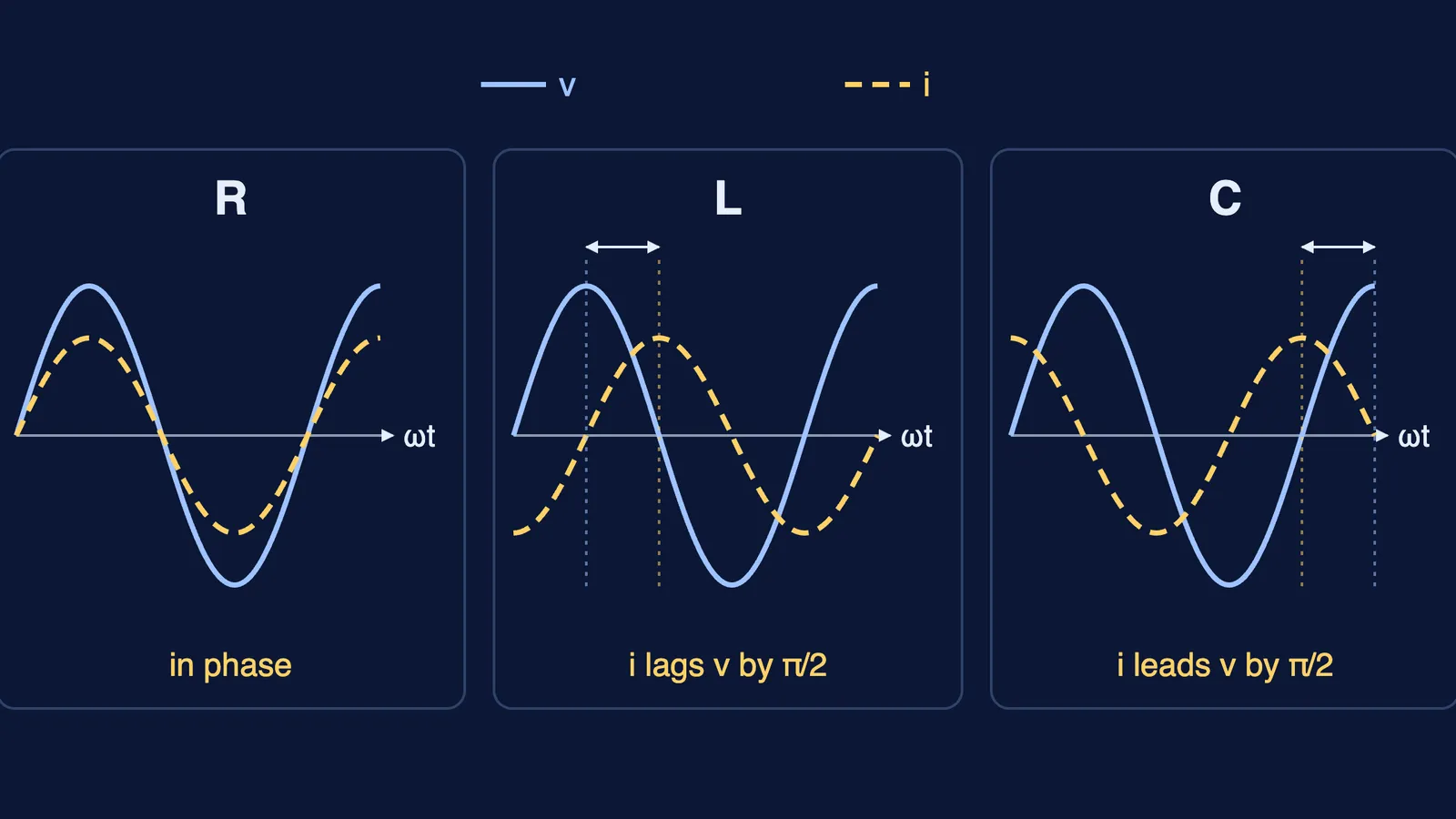
AC through pure R, L and C with phasors: current in phase for R, lagging by π/2 for L, leading by π/2 for C.
Series LCR impedance from the phasor diagram: Z = √(R² + (XC − XL)²), tan φ = (XC − XL)/R.
Resonance: XL = XC gives ω0 = 1/√(LC), Z = R and maximum current.
Power P = V I cos φ; zero average power in pure L or C.
Ideal transformer: Vs/Vp = Ns/Np, and Ip/Is = Ns/Np when input power equals output power.
Preparing for JEE too? Our Alternating Current for JEE Main guide covers that exam.
How should you set out 2-, 3- and 5-mark AC answers?
The CBSE Physics Sample Question Paper 2026-27 has 33 questions in five sections: 1-mark questions, including assertion-reason, in Section A, 2-mark questions in Section B, 3-mark questions in Section C, two 4-mark case studies in Section D and three 5-mark questions in Section E. Calculators are not allowed, so practise by hand.
2 marks: formula, substitution with units, answer.
3 marks: a labelled phasor diagram, the relation read from it, then the result.
5 marks: split it as the question does. The sample paper's transformer question is marked 2+2+1, and the marking scheme gives 1 mark for the device and labelled diagram with its principle (mutual induction), ½ each for Vs/Vp = Ns/Np and VpIp = VsIs, 1 for the working mechanism, 1 for needing an AC input and 1 for one named loss.
How do you solve a board-style LCR numerical?
A series circuit has R = 500 Ω, L = 0.25 H and C = 4 μF across a 250 V rms source of angular frequency 2000 rad/s. Find the current, the phase and the power. At what ω would the current be largest?
First pass: impedance.
XL = ωL = 2000 × 0.25 = 500 Ω.
XC = 1/(ωC) = 1/(2000 × 4 × 10⁻⁶) = 125 Ω.
Z = √(500² + 375²) = √390625 = 625 Ω.
I = V/Z = 250/625 = 0.4 A (rms).
cos φ = R/Z = 0.8; XL > XC, so the circuit is inductive and the current lags the voltage by tan⁻¹(3/4).
P = V I cos φ = 250 × 0.4 × 0.8 = 80 W.
Second pass: phasors. VR = 200 V, VL = 200 V and VC = 50 V. VL and VC are opposite, leaving 150 V, so the supply is √(200² + 150²) = 250 V, as given. I²R = 0.16 × 500 = 80 W agrees. The parts add to more than 250 V; rms voltages add as phasors, not numbers.
Resonance: ω0 = 1/√(0.25 × 4 × 10⁻⁶) = 1000 rad/s. There Z = R = 500 Ω, I = 0.5 A and P = 125 W.
Which assertion-reason and case-study traps catch students?
Each twists a line in NCERT Chapter 7 that students half-remember:
"A pure inductor carries current, so it uses power." False: average power over a cycle is zero; the current is wattless.
"Resonance can occur in an RC circuit." False: it needs both L and C.
In an LCR circuit, only R turns energy into heat.
A transformer steps up voltage, not power; current falls in the same ratio.
Mixing peak and rms: household 220 V is rms, with a peak of about 311 V.
Transformer case studies lean on NCERT's four losses: flux leakage, winding resistance, eddy currents and hysteresis, each with its fix. Our guides to assertion-reason questions and case-based questions cover the general method.
What is a good revision plan for Alternating Current?
Day 1: rms and peak values; R, L and C phasor diagrams from memory.
Day 2: the LCR impedance derivation, written in full and timed.
Day 3: the numerical above with your own numbers, checked both ways.
Day 4: resonance, power factor, wattless current; write five assertion-reason pairs.
Day 5: transformer derivation and losses; sample paper question 33, marked against the scheme.
Day 6: mixed 2-, 3- and 5-mark questions without a calculator; list every lost step.
If phase is hard to picture, the Fermi Simulation Lab has interactive simulations for the ideas that are easier to see than to read. When you cannot find your wrong step, the Fermi Problem Library has worked problems with a step-by-step solver that explains the reasoning rather than printing an answer.