On this page
Alternating Current becomes scoreable once you can draw a phasor diagram without thinking. Here is the syllabus, one worked circuit and a seven-day plan.
What does the JEE Main syllabus include in Alternating Current?
In the NTA's Syllabus for JEE (Main) - 2027, AC sits in Physics Unit 14, "Electromagnetic Induction and Alternating Currents". It lists peak and RMS values, reactance and impedance, the LCR series circuit, resonance, power in AC circuits, wattless current, the AC generator and the transformer.
The textbook match is Chapter 7 of NCERT Class 12 Physics Part 1 (Reprint 2026-27), which runs from AC in a resistor and phasors through the series LCR circuit and power factor to transformers (section 7.8). The AC generator is section 6.8, per the book's contents. The reprint has no LC oscillations section, and Q appears only in the chapter's summary table, so learn ω0 = 1/√(LC) and Q = ω0L/R without spending a week on them.
If induction feels shaky, revise our Electromagnetic Induction and AC guide first; self-inductance is where XL comes from.
Which formulas do you need for AC in JEE Main?
Vrms = Vm/√2 and Irms = Im/√2. Our step-by-step derivation of the rms value shows where the √2 comes from.
XL = ωL and XC = 1/(ωC), with ω = 2πf.
Series LCR: Z = √(R² + (XL − XC)²) and tan φ = (XL − XC)/R.
Power: P = Vrms Irms cos φ, with power factor cos φ = R/Z; wattless current is Irms sin φ.
Ideal transformer: Vs/Vp = Ns/Np = Ip/Is.
How do you solve a series LCR circuit step by step?
Take R = 40 Ω, L = 80 mH and C = 20 μF in series with a 100 V rms source at ω = 1000 rad/s.
Reactances: XL = 1000 × 0.080 = 80 Ω; XC = 1/(1000 × 20 × 10⁻⁶) = 50 Ω.
Impedance: Z = √(40² + 30²) = 50 Ω.
Current: Irms = 100/50 = 2.0 A. Peak values: Vm ≈ 141 V, Im ≈ 2.83 A.
Phase: tan φ = 30/40, so φ ≈ 36.9°. XL exceeds XC, so the current lags the voltage.
Power: cos φ = 0.8, so P = 100 × 2.0 × 0.8 = 160 W.
Wattless current: 2.0 × 0.6 = 1.2 A.
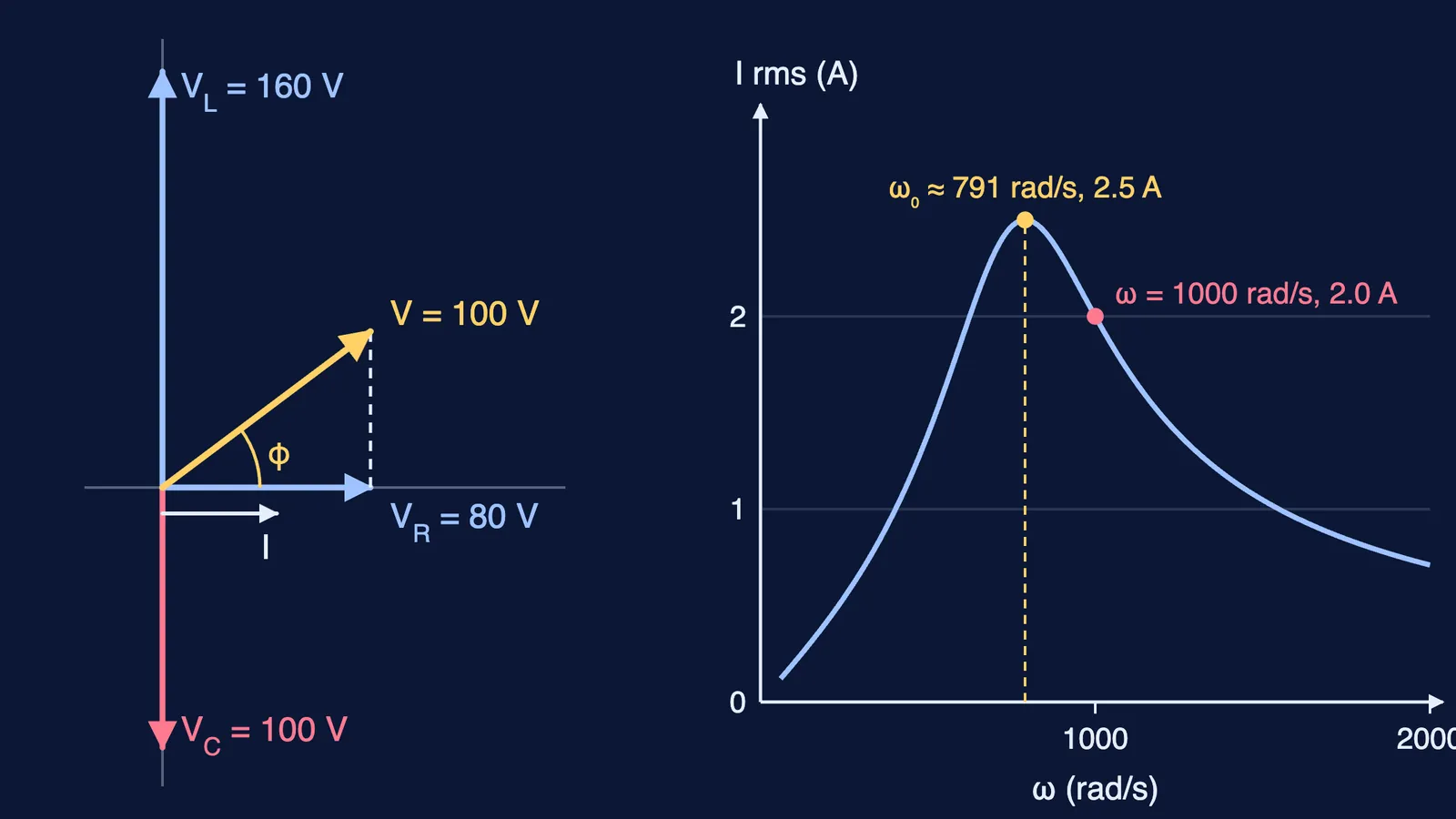
Across the parts, VR = 80 V, VL = 160 V and VC = 100 V. VL exceeds the supply and the three do not add to 100. Both are fine: VL and VC are opposite phasors, so the supply is √(80² + 60²) = 100 V, as the diagram at the top shows.
What happens at resonance, and what is Q?
For the same L and C, ω0 = 1/√(0.080 × 20 × 10⁻⁶) ≈ 791 rad/s, about 126 Hz. There XL = XC, so Z = R = 40 Ω, the current peaks at 2.5 A, cos φ = 1 and power rises to 250 W. Q ≈ 791 × 0.080/40 ≈ 1.6, which is why the peak in the graph is broad. A smaller R gives a taller, sharper peak at the same ω0.
Traps: resonance needs both L and C, and VL and VC can each exceed the supply (here about 158 V).
Our Oscillations for JEE Main guide covers the same idea as forced oscillations.
How do transformer questions work?
An ideal transformer has 1,200 primary and 60 secondary turns, with 240 V rms on the primary. Then Vs = 240 × 60/1200 = 12 V. A 6 Ω load draws Is = 2.0 A, so the output is 24 W. With no losses the input is also 24 W, so Ip = 24/240 = 0.10 A, matching Ip/Is = Ns/Np = 1/20.
Stepping voltage down raises current; it never creates power. NCERT section 7.8 also lists real losses (flux leakage, winding resistance, eddy currents, hysteresis) worth listing for theory questions.
What are the common traps, and how should you practise?
Using f where ω belongs in XL and XC.
Adding rms voltages as plain numbers instead of as phasors.
Forgetting that a pure inductor or capacitor takes zero average power.
Giving the peak value when the question asks for rms, or the reverse.
A seven-day plan:
Day 1: rms and peak values; derive the √2 yourself.
Day 2: R, L and C alone; draw each phasor diagram from memory.
Day 3: series LCR with numbers you invent; check each with Irms² × R.
Day 4: resonance, Q and the current-frequency curve.
Day 5: power factor and wattless current.
Day 6: transformer and AC generator.
Day 7: a timed mixed set, then a written list of every mistake.
The Fermi Simulation Lab has interactive simulations for the ideas that are easier to see than to read. When you cannot find your wrong step, the Fermi Problem Library has worked problems with a step-by-step solver that explains the reasoning rather than printing an answer.