On this page
In Chemical Thermodynamics almost every answer turns on a sign. Below: the official syllabus, real reactions worked with real data, and a two-week plan. Heat engines and PV diagrams are in our Thermodynamics for JEE Main physics guide.
What does the JEE Main syllabus include in Chemical Thermodynamics?
In NTA's Syllabus for JEE (Main) - 2027, linked as "Syllabus" from the official JEE Main site, Chemical Thermodynamics is Unit 4 of Physical Chemistry. It covers:
Fundamentals: system and surroundings, extensive and intensive properties, state functions, entropy, types of processes.
First law: work, heat, internal energy, enthalpy, heat capacities and Hess's law.
Enthalpies of bond dissociation, combustion, formation, atomization, sublimation, phase transition, hydration, ionization and solution.
Second law: spontaneity, ΔS of the universe and ΔG of the system as criteria, and ΔG° with the equilibrium constant.
The matching chapter is Unit 5, Thermodynamics, in the NCERT Class 11 Chemistry textbook (Reprint 2026-27). Read it fully before any question bank.
Which sign convention does chemistry use for the first law?
NCERT Unit 5 writes the first law as ΔU = q + w, where w is work done on the system, so work done by the system is negative (NCERT Unit 5). The same page notes that physics books still use the older convention.
Example: a gas absorbs 250 J of heat and does 90 J of work on its surroundings. So q = +250 J, w = −90 J and ΔU = +160 J.
For reactions involving gases, ΔH = ΔU + Δn_gRT, where Δn_g counts gaseous moles only (products minus reactants). For N₂(g) + 3H₂(g) → 2NH₃(g), the NIST WebBook gives ΔfH° of ammonia as −45.90 kJ/mol, so ΔrH° = −91.8 kJ/mol. Here Δn_g = 2 − 4 = −2 and RT = 2.479 kJ/mol at 298.15 K, so ΔU = −91.8 + 4.96 = −86.8 kJ/mol.
How do you calculate enthalpy of reaction in JEE Main questions?
Work C₂H₄(g) + H₂(g) → C₂H₆(g) three ways.
From formation enthalpies (products minus reactants): with ethene at +52.47 kJ/mol, ethane at −84.0 kJ/mol and H₂ at zero, ΔrH° = −84.0 − 52.47 = −136.5 kJ/mol.
Hess's law cycle, to get ΔfH° of ethane from combustion data: burn 2 mol C (−393.5 kJ/mol each) and 3 mol H₂ to liquid water (−285.83 kJ/mol each), both values from NCERT Unit 5, then reverse the combustion of ethane (−1560.7 kJ/mol, NIST): −787.0 − 857.5 + 1560.7 = −83.8 kJ/mol, matching the tabulated −84.0.
Bond enthalpies (gas phase only): bonds broken minus bonds formed. With NCERT Table 5.3 mean values, break C=C (611) and H–H (435.8), then form C–C (347) and two C–H (2 × 414): 1046.8 − 1175 = −128.2 kJ/mol.
The bond estimate is 8 kJ off because mean bond enthalpies are averages; NCERT calls the method approximate, valid when all species are gaseous.
How do you decide whether a reaction is spontaneous?
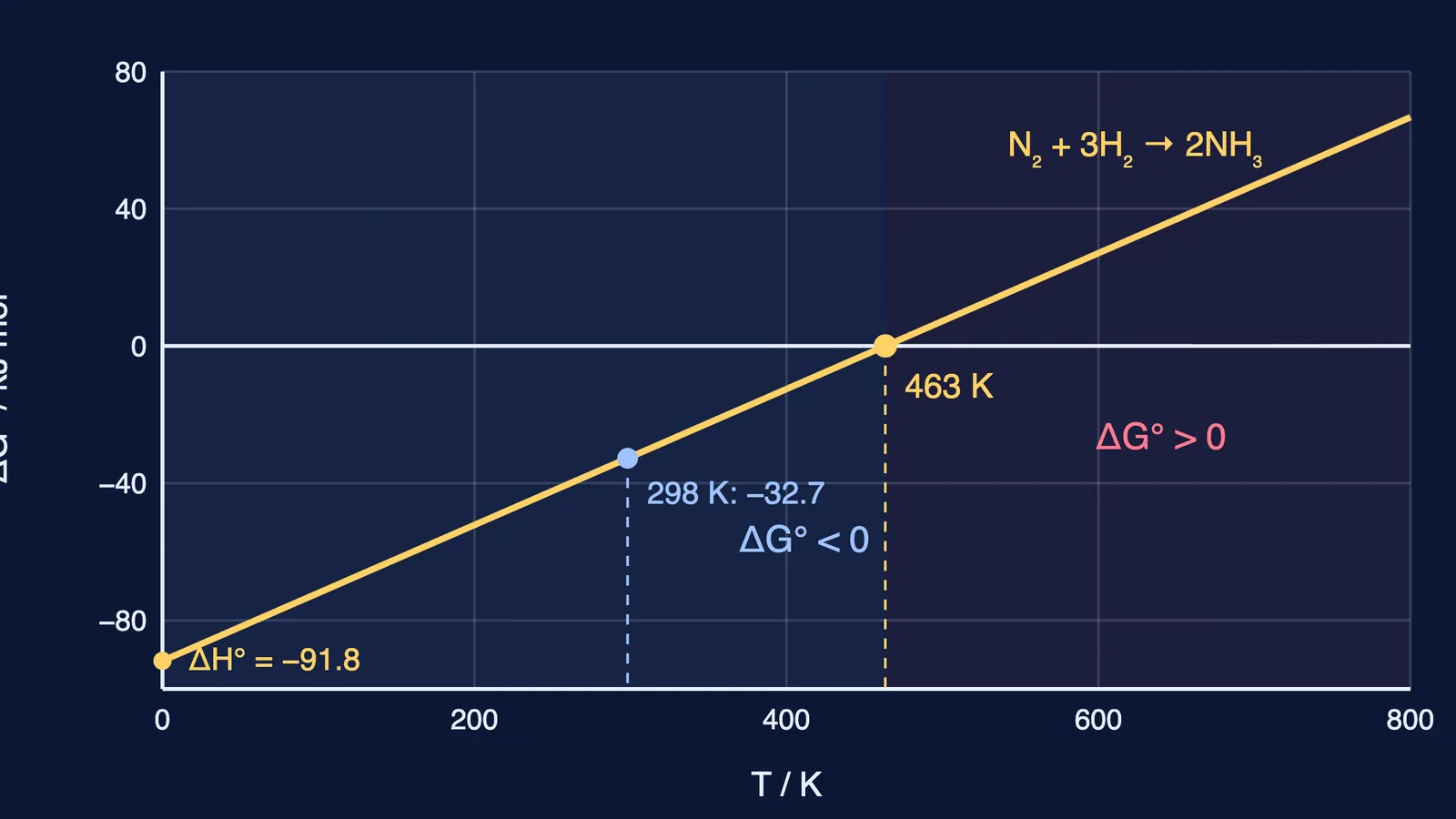
Back to ammonia at 298.15 K. Using NIST standard entropies for NH₃ (192.77), N₂ (191.61) and H₂ (130.68 J/K mol), ΔS° = 2(192.77) − 191.61 − 3(130.68) = −198.1 J/K mol.
Surroundings: ΔS_surr = −ΔH/T = 91,800/298.15 = +307.9 J/K mol, so ΔS_univ = +109.8 J/K mol. Positive means spontaneous.
Gibbs energy: ΔG° = ΔH° − TΔS° = −91.8 − 298.15 × (−0.1981) = −32.7 kJ/mol.
Crossover: ΔG° = 0 at T = ΔH°/ΔS° = 91,800/198.1 ≈ 463 K (about 190 °C), assuming ΔH° and ΔS° stay constant.
Equilibrium constant: ΔG° = −RT ln K, so ln K = 32,730/(8.314 × 298.15) = 13.2 and K ≈ 5.4 × 10⁵.
From ΔG = ΔH − TΔS: negative ΔH with positive ΔS is spontaneous at all temperatures, the reverse never is, and mixed cases switch at T = ΔH/ΔS. Practise with the temperature at which a reaction becomes spontaneous and how to calculate K from ΔG°.
What mistakes cost marks in Chemical Thermodynamics?
Using the physics form of the first law.
Counting liquid water in Δn_g.
Mixing J and kJ in ΔH − TΔS.
Using log K without the 2.303 factor.
Using bond enthalpies when a liquid or solid is involved.
Giving an element a non-zero ΔfH° in its reference state (graphite for carbon, per NCERT).
When a sign keeps going wrong, the Fermi Problem Library has worked problems with a step-by-step solver that explains the reasoning rather than printing an answer.
How should you plan two weeks for Chemical Thermodynamics?
Days 1-3: read NCERT Unit 5; write the first law and ΔH = ΔU + Δn_gRT from memory.
Days 4-6: find one gas-phase reaction's ΔrH all three ways.
Days 7-9: entropy, ΔS_surr and ΔG; draw ΔG against T for all four sign cases.
Days 10-11: ΔG° and K.
Days 12-14: timed mixed sets; tag every error as sign, unit, phase or method.
If entropy still feels vague, the Fermi Concept Library covers every concept in physics, chemistry, biology, mathematics and computing, each with its own lesson and its place in the map.