On this page
Thermodynamics in JEE Main physics rests on the first law and on reading PV diagrams. Two easy places to lose marks are signs and units.
What does the JEE Main syllabus include in Thermodynamics?
Unit 8 of the official Syllabus for JEE (Main) - 2027, linked from the NTA JEE Main website, lists the zeroth law, heat, work and internal energy, the first law, isothermal and adiabatic processes, and the second law with reversible and irreversible processes.
The matching chapter is Chapter 11 of NCERT Class 11 Physics Part II (Reprint 2026-27). It keeps the second law, reversibility and section 11.11 on the Carnot engine, with efficiency η = 1 − T2/T1. NTA names neither the Carnot engine nor heat engines, though a Carnot cycle uses only the isothermal and adiabatic steps it lists.
Which sign convention should you use for the first law?
NCERT physics writes ΔQ = ΔU + ΔW, where ΔQ is heat supplied to the system and ΔW is work done by the system (NCERT section 11.5). NCERT chemistry writes ΔU = q + w, with w as work done on the system, and notes that physics books keep the older convention (NCERT Chemistry Unit 5). State yours before solving.
Example 1. A gas absorbs 800 J and does 300 J of work: ΔU = 800 − 300 = 500 J. Compress it with 200 J of work (ΔW = −200 J) while it loses 50 J (ΔQ = −50 J): ΔU = −50 + 200 = +150 J.
How do you calculate work in isothermal and adiabatic processes?
Isothermal, ideal gas: W = nRT ln(V2/V1), and Q = W because U depends only on T (NCERT section 11.8.2).
Example 2. Two moles at 300 K expand from 5 L to 15 L: W = 2 × 8.314 × 300 × ln 3 ≈ 5480 J.
Adiabatic: PV^γ and TV^(γ−1) stay constant, and W = (P1V1 − P2V2)/(γ − 1) (NCERT sections 11.8.3 and 11.11). A rigid diatomic gas has γ = 7/5 (NCERT Chapter 12).
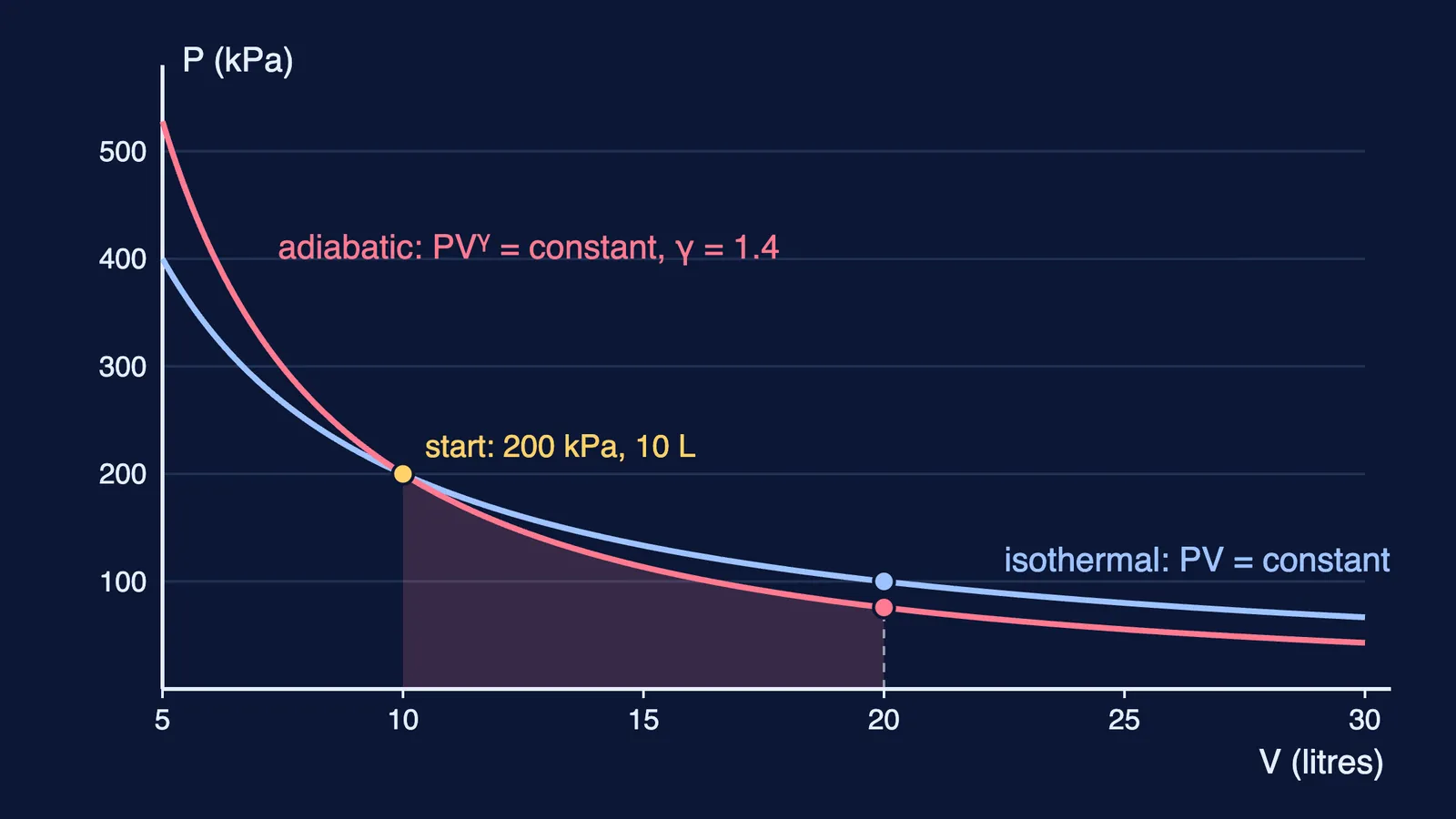
Example 3. A diatomic gas at 200 kPa, 10 L and 300 K expands adiabatically to 20 L.
P2 = 200 × 0.5^1.4 ≈ 75.8 kPa
T2 = 300 × 0.5^0.4 ≈ 227 K
W = (2000 − 1516)/0.4 ≈ 1211 J
Check: with nR = P1V1/T1 = 2000/300 J/K, nCvΔT = 2.5 × (2000/300) × 72.6 ≈ 1211 J, the fall in internal energy.
From the same start, an isotherm to 20 L ends at 100 kPa and does 2000 × ln 2 ≈ 1386 J. The adiabat is steeper, so it ends lower and does less work, as the diagram above shows. See why air from a burst tyre feels cold.
How do you read a cyclic process on a PV diagram?
Over a cycle ΔU = 0, so net heat absorbed equals net work done (NCERT section 11.8.6). Net work is the enclosed area, positive for a clockwise loop.
Example 4. A gas goes A (10 L, 100 kPa) to C (10 L, 300 kPa) at constant volume, straight to B (30 L, 100 kPa), then back to A at constant pressure.
A to C: 0
C to B: 200 kPa average × 0.020 m³ = 4000 J
B to A: 100 kPa × (−0.020 m³) = −2000 J
Net work is 2000 J, equal to the triangle's area, ½ × 0.020 × 2 × 10^5 J. Clockwise, so the gas absorbs a net 2000 J.
Why is Cp − Cv = R, and how does Carnot efficiency work?
At constant pressure, part of the heat pushes the piston, which gives Cp − Cv = R for an ideal gas (NCERT section 11.6).
Example 5. Heat 3 mol of rigid diatomic gas through 40 K. Constant volume: 3 × 2.5 × 8.314 × 40 ≈ 2494 J. Constant pressure: 3 × 3.5 × 8.314 × 40 ≈ 3492 J. The 998 J difference is nRΔT, the work PΔV.
Example 6. A Carnot engine runs between 227 °C and 27 °C, that is 500 K and 300 K: η = 1 − 300/500 = 0.40. From 1200 J of heat it does 480 J of work and rejects 720 J. Using Celsius gives 1 − 27/227 ≈ 0.88, an impossible engine.
If your method keeps slipping, the Fermi Problem Library has worked problems with a step-by-step solver that explains the reasoning rather than printing an answer.
How should you prepare Thermodynamics in one week?
Day 1: read NCERT 11.4 to 11.8; write the first law in both conventions.
Day 2: derive both work formulas from a blank page.
Day 3: redo Examples 2 and 3 with new numbers.
Day 4: find the net work of five PV loops by area and by steps, then try our spring-loaded piston first-law problems.
Day 5: Cp − Cv = R, the second law and Carnot. Then read our Stirling engine explainer.
Day 6: twenty timed mixed questions; tag each error as sign, unit, process or arithmetic.
Day 7: redo only the wrong ones.