On this page
Solutions is where JEE Main chemistry turns into careful arithmetic, and a wrong unit or a missing van't Hoff factor is enough to lose the mark. Below: the scope from the official syllabus, then one original worked numerical for each idea.
What does the JEE Main syllabus include in Solutions?
Solutions is Unit 5 of chemistry in the official NTA Syllabus for JEE (Main) - 2027, linked from jeemain.nta.nic.in. It lists:
concentration as molality, molarity, mole fraction and percentage (mass and volume)
Raoult's law, ideal and non-ideal solutions, and vapour pressure-composition plots
relative lowering of vapour pressure, depression of freezing point, elevation of boiling point and osmotic pressure
molar mass from these properties, abnormal molar mass and the van't Hoff factor
The textbook match is Unit 1, Solutions, of NCERT Class 12 Chemistry Part I (reprint 2026-27). NCERT teaches Henry's law here, but the NTA document lists it under Unit 6, Equilibrium, so revise it either way.
How do you convert between molarity, molality and mole fraction?
Fix a basis first: 1 kg of solvent.
Worked example. A urea solution (60 g/mol) has molality 2.00 mol/kg and density 1.03 g/mL.
In 1000 g water there are 2.00 mol urea = 120 g, so the solution weighs 1120 g.
Volume = 1120 ÷ 1.03 = 1087 mL, so molarity = 2.00 ÷ 1.087 = 1.84 mol/L.
Water = 1000 ÷ 18 = 55.6 mol, so the mole fraction of urea = 2.00 ÷ 57.6 = 0.0347.
More practice: converting mole fraction to molality and molarity.
How does Raoult's law work, and when do solutions deviate?
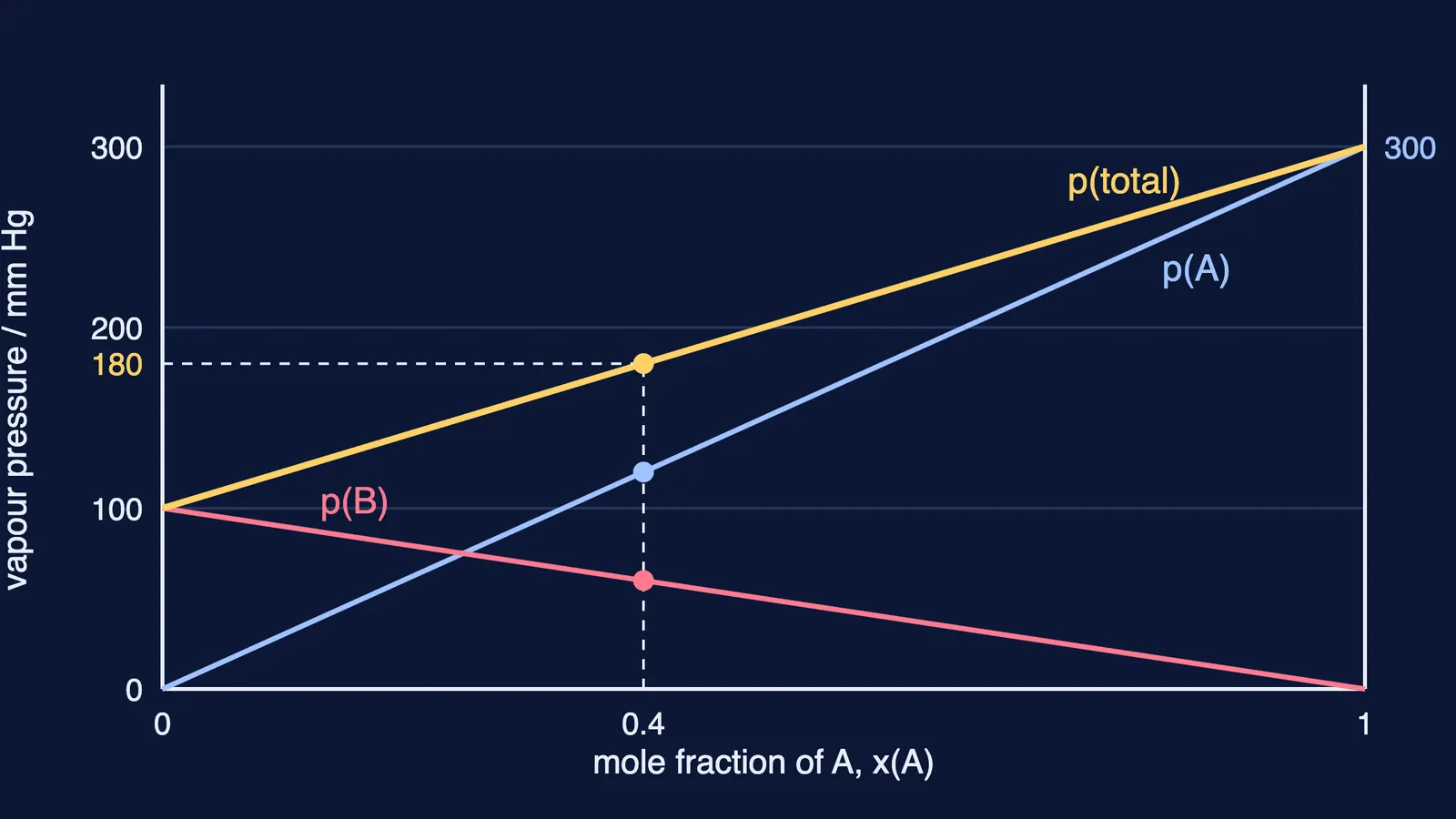
In an ideal solution, each partial pressure is mole fraction times pure vapour pressure; the total is their sum.
Worked example. p°A = 300 mm Hg and p°B = 100 mm Hg. At xA = 0.40, pA = 120 and pB = 0.60 × 100 = 60, so P = 180 mm Hg. In the vapour, yA = 120 ÷ 180 = 0.67: richer in A, the more volatile liquid.
The NCERT chapter describes both deviations:
Positive: A-B attractions are weaker than A-A and B-B, pressure sits above the ideal line, and a large deviation gives a minimum boiling azeotrope, such as ethanol-water at about 95% ethanol by volume.
Negative: A-B attractions are stronger, pressure falls below the line, and a large deviation gives a maximum boiling azeotrope, such as nitric acid-water at about 68% nitric acid by mass.
How do you solve colligative property numericals?
NCERT's chapter gives Kb = 0.52 K kg/mol and Kf = 1.86 K kg/mol for water, with R = 0.083 L bar/(mol K).
Boiling point: 9.0 g glucose (180 g/mol) in 150 g water = 0.050 mol ÷ 0.150 kg = 0.333 mol/kg. ΔTb = 0.52 × 0.333 = 0.17 K.
Freezing point: 31.0 g ethylene glycol (62 g/mol) in 500 g water = 1.00 mol/kg. ΔTf = 1.86 K, so it freezes at -1.86 °C.
Osmotic pressure: 0.10 mol/L glucose at 300 K gives π = CRT = 0.10 × 0.083 × 300 = 2.49 bar.
Molar mass: 2.00 g of a protein in 0.250 L at 310 K gives π = 3.43 × 10⁻³ bar, so M = wRT ÷ (πV) = 51.46 ÷ (8.575 × 10⁻⁴) ≈ 60,000 g/mol.
See also reading boiling point elevation from vapour pressure curves.
How does the van't Hoff factor change the answer?
The factor i multiplies every colligative formula, as in ΔTf = i Kf m. For an electrolyte giving n ions with degree of dissociation α, i = 1 + (n − 1)α.
Worked example. 0.10 mol/kg CaCl₂ freezes 0.502 K below pure water. Without dissociation, ΔTf = 1.86 × 0.10 = 0.186 K, so i = 0.502 ÷ 0.186 = 2.70. CaCl₂ gives three ions, so α = (2.70 − 1) ÷ 2 = 0.85, or 85%.
When molecules associate, as ethanoic acid dimerises in benzene, i falls below 1 and the apparent molar mass is too high.
If you keep choosing the wrong method, the Fermi Problem Library has worked problems with a step-by-step solver that explains the reasoning rather than printing an answer.
A seven-day plan and the traps to avoid
Read the NCERT chapter; write every formula with units on one page.
Ten concentration conversions.
Raoult's law and both deviation plots, sketched from memory.
Boiling and freezing point numericals, including molar mass.
Osmotic pressure, isotonic solutions and reverse osmosis.
van't Hoff factor for dissociation and association.
A timed mixed set of past JEE Main questions; log each error.
Traps:
Molality uses kilograms of solvent, not solution.
Molarity changes with temperature; molality and mole fraction do not.
A 1 K change equals a 1 °C change.
Match R to your pressure unit.
Never drop i for a salt.