On this page
In Properties of Solids and Liquids, three mix-ups cost easy marks: gauge versus absolute pressure, radius versus diameter, and a drop versus a bubble.
What does the JEE Main syllabus include in Properties of Solids and Liquids?
Unit 7 of the official Syllabus for JEE (Main) - 2027 (NTA JEE Main website) lists:
Elasticity: stress-strain, Hooke's law, Young's modulus, bulk modulus and modulus of rigidity.
Fluids: fluid-column pressure, Pascal's law, viscosity, Stokes' law, terminal velocity, streamline and turbulent flow, critical velocity, Bernoulli's principle.
Surface tension: surface energy, angle of contact, excess pressure, drops, bubbles, capillary rise.
Heat: temperature, thermal expansion, specific heat, calorimetry, latent heat, conduction, convection, radiation.
The matching NCERT Class 11 Physics Part II chapters (Reprint 2026-27) are Chapter 8, Mechanical Properties of Solids, Chapter 9, Mechanical Properties of Fluids and Chapter 10, Thermal Properties of Matter. Chapter 10 also covers Newton's law of cooling, which the NTA unit does not name, so we skip it.
How do you solve elasticity numericals for JEE Main?
Young's modulus is Y = (F/A)/(ΔL/L), so the elongation is ΔL = FL/(YA) (NCERT section 8.5.1). NCERT gives Y for structural steel as 2.0 × 10^11 N m^-2.
Example 1. A steel wire 2.5 m long and 1.0 mm in diameter holds an 8 kg load (g = 9.8 m/s²).
A = π(0.5 × 10^-3)² = 7.85 × 10^-7 m²; F = 78.4 N
ΔL = 78.4 × 2.5 / (2.0 × 10^11 × 7.85 × 10^-7) ≈ 1.25 mm
Using the diameter as the radius makes the area four times too big.
How do Pascal's law and Bernoulli's principle appear in numericals?
Pressure at depth h is P = Pa + ρgh, and P − Pa is the gauge pressure (NCERT section 9.2.2).
Example 2. At 12 m under water, gauge pressure = 1000 × 9.8 × 12 = 1.18 × 10^5 Pa; adding Pa = 1.01 × 10^5 Pa gives an absolute 2.19 × 10^5 Pa.
In a hydraulic lift, F1/A1 = F2/A2 (NCERT section 9.2.4).
Example 3. Pistons of radius 1.5 cm and 15 cm lift a 1500 kg car (14,700 N). The area ratio is (15/1.5)² = 100, so the small piston needs 147 N.
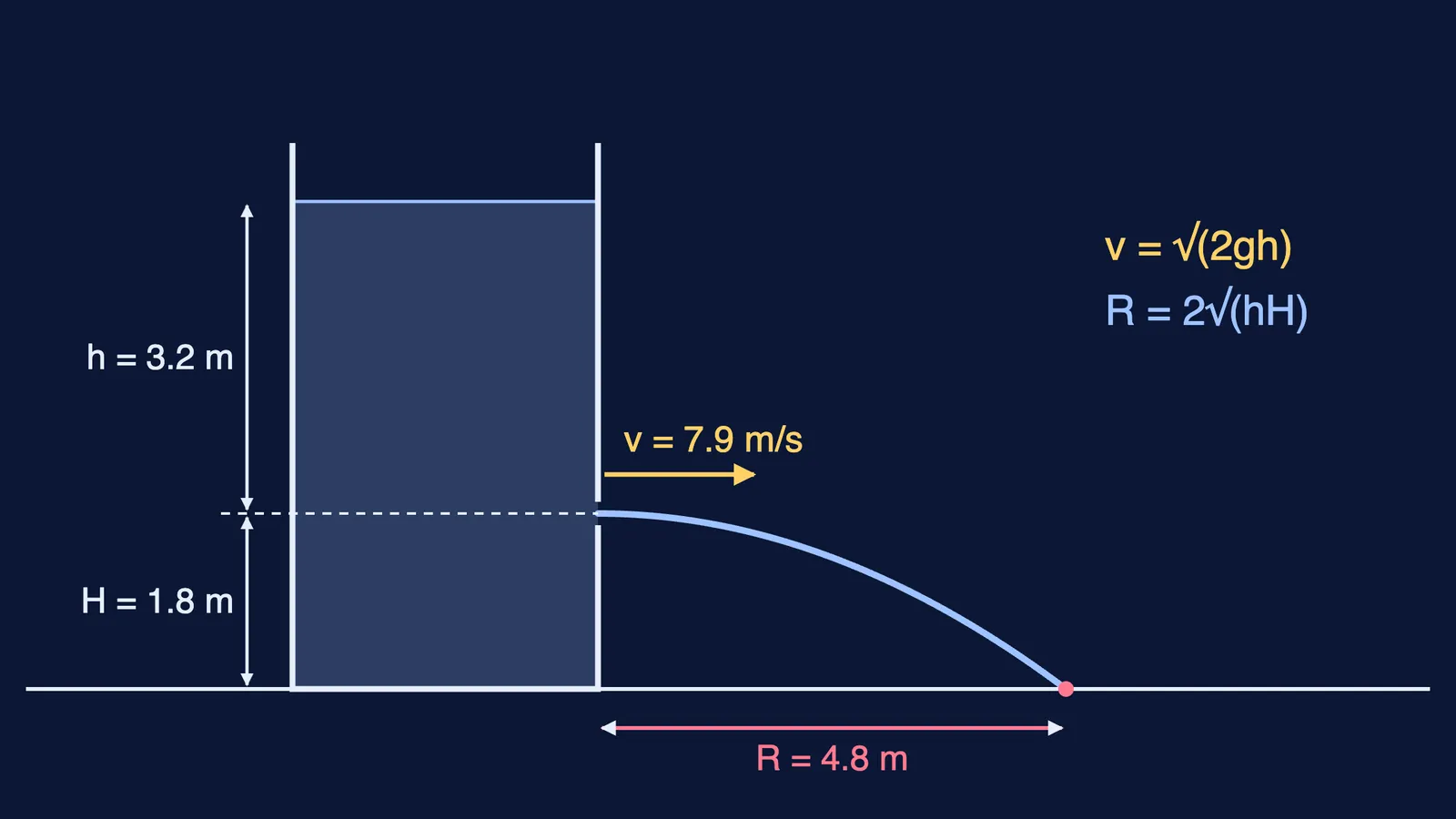
Bernoulli's principle says P + ½ρv² + ρgh stays constant along a streamline; for an open tank it gives Torricelli's law, v = √(2gh) (NCERT section 9.4.1).
Example 4. A hole sits 3.2 m below the water surface and 1.8 m above the ground. Efflux speed v = √(2 × 9.8 × 3.2) ≈ 7.9 m/s. It falls 1.8 m in 0.61 s and lands 4.8 m away, matching R = 2√(hH).
Bernoulli is energy conservation per unit volume; if that feels shaky, revise our Work, Energy and Power guide.
Which viscosity and surface tension formulas trip students up?
Stokes' law gives the drag F = 6πηav, and at terminal velocity vt = 2a²(ρ − σ)g/(9η) (NCERT section 9.5.1).
Example 5. A steel ball (radius 1.5 mm, density 7800 kg/m³) falls through oil of density 1300 kg/m³ and viscosity 1.2 Pa s: vt = 2 × (1.5 × 10^-3)² × 6500 × 9.8 / (9 × 1.2) ≈ 2.65 cm/s.
Excess pressure is 2S/r inside a drop but 4S/r inside a soap bubble (NCERT section 9.6.4).
Example 6. With S = 0.030 N/m and r = 2.0 mm, a drop has 30 Pa of excess pressure and a bubble 60 Pa.
Capillary rise is h = 2S cos θ/(ρga) (NCERT section 9.6.5). NCERT lists water's surface tension at 20 °C as 0.0727 N/m.
Example 7. In a clean glass tube of radius 0.25 mm (θ ≈ 0): h = 2 × 0.0727 / (1000 × 9.8 × 2.5 × 10^-4) ≈ 5.9 cm.
How should you prepare calorimetry and heat transfer?
Calorimetry rests on heat lost = heat gained, with Q = mL during a change of state (NCERT sections 10.7 and 10.8). NCERT gives water's specific heat as 4186 J kg^-1 K^-1 and ice's latent heat of fusion as 3.33 × 10^5 J/kg.
Example 8. Drop 30 g of ice at 0 °C into 200 g of water at 25 °C. Melting needs 0.030 × 3.33 × 10^5 = 9990 J; cooling the water to 0 °C releases 0.200 × 4186 × 25 = 20,930 J, so all the ice melts. Then 20,930 − 837.2T = 9990 + 125.6T gives T ≈ 11.4 °C.
For heat transfer, learn the conduction equation and the Stefan-Boltzmann law from NCERT section 10.9, then move to our Thermodynamics for JEE Main guide.
What is a good two-week practice plan?
Days 1-3: elasticity; solve ten wire problems.
Days 4-7: pressure, Pascal and Bernoulli; sketch every tank first.
Days 8-10: viscosity and surface tension; one page of drop, bubble and capillary cases.
Days 11-13: heat.
Day 14: a timed mixed set, then analyse previous year questions by mistake type.
When the method goes wrong, the Fermi Problem Library has worked problems with a step-by-step solver that explains the reasoning rather than printing an answer.