On this page
Work, Energy and Power is Unit 4 of the physics syllabus in the official Syllabus for JEE (Main) - 2027 published by NTA. In the current NCERT Class 11 Physics Part I (reprint 2026-27), the matching chapter is Chapter 5, Work, Energy and Power. Below: the map, four worked problems and a two-week plan.
What does the JEE Main 2027 syllabus include in Work, Energy and Power?
The NTA syllabus lists these topics for Unit 4, and each one has a home in NCERT Chapter 5:
Work by a constant and a variable force: sections 5.3 and 5.5
Kinetic and potential energy, and the work-energy theorem: sections 5.2, 5.4, 5.6 and 5.7
Potential energy of a spring: section 5.9
Conservation of mechanical energy, conservative and non-conservative forces: section 5.8
Motion in a vertical circle: the worked pendulum example inside section 5.8
Power: section 5.10
Elastic and inelastic collisions in one and two dimensions: section 5.11
Four worked problems: how do you apply the work-energy theorem?
Take g = 9.8 m/s². The numbers are ours; check each step.
1. Work-energy theorem with friction. A 2 kg block starts from rest on a floor with μ = 0.3. You push it with a horizontal 20 N force for 5 m. Friction is 0.3 × 2 × 9.8 = 5.88 N. Your force does +100 J and friction does −29.4 J, so the net work is 70.6 J. Setting 70.6 J = ½ × 2 kg × v² gives v ≈ 8.40 m/s.
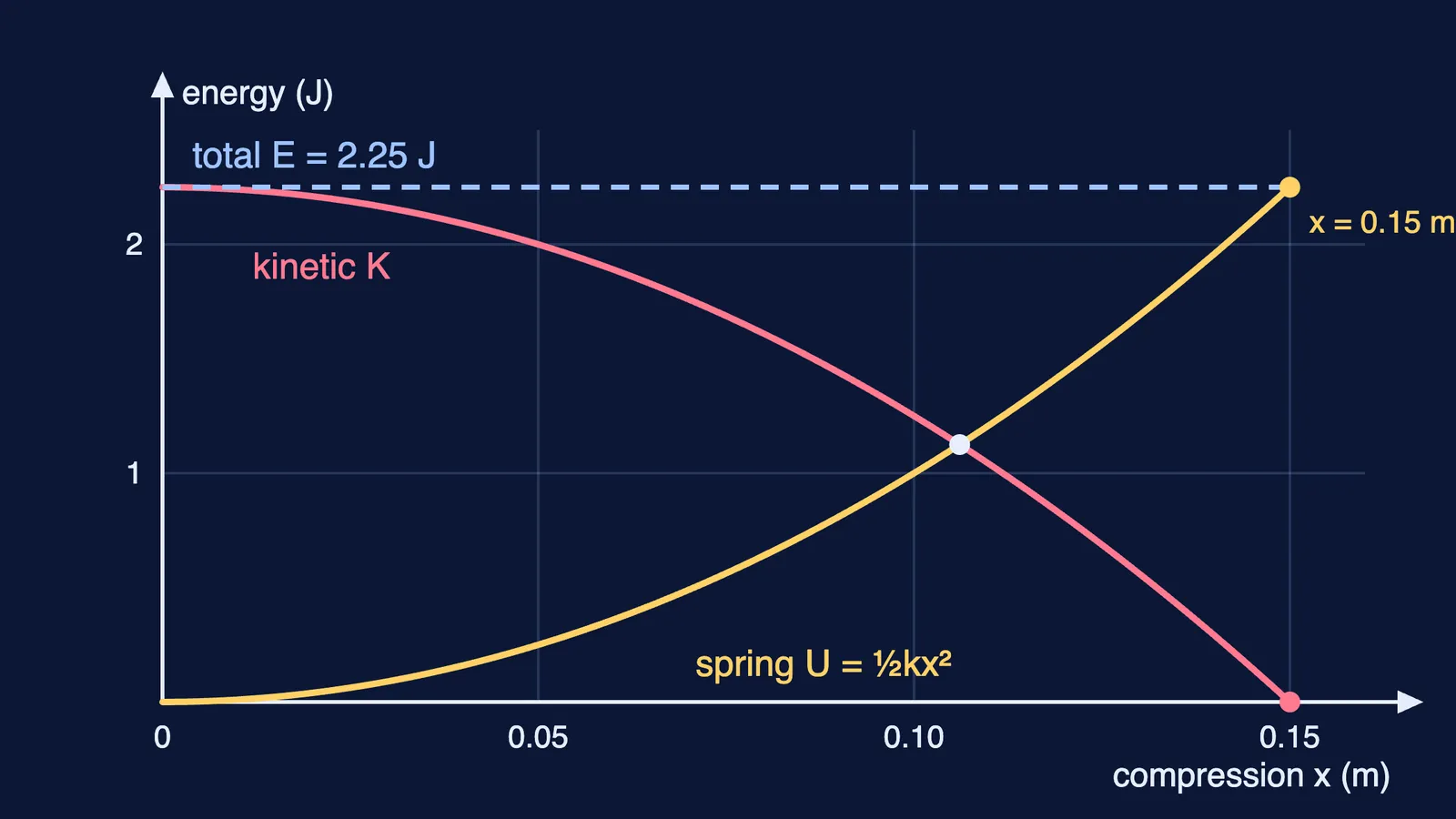
2. A spring stopping a block. A 0.5 kg block slides at 3 m/s on a smooth floor into a spring with k = 200 N/m. Its kinetic energy is ½ × 0.5 × 3² = 2.25 J. At maximum compression all of it is stored: ½ × 200 × x² = 2.25 J, so x = 0.15 m. The graph at the top shows this energy swap.
3. One collision, two outcomes. A 2 kg cart at 4 m/s hits a 1 kg cart at rest. Momentum before is 8 kg m/s.
Elastic: the 2 kg cart moves on at 1.33 m/s and the 1 kg cart leaves at 5.33 m/s. Momentum stays 8 kg m/s; kinetic energy stays 16 J.
Perfectly inelastic (they stick): both move at 8/3 ≈ 2.67 m/s. Kinetic energy falls from 16 J to 10.67 J, so 5.33 J (one third) goes into heat and deformation.
4. Power and top speed. A car meets 600 N of resistance at 20 m/s. To hold that speed the engine supplies P = Fv = 600 N × 20 m/s = 12 kW. If 12 kW is the engine's limit and resistance stays at 600 N, at 25 m/s it could push with only 12000 ÷ 25 = 480 N, less than the resistance, so 20 m/s is its top speed.
Practise that check with how to check a collision answer with momentum and energy and the reverse case, an explosion into two fragments and who gets more kinetic energy.
Which mistakes cost marks in this chapter?
Signs of work. Friction on a sliding block, and gravity on a rising one, do negative work.
The wrong potential energy. mgh is for gravity near the ground. A spring needs ½kx², with x measured from its natural length.
Assuming kinetic energy is always conserved. Momentum is conserved in a collision with no external impulse; kinetic energy is conserved only if the collision is elastic.
Vertical circle: string or rod. A string must stay taut at the top, so the top speed must be at least √(gL). A rod can hold it at zero speed. For L = 0.8 m, the lowest-point speed needed is √(5gL) ≈ 6.26 m/s with a string but only √(4gL) = 5.60 m/s with a rod.
Power at an angle. P = F·v uses only the force component along the velocity.
How should you practise Work, Energy and Power in two weeks?
Days 1-3: read NCERT sections 5.1 to 5.7 and redo the in-text examples without looking. For variable forces, work is the area under the force-displacement graph.
Days 4-6: springs, conservation of mechanical energy and the vertical circle. Write the energy equation before any numbers.
Days 7-9: power, then collisions in one and two dimensions.
Days 10-12: mixed, timed sets of 15 questions. Log each error as concept, sign, algebra or misread.
Days 13-14: redo every logged error.
If your errors keep coming from picking the wrong method, the Fermi Problem Library has worked problems with a step-by-step solver that explains the reasoning rather than printing an answer. If collisions are hard to picture, the Fermi Simulation Lab has interactive simulations for the ideas that are easier to see than to read. Then test yourself with same push, same time: which cart gets more momentum and energy?
Start with problem 1 today, then redo it tomorrow without the solution.