

On this page
A classic mechanics problem goes like this: a shell at rest bursts into two pieces, and you are asked how the kinetic energy is divided between them. Once you see the reasoning, the answer takes two lines. Below: the reasoning, a worked example, and four checks for when the shortcut fails.
Why do both fragments get equal and opposite momentum?
OpenStax University Physics states the rule plainly: the total momentum of a closed system is conserved. The same section explains why an explosion does not break this rule. Internal forces cannot change a system's total momentum, because their changes sum to zero.
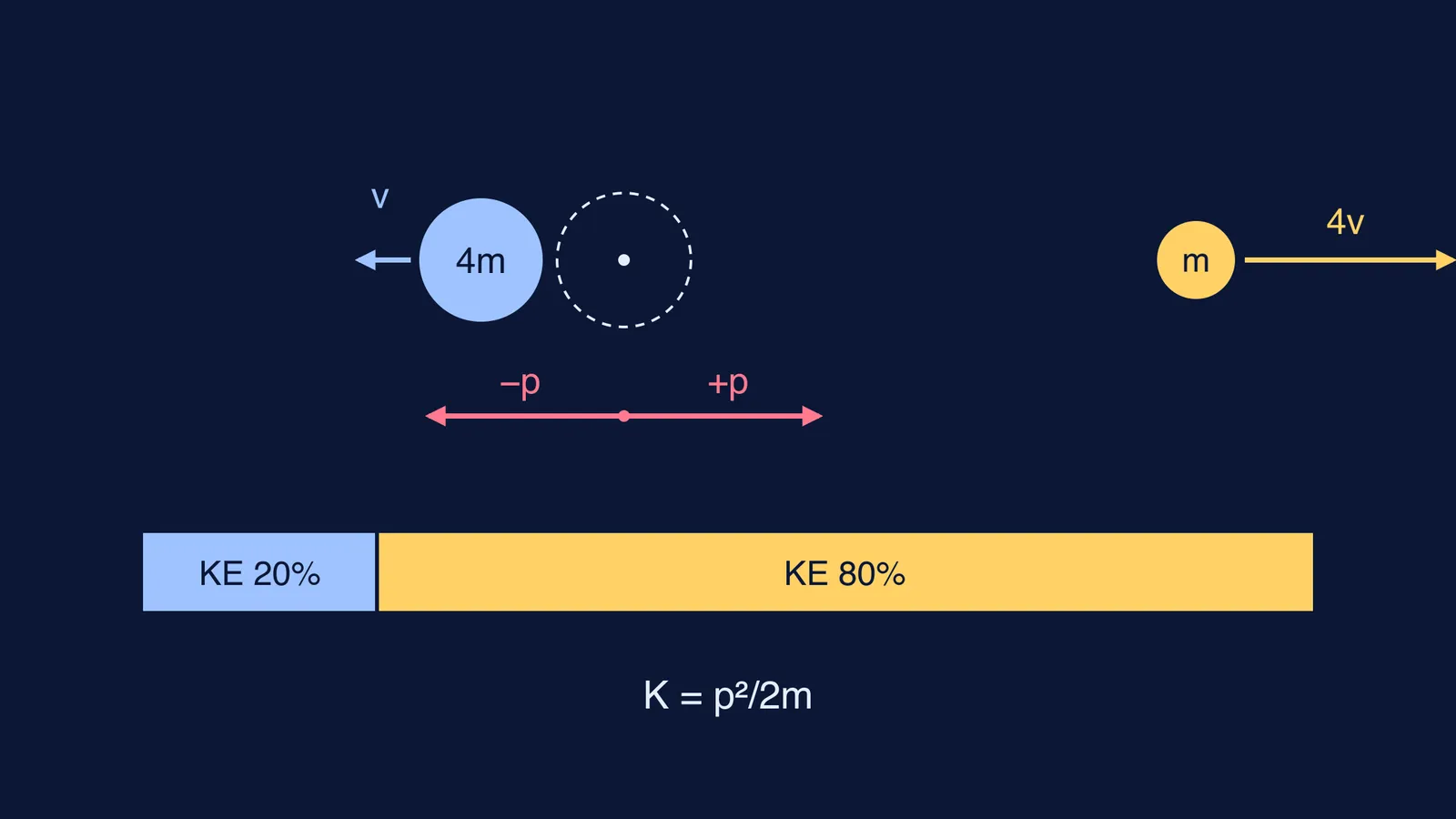
So if the body was at rest, its total momentum was zero, and it is still zero afterwards. For two fragments that means p₁ + p₂ = 0: the momenta are equal in size and opposite in direction. Momentum is mass times velocity (OpenStax, section 9.1), so m₁v₁ = m₂v₂ in size. A piece with a quarter of the mass moves four times as fast.
How is kinetic energy shared in an explosion of two fragments?
Kinetic energy is not conserved here. OpenStax's section on types of collisions notes that in an explosion the system's momentum is conserved but its kinetic energy increases. The extra energy comes from some form of stored potential energy, such as the chemical energy of burning gunpowder.
To see how that energy splits, write kinetic energy in terms of momentum. Since K = ½mv² and p = mv, substituting v = p/m gives K = p²/2m. Both fragments have the same p, so:
K₁ / K₂ = m₂ / m₁
K₁ = E × m₂ / (m₁ + m₂)
K₂ = E × m₁ / (m₁ + m₂)
Here E is the total kinetic energy released. Each fragment's share of the kinetic energy is inversely proportional to its own mass, so the lighter fragment always carries more.
Worked example: a 5 kg shell splits into 1 kg and 4 kg
A 5 kg shell at rest explodes into fragments of 1 kg and 4 kg. The explosion releases 40 J of kinetic energy. Find each fragment's speed and kinetic energy.
Momentum: the total is zero, so the two pieces fly apart in opposite directions with equal p.
Energy ratio: K(1 kg) / K(4 kg) = 4 / 1.
Shares: K(1 kg) = 40 × 4/5 = 32 J, and K(4 kg) = 40 × 1/5 = 8 J.
Speeds: from K = ½mv², the 1 kg piece moves at 8 m/s and the 4 kg piece at 2 m/s.
Check: the momenta are 1 × 8 = 8 kg m/s and 4 × 2 = 8 kg m/s, equal and opposite, and the energies add to 40 J.
The light piece has one fifth of the mass but takes four fifths of the energy. The usual slip is to put a fragment's own mass on top of its fraction, which swaps the two answers. If your answers keep coming out reversed, the Fermi Problem Library has worked problems with a step-by-step solver that explains the reasoning rather than printing an answer, so you can compare each step with your own.
Where does this show up outside the textbook?
Alpha decay is a two-body explosion at the scale of a nucleus. Lecture notes on alpha decay from the University of Southampton use exactly this momentum argument. The daughter nucleus must recoil to conserve momentum, and, taking the mass ratio as 4/A, the alpha particle's kinetic energy is A/(A+4) of the decay energy Q, where A is the daughter's mass number. In their example, polonium-214 decays to lead-210 with Q = 7.83 MeV, and the alpha particle gets 210/214 of it, about 7.68 MeV. The lead nucleus has roughly 52 times the alpha's mass, so it keeps only the remaining 0.15 MeV or so.
Gun recoil works the same way: bullet and gun get equal and opposite momentum, but the light bullet takes almost all the kinetic energy.
When does the inverse-mass shortcut fail?
Run these four checks before you write K₁/K₂ = m₂/m₁:
Was the body at rest? If it was moving, the ratio holds in the centre-of-mass frame, not the ground frame.
Are there exactly two fragments? With three, momentum conservation alone does not fix the split, so you need more data.
Is external impulse negligible? Gravity's impulse during the brief burst is tiny, so momentum is conserved across the explosion itself.
Were you given masses or speeds? With equal p, K = pv/2, so the energy ratio equals the speed ratio directly.
If momentum and kinetic energy still feel shaky, the Fermi Concept Library covers every concept in physics, each with its own lesson and its place in the map.


