On this page
Here is a short puzzle worth trying before you calculate anything. Two carts sit at rest on a smooth, level track. One has a mass of 0.5 kg, the other 2 kg. You push each with the same steady force of 1 N for exactly 2 seconds. Which cart ends up with more momentum? Which ends up with more kinetic energy?
Write your two answers down before you read on. That small step matters. In a study of physics lecture demonstrations, Catherine Crouch, Adam Fagen, J. Paul Callan and Eric Mazur found that students who only watched a demonstration understood the concept no better than students who did not see it at all, while students who predicted the outcome first showed significantly greater understanding (American Journal of Physics, 2004).
Which cart gets more momentum with the same force and time?
Neither. They get exactly the same.
Impulse is the force multiplied by the time it acts, J = F × Δt (OpenStax University Physics, section 9.2). The impulse-momentum theorem says the change in a system's momentum is exactly equal to the impulse applied, Δp = J (same source).
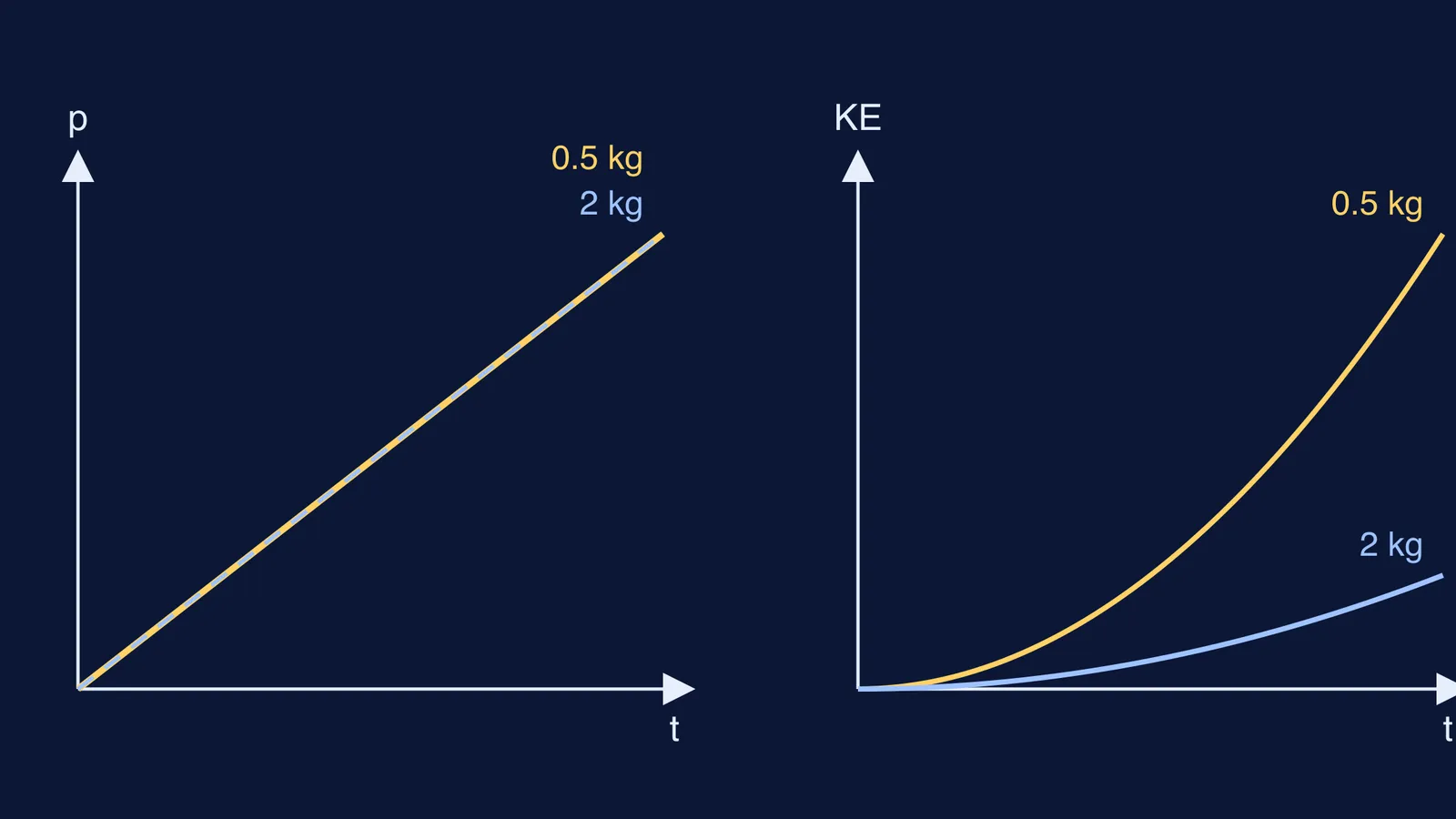
Mass does not appear anywhere in F × Δt. So 1 N for 2 s gives each cart an impulse of 2 N s, and each cart, starting from rest, ends with a momentum of 2 kg m/s. The heavy cart moves slowly and the light cart moves fast, but the product m × v comes out equal. If you want more practice with this step, see our worked examples on change in momentum from force and time.
Which cart gets more kinetic energy?
The light one, and by a lot.
Kinetic energy can be written in terms of momentum as K = p²/2m (OpenStax University Physics, section 7.2). When p is the same for both carts, kinetic energy is inversely proportional to mass, so a cart with a quarter of the mass ends with four times the kinetic energy.
Here is the worked example, checked step by step:
Speed from momentum: the light cart has v = p/m = 2/0.5 = 4 m/s; the heavy cart has v = 2/2 = 1 m/s.
Kinetic energy from ½mv²: the light cart has ½ × 0.5 × 4² = 4 J; the heavy cart has ½ × 2 × 1² = 1 J.
Kinetic energy from p²/2m: the light cart has 2²/(2 × 0.5) = 4 J; the heavy cart has 2²/(2 × 2) = 1 J.
Two routes, one answer. If the step from force and distance to ½mv² feels like magic, our derivation of kinetic energy from F s to ½mv² walks through it.
Why does the same push give different energy?
Because energy builds up with distance, not with time. The work-energy theorem states that the net work done on a particle equals the change in its kinetic energy (OpenStax University Physics, section 7.3). Work is the force times the distance moved along it.
The light cart accelerates faster, so in the same 2 seconds it covers more ground. Its acceleration is 1/0.5 = 2 m/s², so it travels ½ × 2 × 2² = 4 m. The heavy cart accelerates at 0.5 m/s² and travels only 1 m. Same force, four times the distance, four times the work: 4 J against 1 J. Those match the kinetic energies above, which is a good sign the reasoning holds together.
The two quantities really are different things, which is also why a system can carry energy with zero total momentum, as we explain in can a system have energy but zero momentum.
How do you use this question to study?
Turn it into a five-step routine you can run on any mechanics problem:
Predict. Write both answers and one sentence of reasoning before you calculate anything.
Choose the tool. Ask whether time or distance is fixed. Fixed time points to impulse and momentum. Fixed distance points to work and energy.
Calculate with small, round numbers, like 1 N, 2 s, 0.5 kg and 2 kg.
Check a second way. ½mv² and p²/2m must give the same energy.
Flip the question. Push both carts with the same force over the same distance instead. Now both get the same kinetic energy, and the heavy cart gets more momentum, because p = √(2mK).
Parents can use step 1 at the dinner table: ask the question, ask for a prediction and a reason, and only then ask for the numbers. Committing to an answer before seeing the result is exactly what the predicting students in the demonstration study did.
Some ideas are easier to see than to read. The Fermi Simulation Lab has interactive simulations for ideas like these. For more practice of this kind, the Fermi Problem Library has worked problems with a step-by-step solver that explains the reasoning rather than printing an answer.
Next time a question says "same force", look straight for the word that follows: time or distance.