

On this page
You don't have to memorise the kinetic energy formula. It follows from the definition of work and the third equation of motion. NCERT's new Class 9 science textbook, *Exploration*, derives it this way in Chapter 7, "Work, Energy, and Simple Machines" (NCERT, Chapter 7 PDF).
What do you need before you start the derivation?
You need four facts, all from the same NCERT chapter:
Work done by a constant force is W = F × s, where s is the displacement in the direction of the force (Eq. 7.2).
Newton's second law: F = ma.
The third equation of motion: v² = u² + 2as. It holds only when acceleration is constant, which is why the derivation assumes a constant force.
The work-energy theorem: work done on an object = change in its energy (Eq. 7.3).
If v² = u² + 2as still feels like magic, see how it comes from a velocity-time graph in our post on deriving the equations of motion graphically.
How do you derive KE = ½mv² step by step?
Take an object of mass m moving with initial velocity u. A constant force F acts on it along its motion, and after a displacement s its velocity is v.
Start from the equation of motion: v² = u² + 2as.
Make s the subject: s = (v² − u²) / 2a.
Write the work done: W = F × s.
Replace F using Newton's second law: W = ma × s.
Substitute s from step 2: W = ma × (v² − u²) / 2a.
Cancel a: W = ½m(v² − u²) = ½mv² − ½mu².
If the object starts from rest, u = 0, so W = ½mv². By the work-energy theorem, this work is stored as kinetic energy: K = ½mv².
These are equations 7.4, 7.5 and 7.6 in the NCERT chapter, which also gives the SI unit of kinetic energy as the joule (J) and says kinetic energy has no direction.
The acceleration cancels, so the answer depends only on mass and speed. OpenStax's *College Physics* reaches the same result, ½mv² − ½mv₀², from v² = v₀² + 2ad, and notes that kinetic energy and work share the joule as their unit (OpenStax College Physics 2e, section 7.2).
Does the formula check out with real numbers?
These two checks use made-up numbers, worked the same way as the examples in the NCERT chapter.
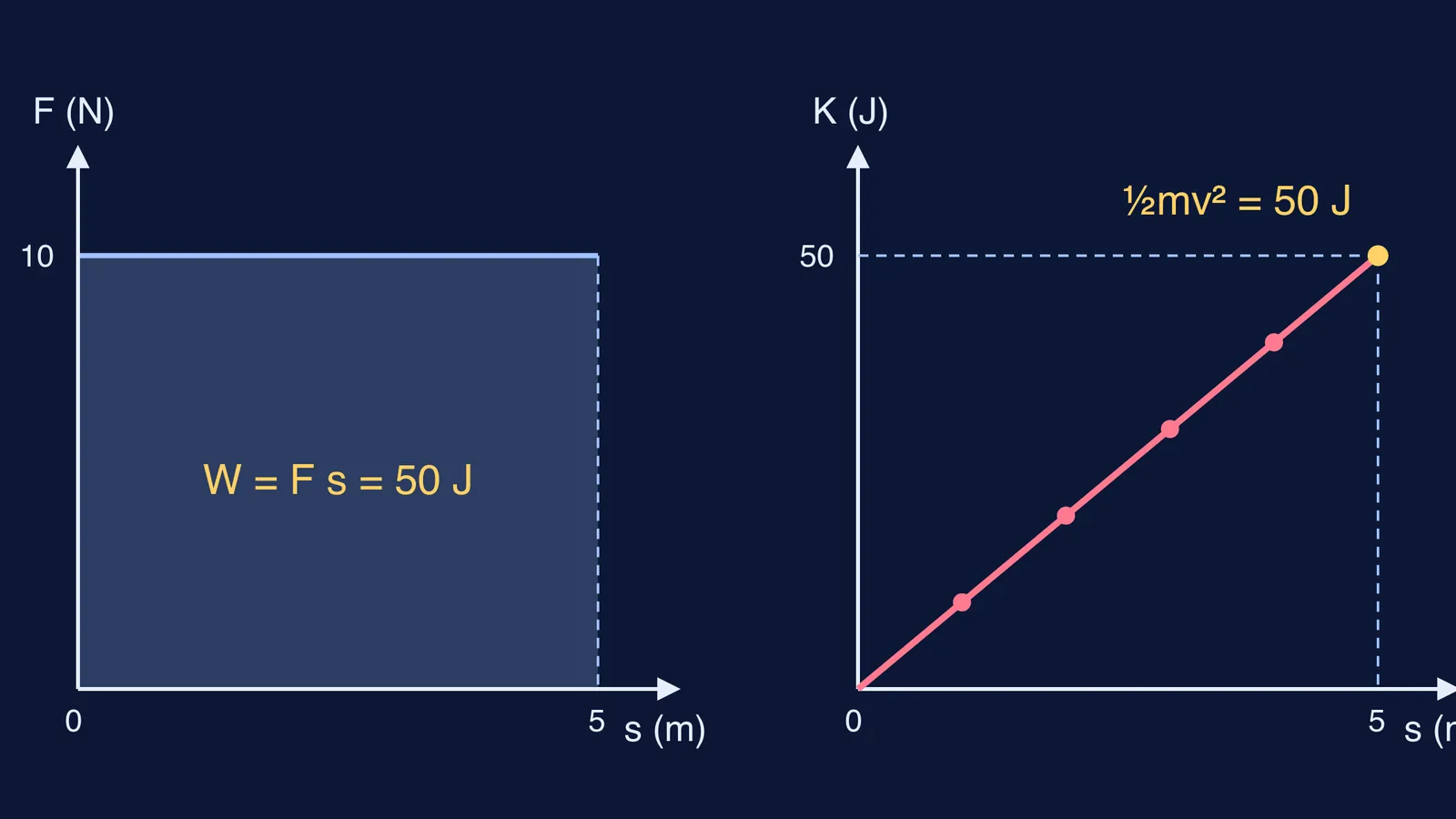
Check 1, starting from rest. A 2 kg trolley at rest is pushed with a steady 10 N force for 5 m on a smooth floor.
Acceleration: a = 10/2 = 5 m/s², so v² = 2 × 5 × 5 = 50 m²/s².
Work done: W = 10 × 5 = 50 J.
Kinetic energy: ½ × 2 × 50 = 50 J.
Check 2, already moving. A net force of 1000 N speeds a 1000 kg car up from 10 m/s to 20 m/s over 150 m.
Work done: W = 1000 × 150 = 150 000 J.
Change in kinetic energy: ½ × 1000 × (20² − 10²) = 150 000 J.
Doubling the speed took the kinetic energy from 50 000 J to 200 000 J, four times as much. NCERT makes the same point in Example 7.4, and Example 7.5 works out that a 0.2 kg cricket ball bowled at 154.8 km/h (43 m/s) carries about 184.9 J.
What mistakes cost marks in this derivation?
Starting with v = u + at. That drags time into the algebra; the v² equation has no t.
Not stating the assumption. Write "force is constant, so acceleration is constant" before using v² = u² + 2as.
Dropping ½mu². If the object is already moving, the work equals the change in kinetic energy, not the final value.
Giving kinetic energy a direction or a minus sign. It is a scalar, and v² is never negative. See why kinetic energy can't be negative.
Assuming every force does work. A force at right angles to the motion does none. Our list of cases where work done is zero covers the usual traps.
How should you write this derivation in an exam?
For a long-answer question, use five parts:
Draw a block with arrows marked F and s, and label u and v.
State the assumption: constant force, so constant acceleration.
Write W = F s and F = ma.
Substitute s = (v² − u²)/2a and circle the a that cancels.
Put u = 0, write K = ½mv², and give the unit as the joule.
If the substitution step keeps tripping you up, the Fermi Problem Library has worked problems with a step-by-step solver that explains the reasoning rather than printing an answer. If work as energy transfer is the shaky part, look it up in the Fermi Concept Library, where each concept has its own lesson.
Tonight, write the derivation from memory, then redo Check 1 with your own numbers until F s and ½mv² come out equal.


