

On this page
Deriving the three equations of motion graphically is a central milestone in Class 9 science. Rather than memorising formulas, you construct a geometric picture of straight-line motion under uniform acceleration. A velocity-time graph encodes two physical concepts at once: its slope represents acceleration, and the area bounded beneath the line represents displacement.
In a diagnostic study of 895 students published in the American Journal of Physics, Robert J. Beichner found that learners frequently confuse graph height with slope or struggle to interpret the area under a curve. Research across several hundred students by Lillian C. McDermott and colleagues in the American Journal of Physics similarly showed that connecting graphs to physical concepts requires step-by-step geometric reasoning. Understanding how slope and area work transforms textbook derivations into clear deductions. For graphical traps to avoid, see our guide to reading physics graphs.
Why do we use a velocity-time graph to derive the equations of motion?
Under the CBSE Secondary Science curriculum, students analyze motion where acceleration remains constant along a straight path.
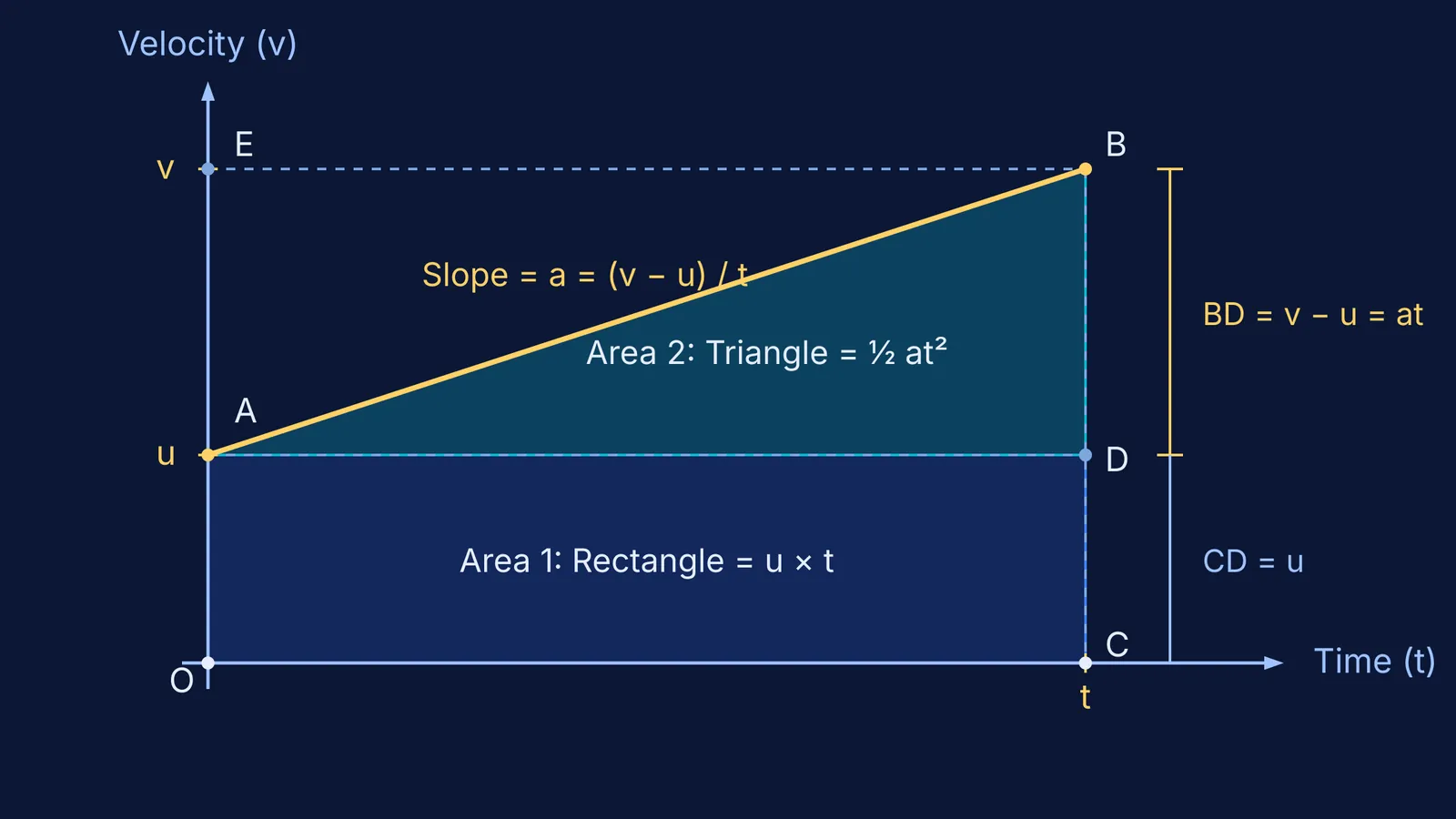
Time t runs horizontally along the x-axis, and velocity runs vertically along the y-axis.
At time t = 0, initial velocity is u at point A, so OA = u.
At time t (point C on the time axis, OC = t), velocity reaches v at point B.
Draw BC perpendicular to OC (so BC = v) and horizontal line AD parallel to OC, meeting BC at D.
Since OADC is a rectangle, opposite sides match: CD = OA = u and AD = OC = t.
The vertical rise BD represents the change in velocity: BD = BC − CD = v − u. This geometric setup provides the foundation for deriving all three equations.
How do you derive the first equation of motion, v = u + at?
The first equation describes the velocity-time relation. Acceleration equals the rate of change of velocity, represented by the slope of line AB:
Acceleration (a) = slope of line AB = BD / AD.
Substitute the graph segments:
a = (v − u) / t.
Multiplying both sides by t gives at = v − u. Rearranging terms yields the first equation of motion:
v = u + at.
This equation calculates the final velocity of an object after accelerating uniformly for time t.
How do you derive the second equation of motion, s = ut + ½at²?
The second equation gives the position-time relation. The displacement s covered during time t equals the total area enclosed under line AB above the time axis OC, forming trapezium OABC. Split this trapezium into rectangle OADC and triangle ABD:
Displacement (s) = Area of rectangle OADC + Area of triangle ABD.
Calculate each geometric area:
Area of rectangle OADC = base × height = OC × OA = t × u = ut.
Area of triangle ABD = ½ × base × height = ½ × AD × BD.
Since AD = t and BD = at (from the first derivation), the triangle's area is ½ × t × at = ½at².
Adding both regions gives the complete second equation of motion:
s = ut + ½at².
Total displacement equals the distance ut covered at initial speed plus the additional distance ½at² contributed by acceleration. For foundational ideas, see our guide to motion concepts and graphs in Class 9.
How do you derive the third equation of motion, v² = u² + 2as?
The third equation gives the position-velocity relation by eliminating time t. Calculate the area of trapezium OABC directly using the trapezium formula:
s = ½ × (sum of parallel sides) × perpendicular height = ½ × (OA + BC) × OC.
Substitute OA = u, BC = v, and OC = t:
s = (v + u)t / 2.
From the first equation, v = u + at, solve for time: t = (v − u) / a. Substitute this expression into the displacement formula:
s = ((v + u)(v − u)) / (2a).
Applying the algebraic identity (v + u)(v − u) = v² − u²:
s = (v² − u²) / (2a).
Multiplying both sides by 2a yields 2as = v² − u². Rearranging gives the third equation of motion:
v² = u² + 2as.
Which equation of motion should you choose for numerical problems?
Standard kinematics problems link five variables: u, v, a, s, and t, as summarized in OpenStax University Physics. To choose the right equation, identify which variable is missing:
If distance s is missing, use v = u + at.
If final velocity v is missing, use s = ut + ½at².
If time t is missing, use v² = u² + 2as.
Worked example: a scooter travelling along a straight road at 10 m/s accelerates uniformly at 2 m/s² for 6 s.
Identify givens: u = 10 m/s, a = 2 m/s², t = 6 s.
Find final velocity: v = u + at = 10 + (2 × 6) = 22 m/s.
Find displacement: s = ut + ½at² = (10 × 6) + ½ × 2 × (6)² = 60 + 36 = 96 m.
Check consistency: v² − u² = 22² − 10² = 384, and 2as = 2 × 2 × 96 = 384. Both sides match.
For further practice with signs and multi-stage journeys, see our guide to solving equations of motion problems.
When practising numericals, the Fermi Problem Library provides worked problems with a step-by-step solver that explains the reasoning rather than printing an answer. To explore how acceleration changes graph slopes and areas, the Fermi Simulation Lab offers interactive simulations for the ideas that are easier to see than to read. In the Fermi Concept Library, every concept in physics, chemistry, biology, mathematics and computing has its own lesson and its place in the map.


