

On this page
Release a compressed spring between two blocks and they fly apart, so the system clearly has energy. Where is its momentum? The short answer is that it has none, and that is fine. The longer answer explains something you will use in every collision and explosion problem.
Can a system have kinetic energy but zero momentum?
Yes. The difference comes down to vectors and scalars.
Momentum is mass times velocity, p = mv, and it is a vector quantity because velocity is (OpenStax University Physics, 9.1). The total momentum of a system is the vector sum of the momenta of its parts (OpenStax, 9.3). Two momenta of equal size pointing in opposite directions add up to zero.
Kinetic energy is K = ½mv², and it can never be negative, because mass and the square of speed are both positive or zero (OpenStax, 7.2). The same section says the kinetic energy of a system is the sum of the kinetic energies of its particles. Nothing cancels. Every moving part adds to the total.
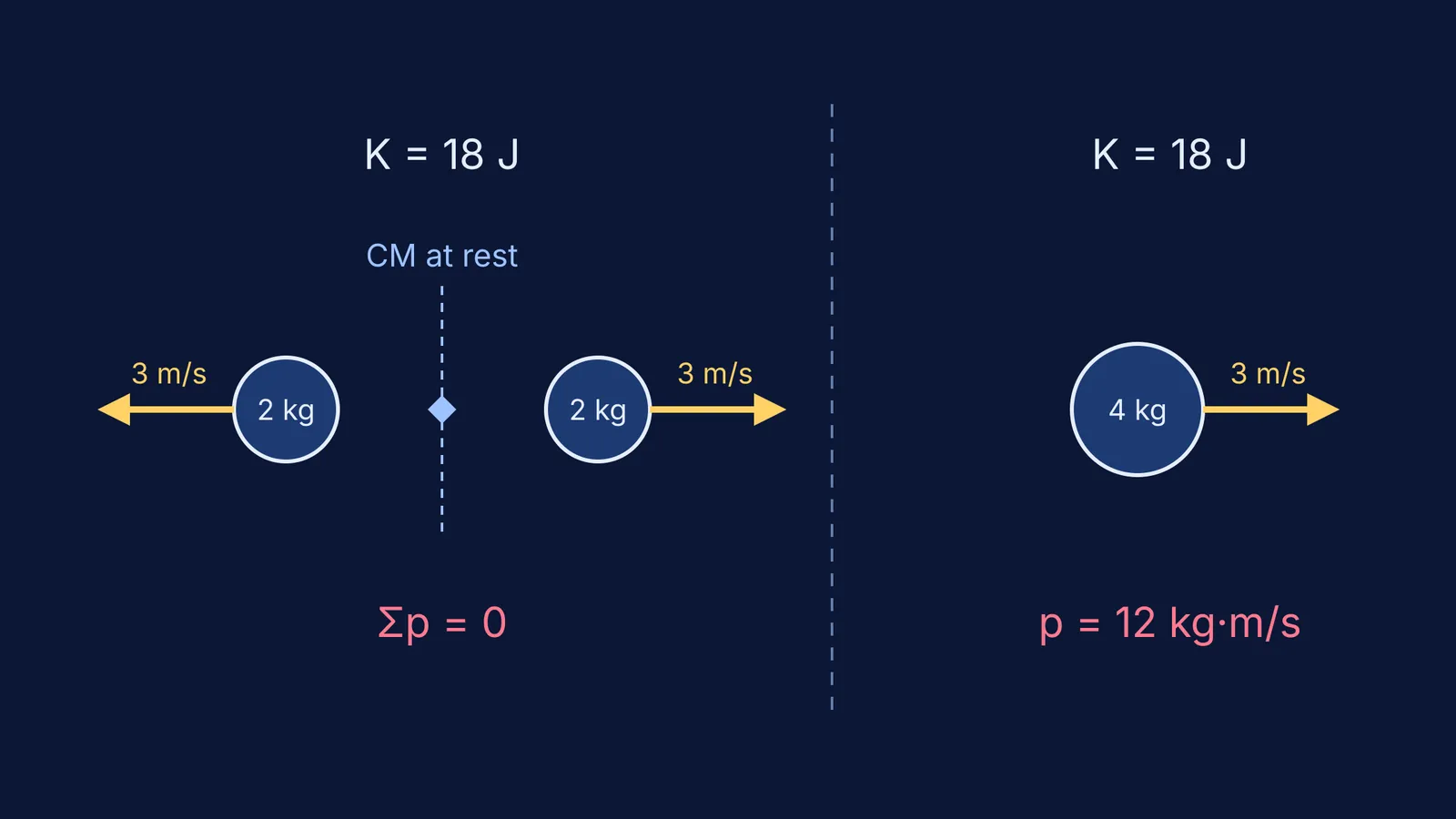
Take two 2 kg blocks pushed apart by a spring, each moving at 3 m/s in opposite directions:
Momentum: (2)(+3) + (2)(−3) = 0
Kinetic energy: ½(2)(3²) + ½(2)(3²) = 9 + 9 = 18 J
The system has 18 J of kinetic energy and zero total momentum, and its centre of mass stays where it was. This is also why, ignoring air resistance, a firework shell's centre of mass follows a parabola after it bursts: the internal forces cannot change the momentum of the centre of mass (OpenStax, 9.6). We look at that case in why the centre of mass velocity does not change in an explosion.
Why can't a single body have energy without momentum?
For a single particle, energy and momentum are locked together. Substitute v = p/m into ½mv² and you get K = p²/2m, which OpenStax gives as another expression for the kinetic energy of a single particle (OpenStax, 7.2).
Read that equation both ways:
If p = 0, then K = 0. A particle at rest has no kinetic energy.
If K > 0, then p² > 0, so p cannot be zero.
There is no partner to cancel against. Give the same 18 J to one 4 kg body and its momentum is √(2 × 4 × 18) = 12 kg·m/s, pointing wherever it moves.
The opposite case is impossible even for a system. It cannot have non-zero total momentum and zero kinetic energy, because zero kinetic energy means every particle is at rest, and particles at rest carry no momentum.
What about a spinning wheel?
This looks like an exception. A wheel spinning on a fixed axle has zero total linear momentum: for every bit of rim moving one way, the bit opposite moves the other way. Yet it has kinetic energy, K = ½Iω², because every point off the axle is moving even though the axle itself stays still (OpenStax, 10.4).
That does not break the rule. A rigid body is a system of particles, and the spinning wheel is the two-block example arranged in a circle. "Energy means momentum" holds for a point particle and for the motion of a body's centre of mass. It does not stop a body from storing energy in spin or vibration.
How do you use this in JEE problems?
Split a system's kinetic energy into two parts: the energy of its centre of mass, P²/2M, plus the energy of motion relative to the centre of mass, which is never negative. That gives a check you can run on any collision, explosion or spring problem:
Find the total momentum P and the total mass M.
The kinetic energy can never be less than P²/2M. That minimum is reached when everything moves together, as in a perfectly inelastic collision.
If P = 0, as in an explosion from rest, the minimum is zero and all the kinetic energy is internal. Every joule came from inside the system: a spring, a chemical charge, a nucleus.
If your answer gives a kinetic energy below P²/2M, look for a sign or algebra mistake.
Worked check: a 1 kg ball at 4 m/s sticks to a resting 1 kg ball. P = 4 kg·m/s and M = 2 kg, so the final kinetic energy is P²/2M = 16/4 = 4 J, down from 8 J. Half the energy goes into heat and deformation, while momentum is fully conserved.
For more practice, see how a man throwing a ball on ice recoils and why kinetic energy depends on the frame you measure it in. In the centre-of-mass frame, total momentum is always zero, but kinetic energy usually is not.
If you keep mixing up which quantity cancels and which adds, the Fermi Concept Library has a lesson on each concept and shows where it sits in the map. When you want to test yourself, the Fermi Problem Library has worked problems with a step-by-step solver that explains the reasoning rather than printing an answer.


