

On this page
When you stand on a completely frictionless surface, you cannot walk or run. Your feet have nothing to push against. If you try to step forward, your foot simply slips backwards, and your centre of mass remains exactly where it was. However, if you are holding a heavy object and throw it, you will suddenly start moving in the opposite direction.
This happens because of a fundamental rule in physics. According to OpenStax *College Physics*, in an isolated system where the net external force is zero, the total momentum remains constant.
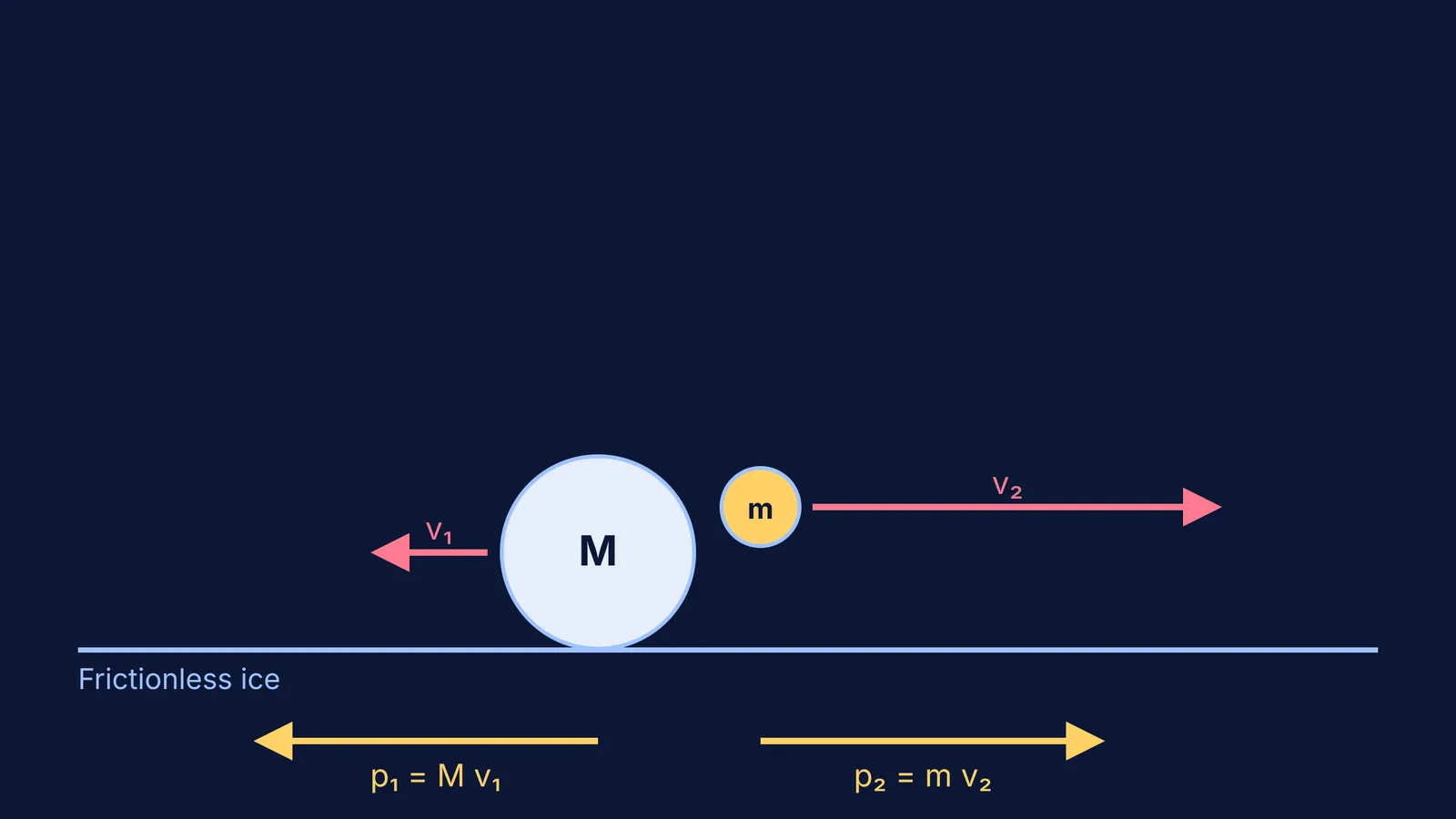
Before you throw the ball, both you and the ball are perfectly still, so the total momentum is zero. When you throw the ball forward, it gains forward momentum. To keep the total momentum of the system at zero, your body must gain an equal amount of backward momentum. This backward movement is called recoil. It is the same effect that pushes a cannon backwards when it fires a heavy shell.
This is the exact same principle that applies in space, where there is no friction or air resistance to push against (see Can a stranded astronaut throw an object to move back to a spaceship?). Without an external force like friction, tossing something away is one of the only ways to move your centre of mass.
How to calculate the man on ice throws ball recoil speed?
To find the recoil speed, you only need to know the mass of the person, the mass of the ball, and the speed at which the ball is thrown. The internal forces generated by your muscles do not change the total momentum of the system.
Because total momentum is conserved, you can write: Initial Momentum = Final Momentum 0 = (mass of man × velocity of man) + (mass of ball × velocity of ball)
If we call the man's mass M and the ball's mass m, the formula becomes: 0 = M × V + m × v
Solving for the man's velocity (V) gives: V = − (m × v) / M
You will notice that the recoil speed is inversely proportional to your mass. The heavier you are compared to the ball, the slower you will move backwards.
If you are unsure whether a specific mechanics question requires this method or a different approach, you can explore the Fermi Problem Library, which has worked problems with a step-by-step solver that explains the reasoning rather than printing an answer. You can also read our guide on Should I Use Energy or Momentum Conservation in Collision Problems?.
Where does the kinetic energy come from?
A common question is how the system gains kinetic energy if it started with none. Before the throw, the total kinetic energy is zero. After the throw, both the ball and the man are moving, so both have kinetic energy.
Because kinetic energy is a scalar quantity—meaning it does not have a direction, unlike momentum—the kinetic energies of the man and the ball do not cancel each other out. Instead, they add up. The total kinetic energy of the system has increased.
This extra energy comes from the work done by your muscles. The chemical energy stored in your body is converted into the kinetic energy of the ball and your own kinetic energy of recoil. The momentum is strictly conserved because there are no external forces acting horizontally, but the kinetic energy is not conserved because an internal source of energy was released.
How far does the person slide afterwards?
Real ice is rarely perfectly frictionless. Once the man recoils, he will likely slide onto a rough patch where friction begins to slow him down.
The distance he slides depends entirely on his recoil speed and the roughness of the surface. According to OpenStax *College Physics*, the coefficient of kinetic friction for shoes on ice is 0.05.
Friction applies a constant stopping force in the direction opposite to his motion. By Newton's second law, this creates a constant deceleration given by a = −μg, where μ is the coefficient of kinetic friction and g is the acceleration due to gravity (9.8 m/s²).
We can then use the standard kinematic equation (v² = u² + 2as) to find out exactly where he stops. Because the deceleration is constant, the distance he slides is proportional to the square of his initial recoil speed. If he had thrown the ball twice as fast, his recoil speed would be twice as fast, and he would slide four times as far.
How do you calculate the sliding distance in a worked example?
Let's put numbers to the theory. Imagine a 75 kg man standing on frictionless ice. He throws a 5 kg medicine ball forward at a speed of 15 m/s. He then recoils backwards and slides onto a rough patch of ice. How far does he slide?
Find the recoil speed: Using the momentum formula, 0 = (75 kg × V) + (5 kg × 15 m/s). This gives 75V = −75, so V = −1 m/s. The man recoils backwards at a speed of 1 m/s.
Find the deceleration: The deceleration is caused by kinetic friction. Using the OpenStax coefficient of 0.05 and a = −μg, we get a = −0.05 × 9.8 m/s², which is −0.49 m/s².
Calculate the distance: Use the kinematic equation v² = u² + 2as, where the final velocity (v) is 0, and the initial velocity (u) is 1 m/s. We get 0 = (1)² + 2 × (−0.49) × s. This simplifies to 0.98s = 1, giving s = 1.02 metres.
The man will slide backwards for 1.02 metres before coming to a complete stop. By breaking the problem down into two distinct phases—first the throw using conservation of momentum, and then the slide using kinematics and friction—you can solve any similar exam question.


