

On this page
One of the most common hurdles in physics is deciding whether a problem calls for conservation of momentum or conservation of energy. A 2003 study in the American Journal of Physics found that most students have difficulty interpreting basic principles of energy and momentum and applying them in physical situations (10.1119/1.1571832).
If you find yourself stuck on a mixed problem, the key is knowing what happens during the exact moment of impact.
Why is momentum conserved in every collision?
Whenever two objects collide, the force the first exerts on the second is equal and opposite to the force it receives back. Because these internal forces cancel each other out over the exact same time interval, the total momentum of the system cannot change.
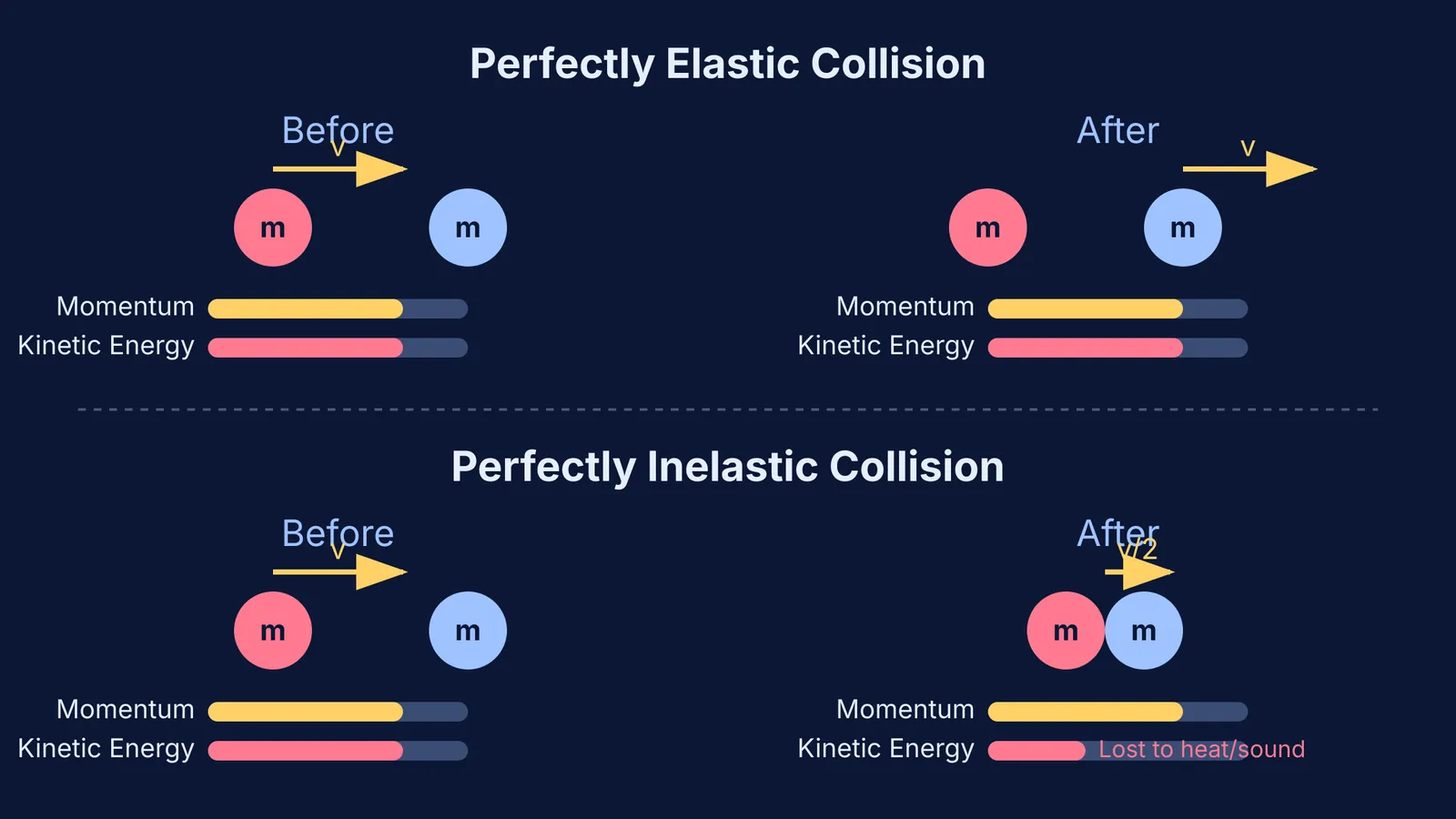
This means you can always rely on conservation of momentum for the brief moment of a collision. It holds true as long as there are no massive external forces (like a wall or friction) interfering during that split second. It does not matter whether the objects bounce off cleanly, stick together, or explode into pieces.
When is kinetic energy conserved in collisions?
Unlike momentum, which is a vector that points in a specific direction, kinetic energy is a scalar quantity of motion. During a collision, objects compress and deform.
In a perfectly elastic collision (like idealized billiard balls or gas molecules), the objects spring back to their original shapes perfectly. This returns all the stored energy back into kinetic energy, meaning the total kinetic energy is conserved.
In an inelastic collision (like a car crash or two lumps of clay sticking together), the objects are permanently deformed and generate heat or sound. That energy has to come from the initial motion, so the total kinetic energy of the system drops.
How do you solve a ballistic pendulum problem?
A classic example of needing both conservation laws is the ballistic pendulum. In this setup, a fast-moving bullet embeds itself into a heavy wooden block hanging from a string, and the block swings upward.
The problem must be split into two distinct stages. In the first stage, the bullet hits the block. This is a perfectly inelastic collision. Because it happens so quickly, the string has no time to swing, so gravity and tension do not interfere. You must use conservation of momentum to find the speed of the block and bullet just after they stick together. The kinetic energy is not conserved here; a significant fraction is lost to heat and deforming the wood.
In the second stage, the combined block and bullet swing upward to a maximum height. There is no longer any collision happening, but gravity is now doing work. Since the tension in the string is always perpendicular to the motion, it does no work. Here, you use conservation of mechanical energy. The kinetic energy the block had just after the collision converts entirely into gravitational potential energy at the peak of the swing.
Attempting to apply energy conservation across the entire event from the initial bullet to the peak swing will give the wrong answer, because it ignores the energy lost during the impact itself.
Should I use energy or momentum conservation in collision problems?
Many exam problems string a collision together with another event, like a pendulum swinging or a block sliding down a ramp. If you are stuck on these multi-step setups, Fermi's AI tutor can work out what you already know and build a plan for the session to help you map out the stages. Here is a checklist for breaking them down:
Before or after the collision: As a block slides down a ramp or swings on a string, gravity and tension are at work. Use conservation of mechanical energy here.
The exact moment of collision: Use conservation of momentum to find the speeds just after impact. Do not assume kinetic energy is conserved unless the problem explicitly states the collision is elastic.
If objects stick together: This is a perfectly inelastic collision. Momentum is conserved, but a large portion of the kinetic energy is lost to heat.
Check your boundaries: Is it an isolated system? If a ball hits a wall fixed to the Earth, the system's momentum is technically conserved if you include the Earth, but practically, the ball's momentum reverses and is not conserved on its own.
If you are unsure where to start, try the Fermi Problem Library. It contains worked problems with a step-by-step solver that explains the reasoning rather than just printing an answer. For more practice, review collisions and momentum problems or the kinetic energy and momentum relation.


