

On this page
Why does throwing a tool move a stranded astronaut?
In orbital space, air resistance is absent and gravity acts equally on a spacewalker and their equipment. When a tether snaps, the astronaut and their tools form an isolated physical system.
Under Newton's third law of motion, formulated in the NCERT Class 11 Physics textbook, forces between interacting bodies always occur in equal and opposite pairs. Flinging a tool pushes the object forward, while the tool exerts an identical force accelerating the astronaut in reverse.
Because no net external force acts along the axis of the throw, total linear momentum remains conserved: Δp_total = 0. Starting from rest relative to the spacecraft, initial momentum is zero. Releasing the tool with forward momentum p_t = m_t × v_t forces the astronaut to take on recoil momentum p_a = -m_t × v_t:
v_a = -(m_t / m_a) × v_t
This same conservation law governs the recoil of a hydrogen atom emitting a photon and momentum conservation in midair explosions. Internal forces redistribute momentum without needing an external wall to push against.
How does recoil speed depend on the tool's mass and velocity?
The recoil velocity equation shows that the astronaut's speed scales directly with tool mass (m_t) and throw velocity (v_t), but inversely with the astronaut's mass (m_a).
In real spaceflight, an astronaut's inertia is substantial. An operational suit adds roughly 145 kg of structural and life-support hardware, bringing working mass to approximately 220 kg, as documented in the Extravehicular Mobility Unit overview.
If an astronaut with a working mass of 220 kg throws a 2 kg wrench at 10 m/s away from the spacecraft, their backward recoil velocity is:
v_a = -(2 kg / 220 kg) × 10 m/s ≈ -0.091 m/s
At roughly 9.1 cm/s, covering 20 m takes about 219 seconds (over 3.5 minutes). Throwing a lighter 0.5 kg screwdriver at 10 m/s reduces recoil speed to 2.3 cm/s, stretching transit time to nearly 15 minutes.
Kinetic energy highlights another constraint. Because K = p² / (2m), equal momentum magnitudes mean kinetic energy splits by inverse mass ratio: K_a / K_t = m_t / m_a. With a mass ratio exceeding 100 to 1, the tool carries away over 99% of the mechanical energy, an imbalance identical to recoil energy sharing in nuclear alpha decay.
What happens if the astronaut throws at an angle or off-centre?
Linear momentum is a vector quantity. As detailed in OpenStax University Physics Volume 1, momentum conservation applies independently along every Cartesian axis:
m_a × v_ax = -m_t × v_tx m_a × v_ay = -m_t × v_ty
Pitching an object at an angle θ relative to the direct return line resolves velocity into two components:
Direct return velocity: v_ax = -(m_t / m_a) × v_t × cos θ
Transverse sideways velocity: v_ay = -(m_t / m_a) × v_t × sin θ
The transverse component pushes the astronaut sideways, risking missing the docking rails entirely.
Throwing off-centre introduces another hazard: rotation. If the force line misses the astronaut's centre of mass, the resulting torque τ = r × F induces a tumbling spin. In actual missions, this hazard is why NASA equips astronauts with the SAFER backpack, carrying 1.4 kg of compressed nitrogen propellant providing up to 3.05 m/s of velocity correction with automatic stabilization, as noted in the Simplified Aid for EVA Rescue specifications.
Worked example: can an astronaut return from 10 metres away?
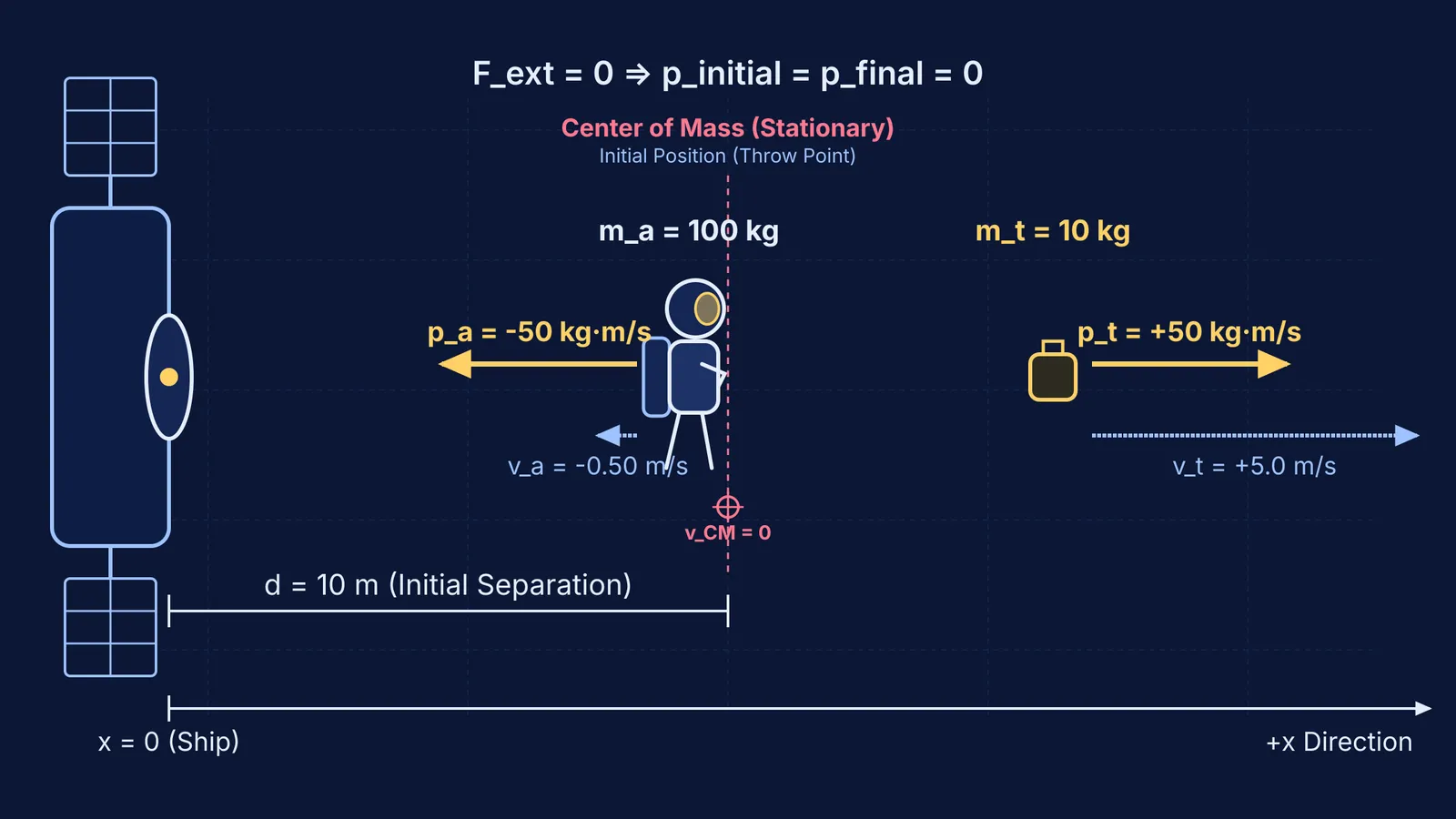
A standard mechanics problem from OpenStax University Physics Volume 1 Additional Problems (Problem 97) tests this scenario with initial drift:
A 100 kg astronaut is separated from a spacecraft by 10 m and drifting away at 0.1 m/s. The astronaut throws a 10 kg tool bag directly away from the spacecraft at 5.0 m/s relative to the ship. How long does the return take?
Initial momentum:
Taking direction away from the ship as positive (+x): p_i = (m_a + m_b) × v_i = (100 kg + 10 kg) × (+0.1 m/s) = +11 kg·m/s
Momentum conservation:
With the tool bag moving away at v_b = +5.0 m/s relative to the ship: p_f = (100 kg) × v_a + (10 kg) × (+5.0 m/s) = 100 × v_a + 50 kg·m/s Equating p_i = p_f: +11 = 100 × v_a + 50 ⇒ v_a = -0.39 m/s (toward the spacecraft)
Return time:
Time = distance / |v_a| = 10 m / 0.39 m/s ≈ 25.6 seconds.
Had the throw speed been 5.0 m/s relative to the astronaut instead, return speed would be 0.355 m/s. The Fermi Problem Library has worked problems with a step-by-step solver that explains the reasoning rather than printing an answer, helping students navigate these subtle relative-velocity conditions.
How to solve momentum recoil problems in exams?
To solve recoil numericals in competitive physics exams:
Define the isolated system: group interacting bodies together so internal reaction forces cancel out and net external force equals zero.
Select an inertial frame: verify whether ejection velocities are measured relative to the spacecraft or the recoiling body.
Resolve into components: balance momentum along x and y axes before computing transit times.
Account for mass changes: total initial mass includes the projectile, while recoil applies only to the remaining body.
Seeing how internal impulses transfer momentum between bodies is intuitive in the Fermi Simulation Lab, which features interactive simulations for the ideas that are easier to see than to read. To connect linear momentum with centre-of-mass theorems and rotational dynamics across your syllabus, the Fermi Concept Library covers every concept in physics, chemistry, biology, mathematics and computing, each with its own lesson and its place in the map.


