

On this page
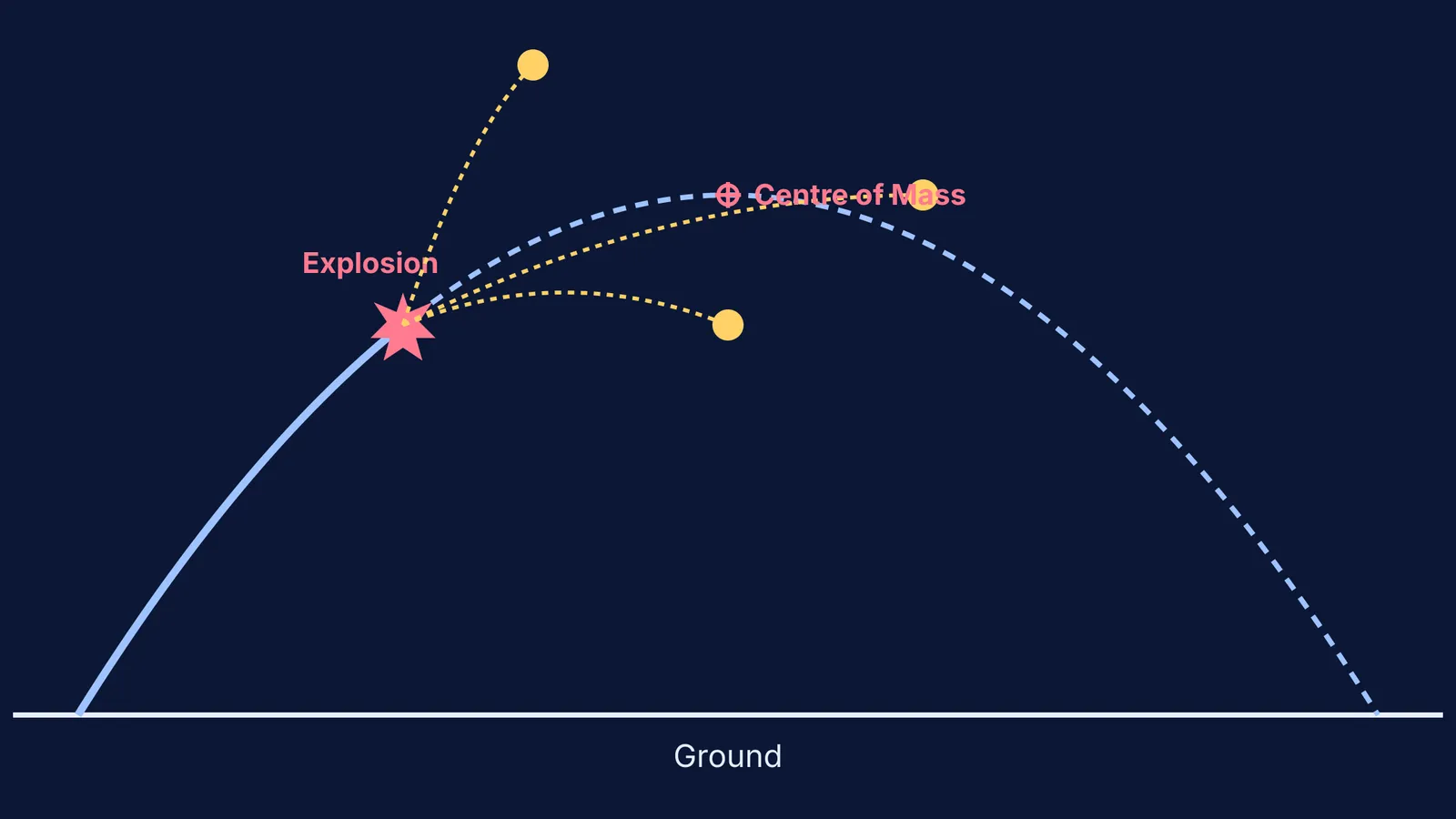
If you watch a firework explode in mid-air, you see fragments flying in every direction. It looks chaotic, as if the path of the original rocket has been completely erased. Yet, physics tells us a different story: the centre of mass of all those glowing fragments continues to follow the exact same parabolic arc it would have taken if the shell had never exploded.
This happens because the explosion is driven entirely by internal forces. But why is the centre of mass velocity unchanged by internal forces? According to OpenStax University Physics, internal forces act in equal and opposite pairs that sum to zero, meaning they cannot change the system's total momentum. Therefore, the centre of mass moves exactly as if all the external forces acted on a single point containing all the mass.
Here is a look at the principles behind this rule and how to use it when solving mechanics problems.
Why is the centre of mass velocity unchanged in internal forces?
The motion of any system's centre of mass is governed by Newton's second law, which states that the net external force equals the total mass multiplied by the acceleration of the centre of mass.
Internal forces are the pushes and pulls that the parts of a system exert on each other. According to Newton's third law, every action has an equal and opposite reaction. If expanding gases push a shell fragment to the left, there is a simultaneous force pushing another part of the system to the right. When you add up all the forces across the entire system, these internal pairs cancel each other out completely.
Because the sum of all internal forces is always zero, they produce no net acceleration on the system as a whole. Without net acceleration from inside, the total momentum remains conserved unless an outside force intervenes. Consequently, the velocity of the centre of mass cannot be changed by anything happening within the system itself.
What happens to the centre of mass when a shell explodes in mid-air?
A classic application of this concept is an object breaking apart during flight, such as an exploding projectile.
Before the explosion, the shell is in free fall. The only external force acting on it is gravity, which pulls it down and creates a predictable parabolic trajectory.
During the explosion, the chemical energy converts into kinetic energy, blowing the object apart. These explosive forces are entirely internal. While they cause individual fragments to fly off at high speeds in different directions, they do not affect the total momentum of the system.
After the explosion, gravity continues to pull down on each piece. Because the internal forces cancelled out to zero, the centre of mass of the combined fragments continues to trace the exact same parabolic path it would have taken if the shell had remained intact. To see the maths behind this, read our guide on a shell exploding midair: momentum, fragments and energy. The pieces spread out, but their average position still falls exactly where the dud shell would have landed.
How to calculate the velocity of the centre of mass?
The total momentum of a system is the sum of the momentums of all its individual particles. The velocity of the centre of mass (v_cm) is simply the total momentum divided by the total mass (M):
v_cm = (m₁v₁ + m₂v₂ + ... + mₙvₙ) / M
In any collision or explosion where no external forces act in a given direction (like horizontally in projectile motion), this velocity remains constant. You can use this constant velocity to find where missing pieces of an exploded object must have landed.
A framework for solving explosion and collision problems
When you are faced with a complex mechanics problem where an object breaks apart or two objects collide, the centre of mass is your best shortcut. To see this in action, review these centre of mass problems: finding it and using it to simplify motion. The method involves a set framework:
Check for external forces: Identify all forces acting on the system from the outside. If there are no external forces in a certain direction, the momentum in that direction is conserved.
Use conservation of momentum: Because internal forces cancel, set the total initial momentum equal to the total final momentum.
Track the centre of mass: If asked where a fragment lands, calculate where the centre of mass must be at that time. Then, use the positions and masses of the known fragments to solve for the missing one.
If you struggle to set up these equations, the Fermi Problem Library has worked problems with a step-by-step solver that explains the reasoning rather than printing an answer. You can also review how to handle situations where thrust is involved by studying variable mass systems: rocket thrust and conveyor belt problems.


