

On this page
In short
Kinetic energy is not the same in all reference frames because an object's velocity depends on the observer. However, the work-energy theorem (W = ΔK) is Galilean invariant, meaning the rule holds true in every non-accelerating frame. While the individual values for work and kinetic energy change depending on where you stand, their relationship stays perfectly balanced.
It is a classic trap in introductory physics. You calculate the kinetic energy of an object, switch your coordinate system to a moving train, and suddenly the energy is completely different. Did the energy disappear? Did you break the laws of physics?
The answer lies in how we define work and energy across different frames of reference. While kinetic energy and work are both frame-dependent, the fundamental rule connecting them—the work-energy theorem—survives the jump between inertial frames.
Is kinetic energy the same in all frames?
No. Kinetic energy is a measure of an object's motion, calculated as K = 1/2 mv². Because velocity (v) is a relative quantity, your kinetic energy changes depending on who is looking at you. This is why you must explicitly state the reference frame before declaring an object's energy.
If you are sitting on a train moving at a constant speed, your velocity relative to the seat is zero. In the train's reference frame, your kinetic energy is zero. But to an observer standing on the station platform, you are moving at the speed of the train, giving you a substantial amount of kinetic energy. Both observers are correct.
The train paradox: where does the extra energy come from?
To see how this works, consider a classic textbook scenario: throwing a ball on a moving train.
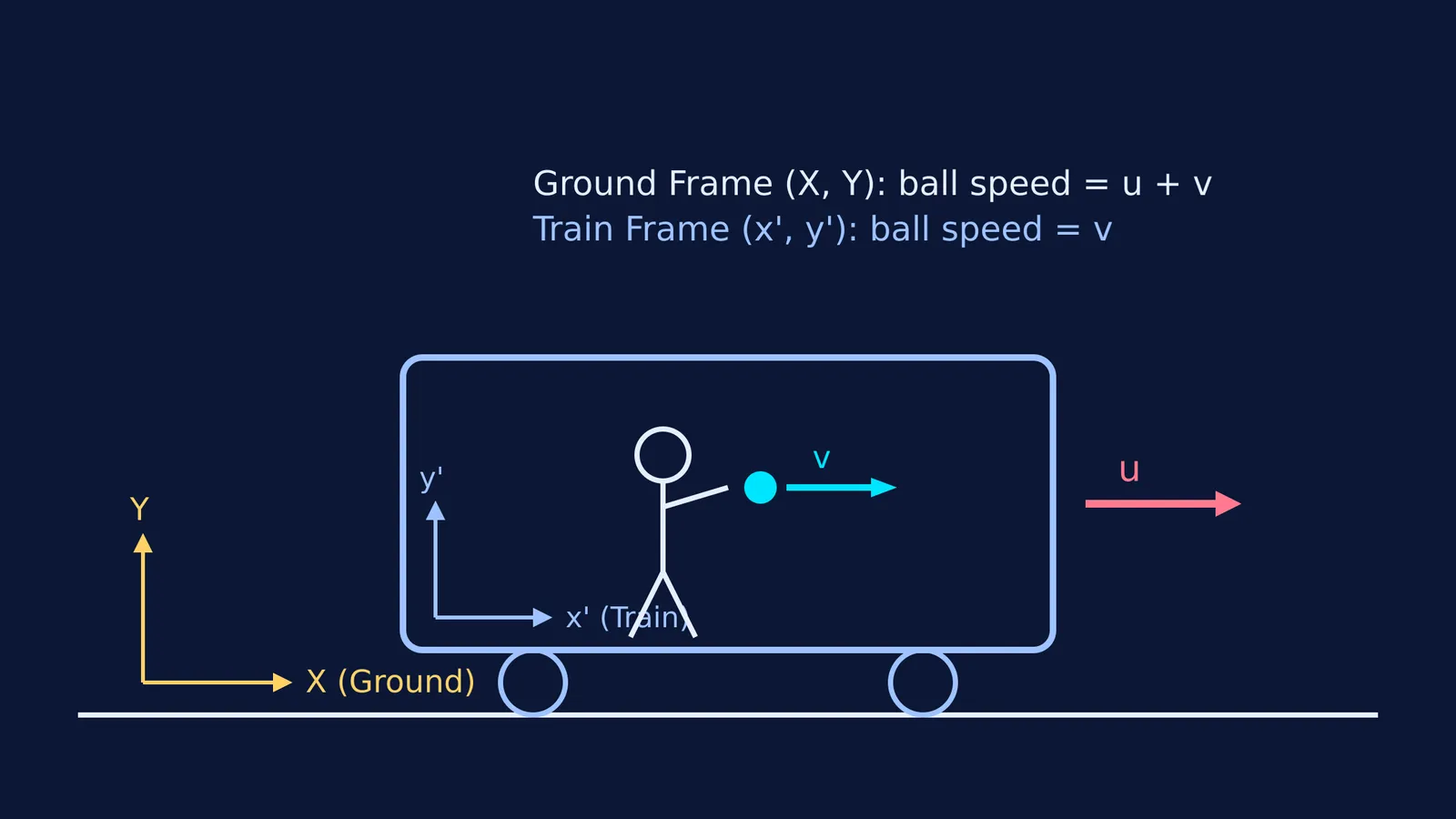
Suppose a passenger throws a ball of mass m forward inside a train moving at a constant velocity u relative to the ground.
In the train frame: The ball starts at rest (v_i = 0) and is thrown to a final speed v (v_f = v).
In the ground frame: The ball starts at the speed of the train (v_i = u) and is thrown to a faster speed (v_f = u + v).
Let's look at the change in kinetic energy (ΔK) in both frames. In the train frame, the calculation is straightforward: ΔK_train = 1/2 mv² − 0 = 1/2 mv²
In the ground frame, the math looks different: ΔK_ground = 1/2 m(u + v)² − 1/2 mu²
If you expand the bracket, you get: ΔK_ground = 1/2 m(u² + 2uv + v²) − 1/2 mu² = 1/2 mv² + muv
The change in kinetic energy in the ground frame is larger by an amount muv. This larger change in kinetic energy is what trips up many students. It looks like a contradiction. If the person throwing the ball exerted the same effort and applied the exact same physical force, how did the ball gain so much more energy in the ground frame? The answer is that the person actually did more work in the ground frame, even if their muscles felt the same effort.
Why does the work-energy theorem survive?
The missing piece of the puzzle is the work done by the person throwing the ball. Work is defined as force multiplied by displacement (W = F × d).
According to Newton's second law, acceleration is the same in all inertial frames, so the force (F) exerted on the ball is invariant. However, displacement is not.
In the train frame, the passenger's hand moves a short distance d while pushing the ball. The work done is W_train = F × d.
In the ground frame, the train is moving forward while the passenger is pushing the ball. The total displacement of the hand relative to the ground is the distance it moved in the train (d), plus the distance the train travelled during the throw (u × t). The work done in the ground frame is: W_ground = F(d + ut) = Fd + Fut
Because F × t is the impulse that equals the change in momentum (mv), we can substitute Ft = mv into the equation: W_ground = W_train + muv
The extra work done in the ground frame exactly matches the extra kinetic energy gained in the ground frame. The energy doesn't come from nowhere; the train itself provides the extra work as it carries the passenger forward during the throw. In both coordinate systems, W = ΔK. The relationship is completely preserved.
How to check your reference frames
When solving mechanics problems for exams like JEE Main or NEET-UG, jumping between frames is a powerful shortcut—but only if you follow the rules.
Pick one frame and stick to it: Do not mix the velocity from the ground frame with the displacement from the train frame.
Remember the invariants: Force, mass, time, and acceleration do not change between non-accelerating (inertial) frames.
Recalculate the variants: Always translate velocity, displacement, and kinetic energy into your chosen frame before calculating.
Treat the system as a whole: If you include the recoil of the train and the person in a completely isolated system, the total energy change becomes invariant.
If you are unsure how to set up the coordinate system, the Fermi Concept Library explains every concept in physics, chemistry, biology, mathematics and computing. When you are ready to test your understanding, the Fermi Problem Library has a step-by-step solver that explains the reasoning rather than printing an answer.
For more practice on related topics, see our guides on Will two projectiles collide midair? The relative motion test and Work to assemble point charges: the pairwise kq₁q₂/r sum.


