On this page
Once you can read a wave equation and sketch the nodes in a string or a pipe, many waves questions become short calculations. Here is what the syllabus covers, six worked numericals and a one-week plan.
What does the JEE Main 2027 syllabus include in waves?
The official Syllabus for JEE (Main) - 2027, linked from the NTA JEE Main website, places waves in Unit 10, Oscillations and Waves. It lists wave motion, longitudinal and transverse waves, speed of the travelling wave, the displacement relation for a progressive wave, superposition, reflection, standing waves in strings and organ pipes, fundamental mode and harmonics, and beats.
Each of these is in NCERT Class 11 Physics Chapter 14, Waves (Reprint 2026-27), sections 14.1 to 14.7. Speed of sound, with Newton's formula and the Laplace correction, sits inside 14.4; standing waves in strings and air columns sit inside 14.6.
For SHM, the unit's other half, see how to prepare oscillations for JEE Main.
Which formulas do you need for waves in JEE Main?
From the NCERT chapter above:
Progressive wave: y(x,t) = a sin(kx − ωt + φ), with k = 2π/λ, ω = 2πf and v = ω/k = fλ.
Stretched string: v = √(T/μ), μ being mass per unit length.
Sound in a gas: Newton's isothermal v = √(P/ρ); Laplace's adiabatic correction v = √(γP/ρ).
String fixed at both ends, or pipe open at both ends: fₙ = nv/2L, n = 1, 2, 3...
Pipe closed at one end: fₙ = nv/4L, odd n only.
Beat frequency: |f₁ − f₂|.
How do you solve wave numericals step by step?
These use our own numbers.
1. Reading a wave equation. y = 0.004 sin(5πx + 800πt), SI units. k = 5π rad/m, so λ = 2π/k = 0.4 m. ω = 800π rad/s, so f = 400 Hz. v = ω/k = 160 m/s, and fλ = 400 × 0.4 = 160 m/s agrees. The x and t terms have the same sign, so the wave travels in the −x direction.
2. Wave speed on a string. T = 100 N, μ = 2.5 g/m = 0.0025 kg/m. v = √(100/0.0025) = √40,000 = 200 m/s. The usual slip is leaving μ in g/m. See also why thicker strings make lower notes.
3. Harmonics on that string. Fix 0.8 m of it at both ends: f₁ = v/2L = 200/1.6 = 125 Hz, then 250 Hz and 375 Hz.
4. Newton versus Laplace. Air with P = 1.0 × 10⁵ Pa, ρ = 1.2 kg/m³, γ = 1.4. Newton: √(10⁵/1.2) ≈ 289 m/s. Laplace: √(1.4 × 10⁵/1.2) ≈ 342 m/s. The ratio is always √γ. Gas mixtures need one more step: speed of sound in a gas mixture.
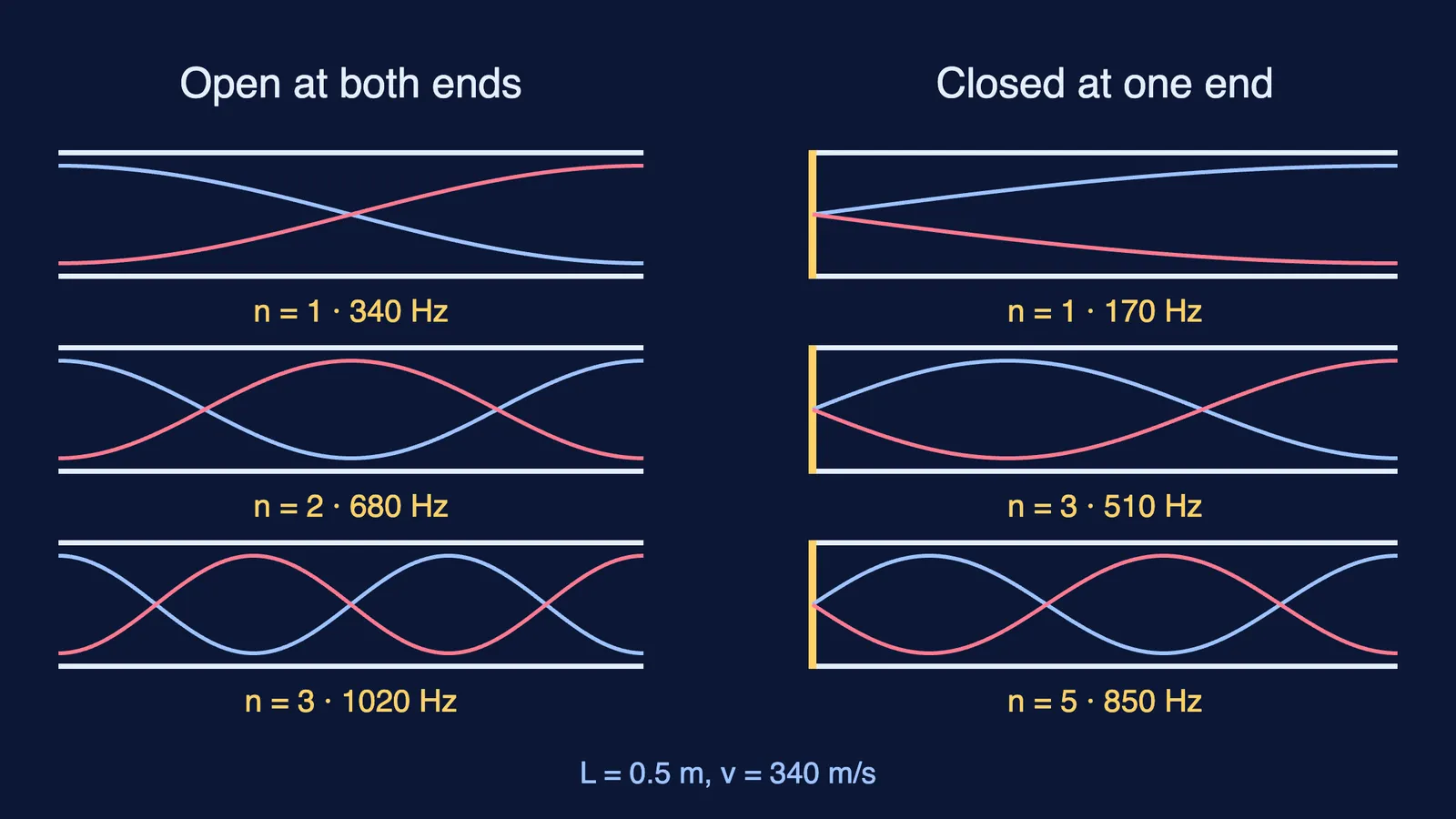
5. Open and closed pipes. A 0.5 m pipe, v = 340 m/s. Open at both ends: f₁ = 340/(2 × 0.5) = 340 Hz, then 680 Hz and 1020 Hz. Closed at one end: f₁ = 340/(4 × 0.5) = 170 Hz, then 510 Hz and 850 Hz. The closed end is a node and the open end an antinode, so the pipe holds a quarter wavelength plus whole half wavelengths. Only odd harmonics fit.
6. Beats. A 256 Hz tuning fork and a string give 4 beats per second. Tightening the string slightly drops this to 2. The string was 252 Hz or 260 Hz; tightening raises its frequency, and only 252 Hz moves closer to 256 Hz. So it was 252 Hz.
If you keep picking the wrong method, the Fermi Problem Library has worked problems with a step-by-step solver that explains the reasoning rather than printing an answer.
What are the common traps?
Judging direction from one sign instead of comparing the signs of kx and ωt.
Writing v = f/k instead of ω/k.
Counting even harmonics in a closed pipe.
Spacing adjacent nodes λ apart instead of λ/2.
Ignoring the loading or tightening clue in beats questions.
How should you plan a week for waves?
Day 1: NCERT 14.1 to 14.3. Read k, ω, v and direction from five equations of your own.
Day 2: Section 14.4. Do the string speed and the Newton-Laplace calculation without notes.
Day 3: Sections 14.5 and 14.6. Sketch the first three modes of a string, an open pipe and a closed pipe from memory.
Day 4: Harmonics numericals mixing all three systems.
Day 5: Section 14.7 and beats questions with a loading or tightening clue.
Day 6: Timed previous-year waves questions.
Day 7: Redo every wrong answer and name its trap.
If a standing wave still feels abstract, the Fermi Simulation Lab has interactive simulations for the ideas that are easier to see than to read.