On this page
Periodicity looks easy: the main trends fit on one slide. Marks slip away on the exceptions. Here is each trend, its exception, the reason in one line, and a one-week plan.
What does the JEE Main syllabus cover in periodicity?
The NTA's Syllabus for JEE (Main) - 2027 lists Unit 9, Classification of Elements and Periodicity in Properties: the modern periodic law, the s, p, d and f blocks, and trends in atomic and ionic radii, ionisation enthalpy, electron gain enthalpy, valence, oxidation states and chemical reactivity. Electronegativity appears in the same document under Unit 3, Chemical Bonding.
The matching textbook is NCERT Class 11 Chemistry Unit 3; its 2026-27 reprint supplies the tables below. Unsure about blocks? Read how to find period, group and block from atomic number.
How do atomic and ionic radii change?
Across a period, radius shrinks: nuclear charge grows while electrons join the same shell. NCERT's table in Unit 3 puts lithium at 152 pm and fluorine at 64 pm, and sodium at 186 pm and chlorine at 99 pm. Down a group, each step adds a shell: lithium 152 pm, caesium 262 pm.
A cation is smaller than its atom (Na 186 pm, Na⁺ 95 pm) and an anion larger (F 64 pm, F⁻ 136 pm), per the same NCERT unit.
Worked example. Rank O²⁻, F⁻, Na⁺ and Mg²⁺ by size. All have 10 electrons; nuclear charge rises 8, 9, 11, 12 and pulls the same cloud tighter, so O²⁻ > F⁻ > Na⁺ > Mg²⁺.
Why is boron's ionisation enthalpy lower than beryllium's?
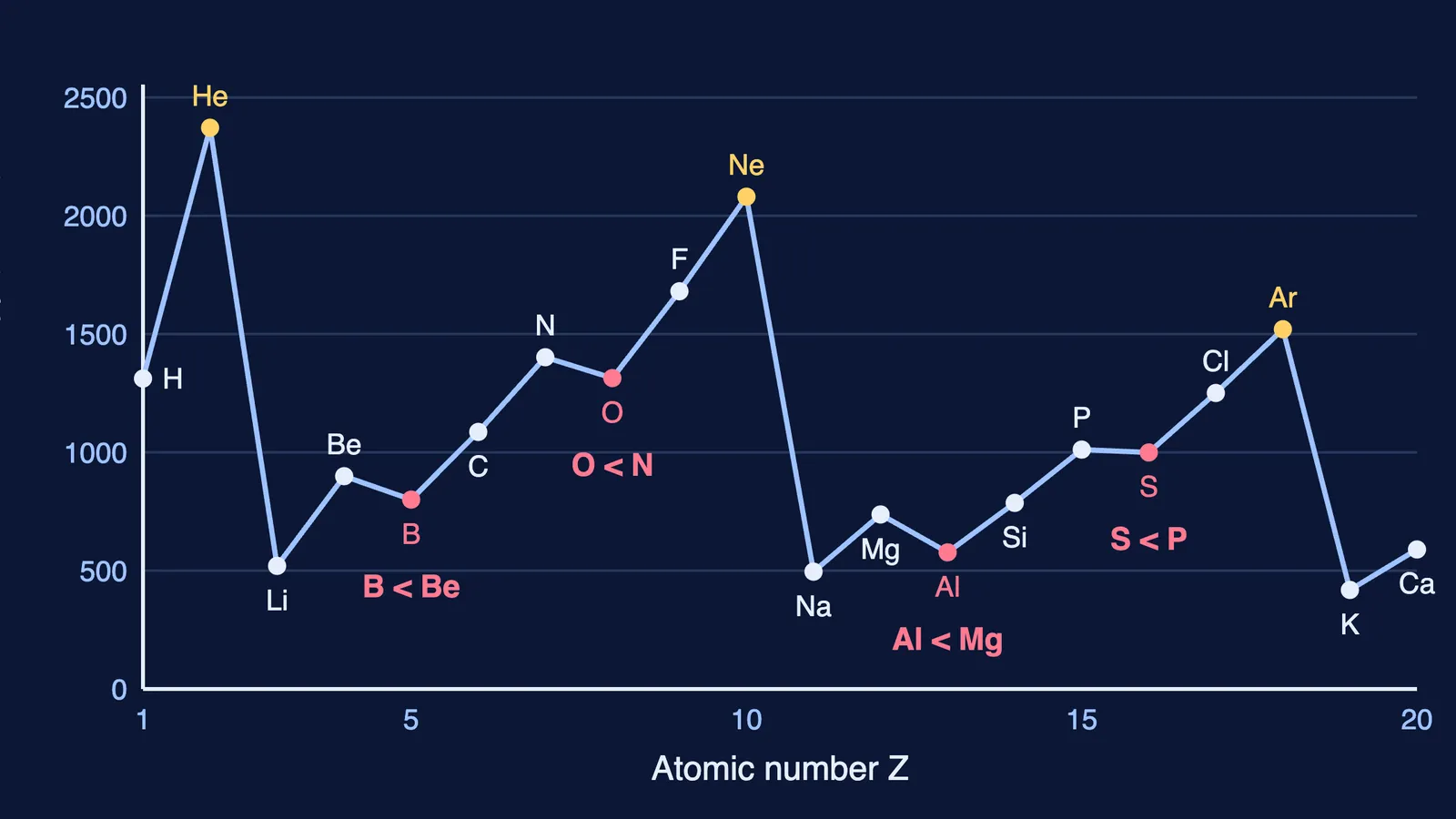
Ionisation enthalpy rises across a period and falls down a group, with two dips per period. Using NIST atomic ionisation energies converted to kJ/mol, beryllium needs 900 and boron 801; nitrogen needs 1402 and oxygen 1314.
B < Be: boron loses a 2p electron, which penetrates less and is more shielded than beryllium's 2s electron.
O < N: nitrogen's three 2p electrons sit in separate orbitals; oxygen's fourth shares an orbital, and that repulsion makes it easier to remove.
Both dips repeat in period 3: magnesium 738 and aluminium 578, phosphorus 1012 and sulphur 1000. If Hund's rule feels shaky, revise Structure of Atom for JEE Main first.
Worked example. Order Li, Be, B, C, N, O by first ionisation enthalpy. From the NIST values: Li 520 < B 801 < Be 900 < C 1086 < O 1314 < N 1402.
Why is chlorine's electron gain enthalpy more negative than fluorine's?
Electron gain enthalpy usually becomes more negative across a period and less negative down a group. NCERT's Table 3.7 breaks that at the top: fluorine is -328 kJ/mol but chlorine is -349; oxygen is -141 but sulphur is -200. The added electron enters the compact n = 2 shell of F or O and meets strong repulsion; the n = 3 shell of Cl or S has more room.
Noble gases are positive in the same table (neon +116 kJ/mol): the added electron must start a new shell. Nitrogen is not in NCERT's table; with its half-filled 2p subshell, it has little tendency to take an extra electron.
Worked example. Rank O, S, F, Cl from most to least negative: Cl (-349) > F (-328) > S (-200) > O (-141).
How do electronegativity and metallic character connect?
Electronegativity is an atom's pull on shared electrons in a bond; NCERT notes it is not measurable and varies with the bonding partner. On the Pauling values in Unit 3, fluorine is 4.0, chlorine 3.0, lithium 1.0 and caesium 0.7. It rises across a period and falls down a group. You will reuse it for bond polarity in chemical bonding for JEE Main.
Metallic character runs the other way, growing down a group and fading across a period: K > Na > Mg > Al.
NCERT Unit 3 only names diagonal relationships in passing and leaves them to later units. The pairs to know are lithium with magnesium and beryllium with aluminium.
What is a good practice plan for periodic trends?
Day 1: read NCERT Unit 3 and copy its radius, electron gain enthalpy and electronegativity tables by hand.
Day 2: sketch first ionisation enthalpy for Z = 1 to 20 from memory and mark the four dips.
Day 3: write each exception and its reason, without notes.
Days 4 and 5: solve mixed ranking questions on radii, isoelectronic ions and both enthalpies; log every miss by type.
Day 6: electronegativity, metallic character, oxidation states from group number, and the diagonal pairs.
Day 7: a timed mixed set; rewrite only the reasons you missed.
If a reason keeps slipping, the Fermi Concept Library covers every concept in physics, chemistry, biology, mathematics and computing, each with its own lesson and its place in the map. For a ranking you got wrong, the Fermi Problem Library has worked problems with a step-by-step solver that explains the reasoning rather than printing an answer.