On this page
Dual Nature of Matter and Radiation is Unit 17 of Physics in the official NTA "Syllabus for JEE (Main) - 2027", linked as "Syllabus" from jeemain.nta.nic.in. Learn five question types well and you have the chapter.
What does the JEE Main 2027 syllabus include for Dual Nature?
The NTA syllabus PDF lists for Unit 17:
dual nature of radiation
the photoelectric effect, with Hertz and Lenard's observations
Einstein's photoelectric equation and the particle nature of light
matter waves and the de Broglie relation
It maps to Chapter 11, "Dual Nature of Radiation and Matter", in the NCERT Class 12 Physics Part II chapter (Reprint 2026-27), Sections 11.2 to 11.8.
That NCERT chapter has no Davisson-Germer section, and the NTA unit does not name the experiment. Our Davisson-Germer explainer with the 54 V maths gives the story; your practice time belongs to the de Broglie relation itself.
Which formulas do you need?
Photon energy: E = hν = hc/λ, so E (in eV) = 1240 / λ (in nm).
Threshold: φ₀ = hν₀, so λ₀ = 1240/φ₀ (nm, with φ₀ in eV).
Einstein's equation: K_max = hν − φ₀ = eV₀, where V₀ is the stopping potential.
de Broglie: λ = h/p. For an electron accelerated from rest through V volts, λ = h/√(2meV) ≈ 1.227/√V nm.
The 1240 eV nm is Planck's constant, 4.135667696... × 10⁻¹⁵ eV s according to NIST, times the speed of light; the product is 1239.8, which rounds to 1240.
How do you solve the main photoelectric numericals?
Light of wavelength 400 nm falls on a metal with work function 2.30 eV.
Photon energy: E = 1240/400 = 3.10 eV.
Threshold: λ₀ = 1240/2.30 = 539 nm. So 600 nm light (2.07 eV) ejects nothing, however bright.
Maximum kinetic energy: K_max = 3.10 − 2.30 = 0.80 eV.
Stopping potential: V₀ = 0.80 V. K_max in eV and V₀ in volts are the same number; do not multiply by e again.
Say this light gives a saturation current of 4.0 µA. Triple the intensity at the same wavelength: the saturation current becomes 12 µA, and V₀ stays 0.80 V. This is the experimental summary in NCERT Section 11.4: more intense light gives a proportionally larger saturation current, but the same stopping potential. Our post on why brighter light doesn't give faster photoelectrons explains why.
How do you read the stopping potential vs frequency graph?
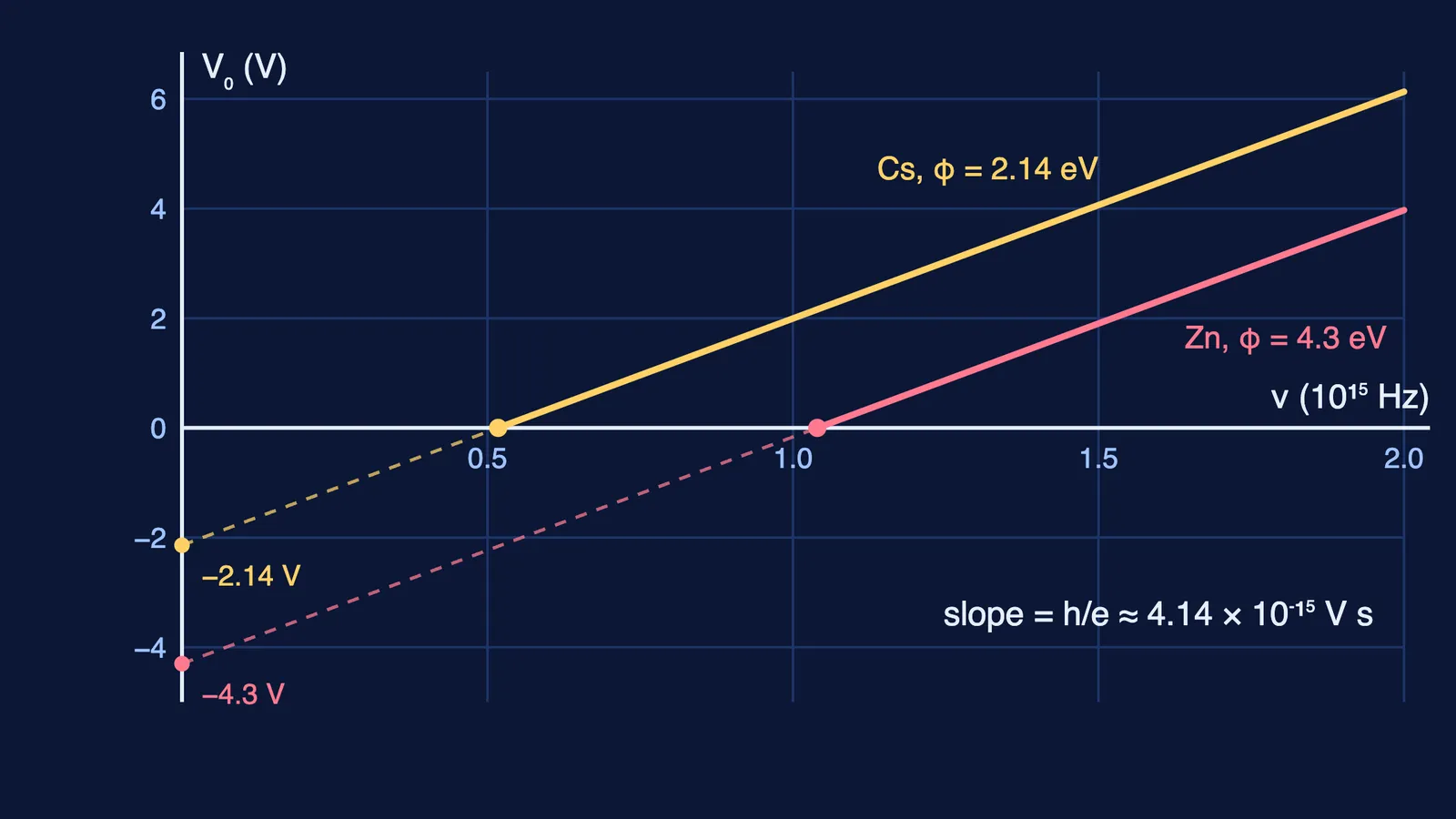
Rearranged, Einstein's equation reads V₀ = (h/e)ν − φ₀/e. Every metal gives a straight line of slope h/e ≈ 4.14 × 10⁻¹⁵ V s (NIST h in eV s). It crosses the frequency axis at ν₀ and, extended back, meets the V₀ axis at −φ₀/e.
The graph above plots caesium, 2.14 eV in NCERT Example 11.2, and zinc, 4.3 eV in the HyperPhysics work function table. The lines are parallel because h/e is the same for every metal.
Worked example: a student measures V₀ = 0.40 V at 6.0 × 10¹⁴ Hz and 2.06 V at 1.0 × 10¹⁵ Hz.
Slope = (2.06 − 0.40) / (4.0 × 10¹⁴) = 4.15 × 10⁻¹⁵ V s.
h = slope × e = 4.15 × 10⁻¹⁵ × 1.6 × 10⁻¹⁹ ≈ 6.64 × 10⁻³⁴ J s.
φ₀/e = 4.15 × 10⁻¹⁵ × 6.0 × 10¹⁴ − 0.40 = 2.09 V, so φ₀ = 2.09 eV.
ν₀ = 2.09 / (4.15 × 10⁻¹⁵) ≈ 5.0 × 10¹⁴ Hz.
Check: 4.15 − 2.09 = 2.06 V at the second point.
For more, see how to find work function and Planck's constant from two wavelengths.
How do you get the de Broglie wavelength of an electron?
Accelerated through 150 V: λ = 1.227/√150 = 1.227/12.25 ≈ 0.100 nm. Through 600 V: λ = 1.227/24.49 ≈ 0.050 nm. Four times the voltage halves the wavelength, because λ ∝ 1/√V.
The 1.227 shortcut is for electrons only. For a proton or alpha particle, use λ = h/√(2mqV) with that particle's mass and charge.
What are the common traps, and what is a 7-day plan?
Mixing nm and Å, or using λ in metres with 1240.
Saying brighter light raises V₀. It raises the current only.
Reading the V₀ intercept as +φ₀/e instead of −φ₀/e.
Forgetting that below threshold the current is zero at any intensity.
The week:
Day 1: read NCERT Sections 11.1 to 11.5; list every observation in your own words.
Day 2: ten photon-energy and threshold questions.
Day 3: ten K_max and stopping-potential questions.
Day 4: draw the V₀-ν and current-voltage graphs from memory; solve five graph questions.
Day 5: de Broglie wavelengths for electrons, protons and alpha particles.
Day 6: a timed mixed set from past JEE Main papers.
Day 7: redo every wrong answer and name the trap behind it.
If your method keeps going wrong, the Fermi Problem Library has a step-by-step solver that explains the reasoning. When a picture would help more than a paragraph, the Fermi Simulation Lab has interactive simulations for the ideas that are easier to see than to read.