On this page
Board and entrance papers often ask some version of this question: the light falling on a metal is made twice as bright, so what happens to the fastest electrons? The answer is "nothing", and once you see why, a whole family of photoelectric questions becomes easy. This post explains the photon picture in plain words, then puts real numbers on a doubled-intensity beam.
What does intensity actually mean for light?
In the photon picture, light intensity corresponds to the number of photons arriving at the metal surface per unit time, as the OpenStax University Physics chapter on the photoelectric effect/University_Physics_III_-_Optics_and_Modern_Physics_(OpenStax)/06%3A_Photons_and_Matter_Waves/6.03%3A_Photoelectric_Effect) puts it. The energy of each photon is a separate thing: it is E = hf, set by the frequency alone.
This idea comes from Albert Einstein's 1905 paper in Annalen der Physik, whose German title is usually translated as "On a heuristic point of view concerning the production and transformation of light". Brighter light of one colour is more photons of the same size, not bigger photons.
Why doesn't maximum kinetic energy depend on intensity?
The key step is that each photon gives all of its energy to only one electron, an "all or nothing" transfer, as the OpenStax chapter/University_Physics_III_-_Optics_and_Modern_Physics_(OpenStax)/06%3A_Photons_and_Matter_Waves/6.03%3A_Photoelectric_Effect) explains. An electron cannot collect energy from two photons and come out faster.
So an electron near the surface receives hf, spends at least the work function φ to escape, and keeps the rest. That gives Einstein's equation, K_max = hf − φ. Intensity appears nowhere in it.
The wave picture predicted the opposite: brighter light should shake electrons harder and give them more kinetic energy. Experiment shows the maximum kinetic energy is independent of intensity, which is one of the reasons wave theory cannot explain the photoelectric effect. Philipp Lenard's experiments showed this pattern, a story told in why brighter light doesn't make faster electrons.
Robert Millikan later tested the equation carefully; his 1916 paper in Physical Review was titled A direct photoelectric determination of Planck's h.
What happens when you double the intensity? A worked example
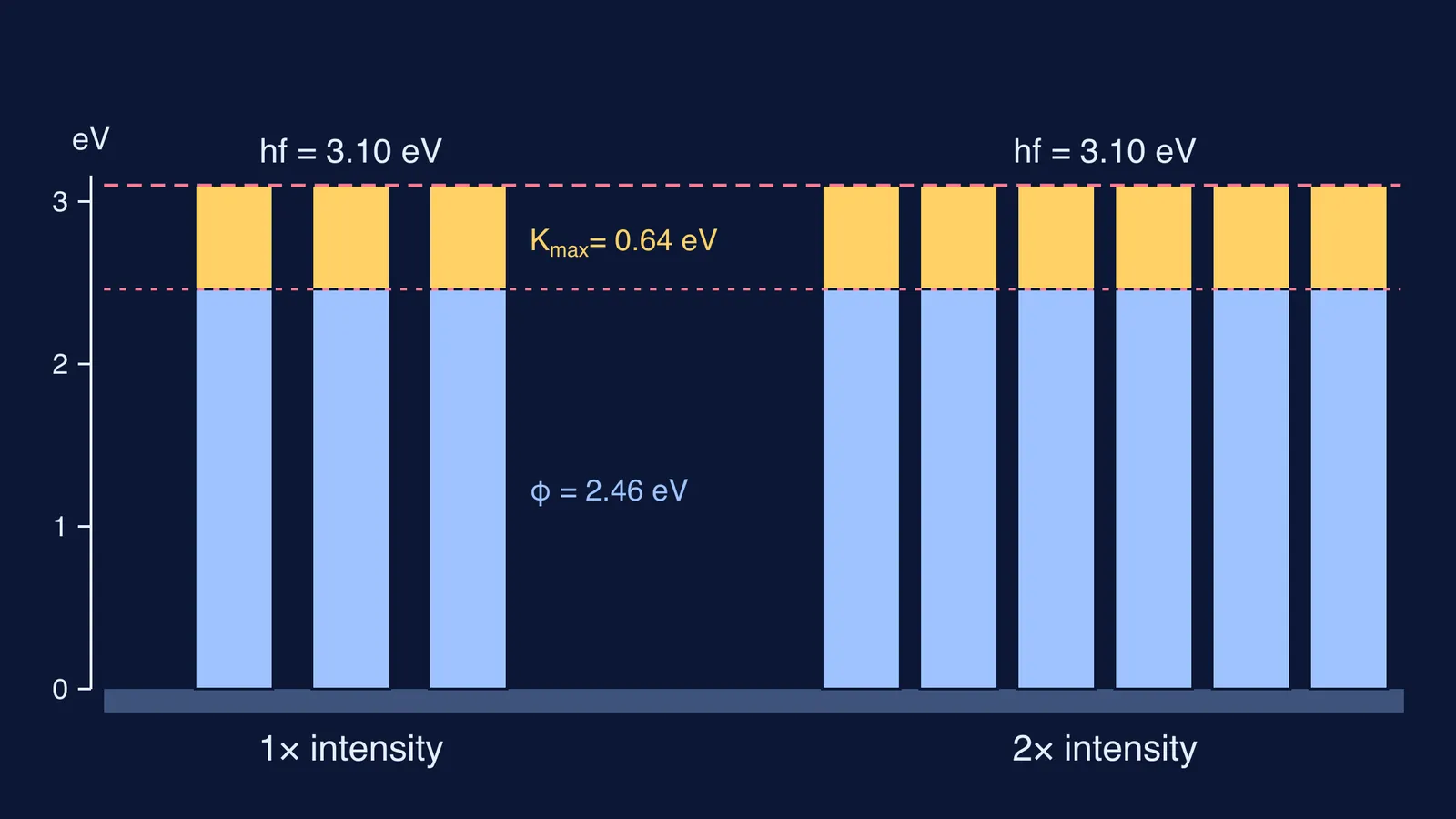
Take violet light of wavelength 400 nm falling on sodium. The numbers below use the work function of sodium, 2.46 eV, and hc = 1240 eV nm, both from the OpenStax chapter/University_Physics_III_-_Optics_and_Modern_Physics_(OpenStax)/06%3A_Photons_and_Matter_Waves/6.03%3A_Photoelectric_Effect), and the exact elementary charge, 1.602176634 × 10⁻¹⁹ C, from NIST.
Photon energy: E = 1240 / 400 = 3.10 eV, which is 3.10 × 1.602 × 10⁻¹⁹ = 4.97 × 10⁻¹⁹ J.
Maximum kinetic energy: K_max = 3.10 − 2.46 = 0.64 eV.
Stopping potential: since K_max = eV₀, V₀ = 0.64 V.
Photons per second in a 1.0 mW beam: N = (1.0 × 10⁻³) / (4.97 × 10⁻¹⁹) ≈ 2.0 × 10¹⁵ per second.
Now double the intensity to 2.0 mW: N ≈ 4.0 × 10¹⁵ per second.
Compare the two beams:
Energy of each photon: 3.10 eV in both.
K_max: 0.64 eV in both, so the stopping potential stays 0.64 V.
Photons per second: doubled.
Photocurrent: larger, because more photons free more electrons; with the same chance per photon, it doubles.
What if the light is below the threshold?
Now shine red light of 700 nm on the same sodium, again using hc = 1240 eV nm and φ = 2.46 eV from the OpenStax chapter/University_Physics_III_-_Optics_and_Modern_Physics_(OpenStax)/06%3A_Photons_and_Matter_Waves/6.03%3A_Photoelectric_Effect). Each photon carries 1240 / 700 = 1.77 eV, less than the work function, so no electron escapes. Making the red beam ten times brighter only sends ten times as many photons that are each too small. The cut-off for sodium is 1240 / 2.46 ≈ 504 nm: only light shorter than that frees any electrons.
How to answer intensity questions in an exam
Use this four-line check before you pick an option:
Has the frequency (or wavelength) changed? If not, K_max and V₀ are unchanged.
Is hf above φ? If not, there is no current at any intensity.
Has the intensity changed? Then the photon rate, and the saturation current, scale with it.
Did the frequency change too? Recompute K_max = hf − φ; it changes, but not in proportion to f.
If you would rather see an idea like this than read about it, the Fermi Simulation Lab has interactive simulations for ideas that are easier to see than to read. To practise the arithmetic, the Fermi Problem Library has worked problems with a step-by-step solver that explains the reasoning rather than printing an answer.