

On this page
When you shine a light on a metal surface, electrons—known as photoelectrons—are ejected. By the late 19th century, classical physics viewed light as a continuous electromagnetic wave spreading its energy smoothly over a wavefront, much like water ripples spreading across a pond.
However, when physicists actually measured the speed and number of these ejected electrons, the results contradicted every prediction made by wave mechanics. It took Albert Einstein’s 1905 paper to resolve the crisis by proving that light does not arrive as a continuous wave, but as a shower of discrete energy packets called photons.
There are three primary reasons why the classical wave theory of light collapsed when confronted with experimental data on the photoelectric effect.
Does kinetic energy depend on the intensity of light?
The most glaring failure of wave theory was its prediction about the energy of the escaping electrons.
The wave theory prediction: According to classical physics, increasing the intensity (brightness) of light means sending a wave with a larger amplitude. A larger, more intense wave carries more total energy. If light were a wave, making it brighter would force the electrons to absorb more energy, meaning they should fly out of the metal with much higher kinetic energy.
The experimental reality: The maximum kinetic energy of a photoelectron is completely independent of the light's intensity. If you shine a dim blue light and an intensely bright blue light on a metal, the fastest electrons will leave with exactly the same kinetic energy in both cases. Making the light brighter only ejects a larger number of electrons, but it does not give them any extra speed. Instead, an electron's kinetic energy depends entirely on the light's frequency.
Why is there a threshold frequency?
Wave theory treats energy accumulation like filling a bucket with a hose: no matter how weak the water flow, the bucket will eventually fill.
The wave theory prediction: Because wave energy is delivered continuously, any colour or frequency of light should eventually be able to eject an electron. If you use a low-frequency light, you would simply need to make it extremely bright, or wait long enough for the electron to soak up enough energy to break free.
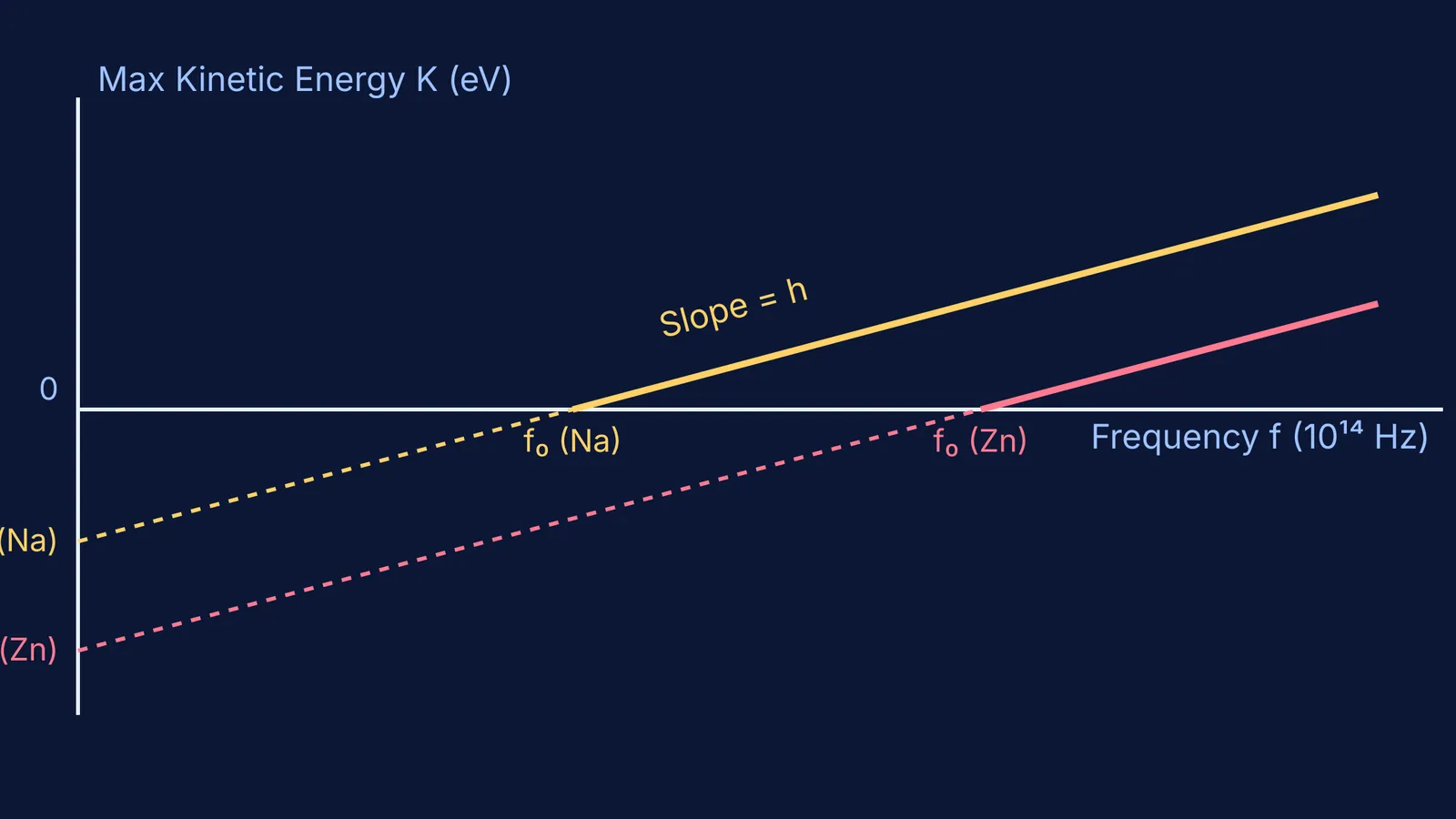
The experimental reality: For every metal, there exists a strict minimum threshold frequency (f₀) below which no electrons are ever emitted. If you shine red light on a zinc plate, absolutely nothing happens—even if you use a powerful laser or leave it on indefinitely.
Why is there no time lag in photoelectric emission?
Classical calculations exposed a massive timing problem with the wave model.
The wave theory prediction: Energy from a continuous wave is spread thinly over the entire wavefront. A single microscopic electron would capture only a tiny fraction of this incoming wave. If you shine a very dim light on a metal, classical calculations show it would take a significant time lag—sometimes hours or days—for a single electron to accumulate the few electron-volts of energy required to escape the metal's surface.
The experimental reality: Photoelectric emission is practically instantaneous. Even with the dimmest possible light source, electrons begin popping out of the metal in less than 10⁻⁹ seconds after the light hits the surface. There is no waiting period for energy to build up.
How do photons explain the photoelectric effect?
Einstein solved these contradictions by proposing the photon picture of light. He argued that light energy is quantized into discrete packets. The energy of a single photon is strictly given by its frequency, where E = hf (Planck's constant multiplied by frequency).
This quantum model explains the three historical failures:
Instantaneous emission: One photon hits one electron. It is a single, immediate collision. There is no waiting to accumulate energy.
Threshold frequency: The metal holds onto electrons with a specific binding energy called the work function (Φ). If a single photon's energy (hf) is less than Φ, it cannot dislodge the electron. You cannot combine two weak photons to do the job of one strong one.
Kinetic energy: When a high-frequency photon hits an electron, the electron uses up Φ energy to break free. The leftover energy becomes the electron's maximum kinetic energy (K_max = hf - Φ). Brighter light simply means more photons, not more energetic ones.
If you want to review how these quantum collisions work across different metals, the Fermi Concept Library has a lesson on wave-particle duality and its place in the map. When solving numerical problems, you will often need to calculate the number of photons emitted per second based on a lamp's power rating, or use shortcuts like E = 1240/λ to find the photon energy in electron-volts quickly without heavy arithmetic.


