On this page
Units and Measurements opens JEE Main Physics, and a dimension check catches a wrong formula in any later chapter. Here is the syllabus, six kinds of worked numericals and a two-week plan.
What does the JEE Main syllabus include in Units and Measurements?
In NTA's official Syllabus for JEE (Main) - 2027, Physics Unit 1 covers units, systems of units, SI units, fundamental and derived units, least count, significant figures, errors in measurements, dimensions and dimensional analysis. Unit 20, Experimental Skills, lists the vernier calipers (diameters and depth of a vessel) and the screw gauge (thickness of a sheet, diameter of a wire).
The matching textbook is Chapter 1, Units and Measurement of NCERT Class 11 Physics Part I (Reprint 2026-27), with sections on the SI, significant figures, dimensions and dimensional analysis. It has no separate section on errors in measurement (error rules appear only briefly in 1.3.3, inside significant figures), and the vernier and screw gauge appear only in its exercises. Practise those topics on purpose.
How do you use dimensional analysis in JEE Main?
It does three jobs. First, write dimensional formulas from a defining equation:
Pressure = force/area: [M L⁻¹ T⁻²]
Power = work/time: [M L² T⁻³]
G = F r²/(m₁m₂): [M⁻¹ L³ T⁻²]
Planck's constant h = E/ν: [M L² T⁻¹], the same as angular momentum, a favourite trap.
Second, check an equation. Take a car's stopping distance d = v t + v²/(2μg), with reaction time t and friction coefficient μ. [v t] = [L T⁻¹][T] = [L], and [v²/(μg)] = [L² T⁻²]/[L T⁻²] = [L]. Every term is a length, so it passes. Had someone written v/(2μg), that term would be [T] and the equation wrong.
Third, derive a relation. Guess that deep-water wave speed depends on wavelength λ, g and water density ρ: v = k λᵃ gᵇ ρᶜ. Matching [L T⁻¹] = [L]ᵃ[L T⁻²]ᵇ[M L⁻³]ᶜ gives c = 0 from M, b = 1/2 from T and a = 1/2 from L, so v = k√(gλ). NCERT's chapter notes the limits: the method cannot find k and cannot tell apart quantities with the same dimensions. Add water depth h to the guess and λ/h becomes a dimensionless ratio whose role it cannot fix. For more practice, see deriving the spring-mass period with dimensions.
How do significant figures and percentage errors work?
The rules are in section 1.3 of NCERT Chapter 1.
Products and quotients keep the fewest significant figures: 4.36 cm × 2.1 cm = 9.156 cm², reported as 9.2 cm².
Sums and differences keep the fewest decimal places: 12.47 m + 3.2 m + 0.816 m = 16.486 m, reported as 16.5 m.
Subtraction trap: 15.82 m − 15.7 m = 0.1 m, not 0.12 m.
For a power law, relative errors add, each multiplied by the size of its power. If Q = a³b²/√c, with errors of 1% in a, 2% in b and 4% in c, the maximum error in Q is 3(1) + 2(2) + ½(4) = 9%. In sums and differences, absolute errors add instead, which is why subtraction costs precision.
How do you read a vernier caliper and a screw gauge?
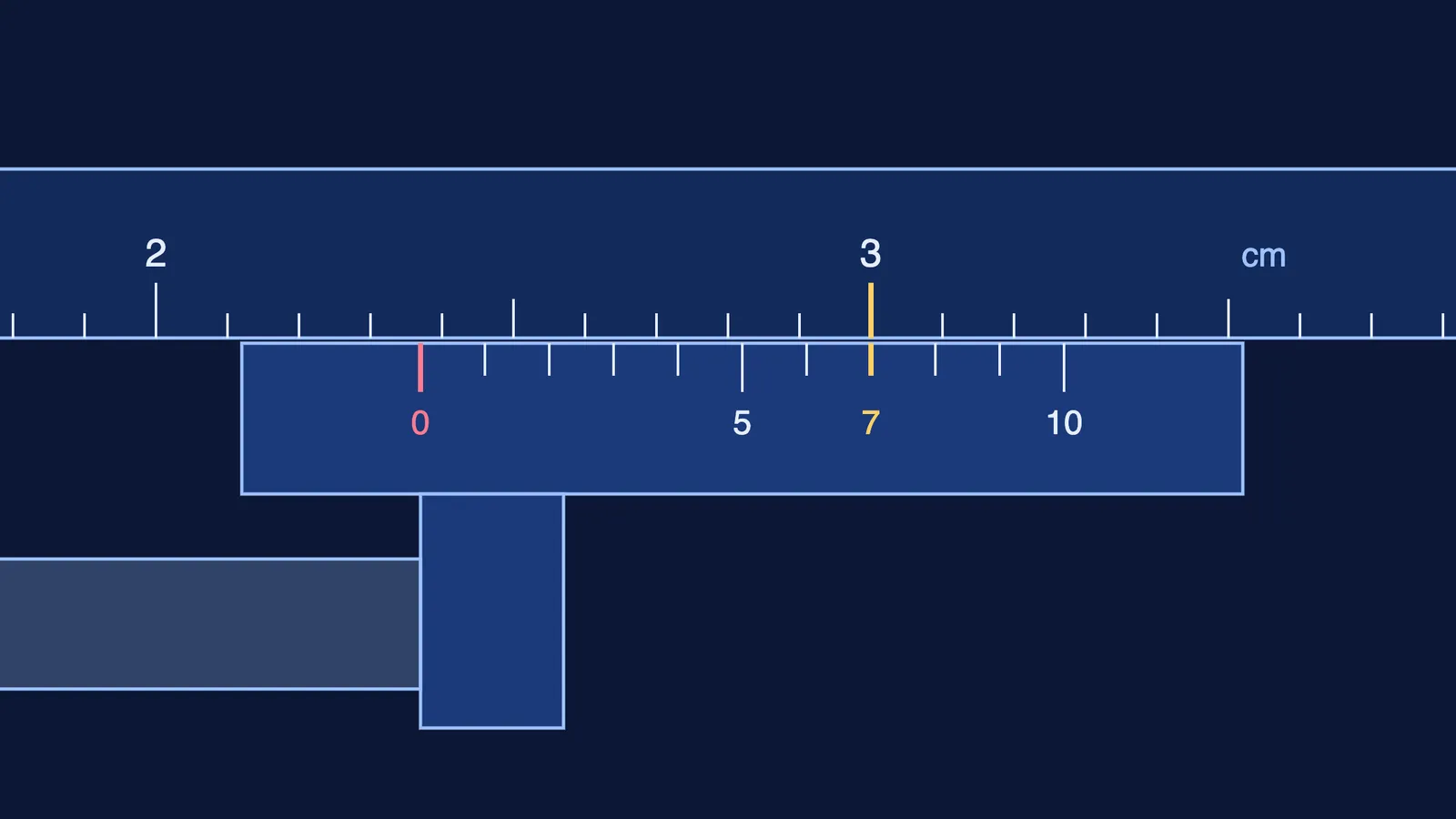
Vernier. The main scale has 1 mm divisions and 10 vernier divisions span 9 mm, so least count = 1 − 0.9 = 0.1 mm. The vernier zero sits just past 23 mm and the 7th vernier mark lines up with a main-scale mark: 23 + 7 × 0.1 = 23.7 mm. With the jaws closed, the vernier zero sits right of the main zero and the 3rd mark lines up: a zero error of +0.3 mm. Corrected reading = 23.7 − 0.3 = 23.4 mm.
Screw gauge. Pitch 0.5 mm and 50 circular divisions give a least count of 0.01 mm. A wire shows 0.5 mm on the linear scale and division 18 on the reference line: 0.5 + 18 × 0.01 = 0.68 mm. With the studs touching, the circular zero sits 4 divisions above the reference line (the line reads 46): a zero error of −0.04 mm. Corrected reading = 0.68 − (−0.04) = 0.72 mm.
Our guide to positive and negative zero error in a screw gauge draws both cases.
A two-week plan for Units and Measurements
Cover Unit 1 and the first two experiments of Unit 20 in the JEE Main 2027 syllabus.
Days 1-2: SI base and derived units; dimensional formulas for 20 quantities from their definitions.
Days 3-4: check equations and derive relations; note what each derivation could not tell you.
Days 5-6: significant figures in mixed calculations.
Days 7-8: percentage errors for power laws, absolute errors for sums.
Days 9-11: vernier and screw gauge readings, with zero errors of both signs.
Days 12-14: a timed mixed set, then redo every wrong answer from a blank page.
When you reach the right number by the wrong method, the Fermi Problem Library has worked problems with a step-by-step solver that explains the reasoning rather than printing an answer.