

On this page
Add two measured lengths, then subtract them, and you might expect both answers to be equally trustworthy. They are not. The error is the same size in both cases, but the answer it sits on can be very different.
What is the error in the sum and difference of two quantities?
Suppose you measure A ± ΔA and B ± ΔB. In Alan Usher's lecture notes on errors, the highest probable value of A + B is the sum of the best values plus (ΔA + ΔB), and the lowest is the sum minus (ΔA + ΔB). The same argument shows that the error in the difference A − B is also ΔA + ΔB.
So the rule fits in two lines:
Sum: if Z = A + B, then ΔZ = ΔA + ΔB.
Difference: if Z = A − B, then ΔZ = ΔA + ΔB.
Notice the plus sign in the second line. Errors never subtract. You cannot know which way each reading is off, so the worst case is that the two errors push the answer in opposite directions.
The NCERT Class 11 Physics chapter on units and measurement makes the same point with significant figures: 12.9 g − 7.06 g cannot be reported as 5.84 g but only as 5.8 g, because uncertainties in addition and subtraction combine by decimal places, not by significant figures.
Why does subtracting nearly equal numbers ruin precision?
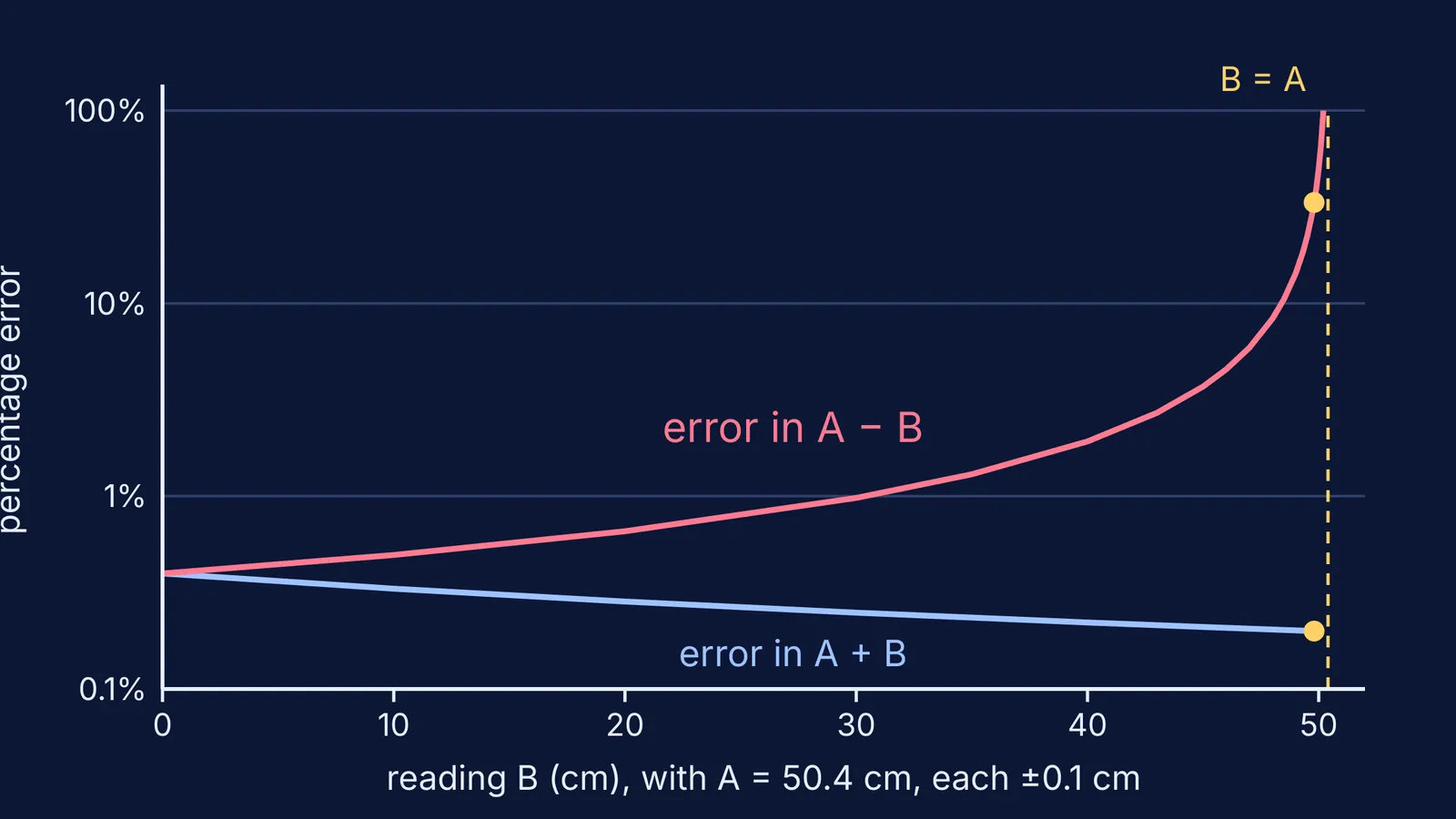
Percentage error is the absolute error divided by the result. For a sum, the result grows, so the percentage error stays small. For a difference of two nearly equal numbers, the result shrinks towards zero while the absolute error stays at ΔA + ΔB. Divide a fixed error by a tiny number and the percentage error can grow without limit.
Worked example: one metre scale, two very different answers
The arithmetic below uses only the sum-and-difference rule from Usher's notes. You read two lengths on a metre scale and take the error of each reading as 0.1 cm (our guide to reading the least count of a metre scale explains where that number comes from).
A = 50.4 ± 0.1 cm and B = 49.8 ± 0.1 cm. Each reading has a percentage error of about 0.2%.
Sum: A + B = 100.2 ± 0.2 cm. Percentage error = 0.2 ÷ 100.2 × 100 ≈ 0.2%.
Difference: A − B = 0.6 ± 0.2 cm. Percentage error = 0.2 ÷ 0.6 × 100 ≈ 33%.
Same scale, same care, same ±0.2 cm. The sum is good to 0.2%; the difference is uncertain by a third of its own size.
The same trap appears in calorimetry. A thermometer read to ±0.5 °C shows 30.0 °C before heating and 32.0 °C after. The temperature rise is 2.0 ± 1.0 °C, a 50% error, even though each reading on its own was good to better than 2%.
Should you add errors directly or in quadrature?
Adding ΔA + ΔB gives the maximum possible error, and it is the form most textbook numericals expect. Usher's notes call it "a bit pessimistic": if A and B are independent, their errors are as likely to partly cancel as to add, so the refined rule combines them in quadrature, ΔZ = √(ΔA² + ΔB²).
The US National Institute of Standards and Technology's reference on measurement uncertainty gives the general law of propagation of uncertainty and notes that it reduces to a simple form when the inputs are uncorrelated and the result is a sum of quantities: the same root-sum-of-squares idea.
In the worked example, quadrature gives √(0.1² + 0.1²) ≈ 0.14 cm, about 24% of 0.6 cm. Quadrature softens the problem; it does not remove it. Use whichever method your question or lab manual asks for, and default to ΔA + ΔB in school numericals.
How do you protect a result that depends on a difference?
Run this five-step check before you trust any subtraction of measured values:
Spot it. Look for a minus sign between two measured quantities: a temperature rise, a zero-error correction, the length between two scale marks, the gap between two burette readings.
Add the absolute errors. Never subtract them, even though the quantities are subtracted.
Find the percentage error of the difference itself, not of the individual readings.
Make the difference bigger where you can: a larger temperature rise, a longer length, a larger sample, so the same absolute error is a smaller fraction.
Measure the small quantity directly with a finer instrument, such as a vernier caliper, instead of subtracting two coarse readings.
For products, quotients and powers the rule switches to relative errors. Our explainers on the percentage error of a squared quantity and on finding error formulas with logarithmic differentiation pick up from here.
If you keep mixing up which rule applies where, the Fermi Problem Library has worked problems with a step-by-step solver that explains the reasoning rather than printing an answer, so you can see where each error term comes from.
Next time you subtract two readings, check the error before you trust the answer.


