

On this page
When a physical quantity is calculated from several measured variables, each measurement brings its own uncertainty into the final result. If you measure the length and gravity for a simple pendulum, the final time period inherits the errors from both.
Students often memorise separate rules for how errors propagate: one rule for addition, another for multiplication, and a third for powers. But there is a faster, more fundamental way. By using logarithmic differentiation, you can find the maximum fractional error for any power-law formula in a single step.
Why does logarithmic differentiation work for errors?
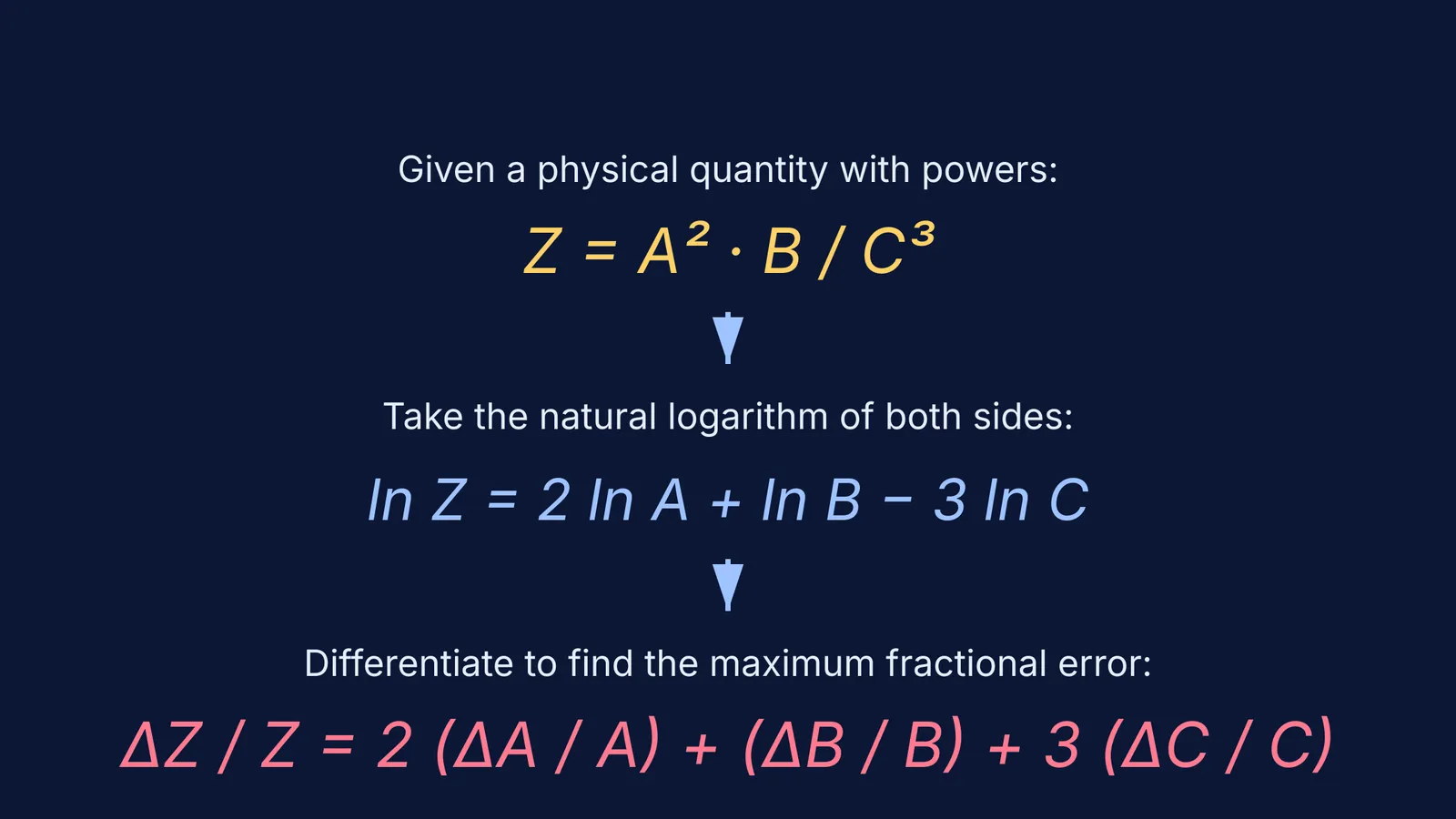
For any formula consisting of multiplied or divided terms, such as Z = (A² × B) / C³, the relative error depends entirely on the powers of the variables.
If you take the natural logarithm (ln) of both sides, the products turn into sums and the powers drop down as multipliers:
ln Z = 2 ln A + ln B − 3 ln C
Now, differentiating one expression with respect to another gives the fractional changes:
dZ / Z = 2(dA / A) + (dB / B) − 3(dC / C)
In error analysis, we want to find the maximum possible uncertainty. We assume the worst-case scenario where all the measurement errors happen to add up. By replacing the differentials (dZ, dA) with absolute uncertainties (ΔZ, ΔA) and making all the terms positive, we get the final fractional error formula:
ΔZ / Z = 2(ΔA / A) + (ΔB / B) + 3(ΔC / C)
How do you use logarithmic differentiation to find error in a formula?
To apply this method to any physics or chemistry problem, follow these four steps:
Write the standard formula linking the variables.
Take the natural logarithm (ln) of both sides to break apart the powers and fractions.
Differentiate the equation to convert the terms into fractional changes.
Change all negative signs to positive and swap the 'd' for 'Δ' to maximise the error.
Worked example: The simple pendulum
Consider the time period of a simple pendulum, T = 2π √(l / g). You might need to know how its period changes with length and g when your instruments have known reading errors.
First, write the formula with fractional powers: T = 2π × l^(1/2) × g^(−1/2)
Second, take the natural logarithm: ln T = ln(2π) + 1/2 ln l − 1/2 ln g
Third, differentiate both sides. Note that the constant ln(2π) vanishes because the derivative of any constant is zero: dT / T = 0 + 1/2 (dl / l) − 1/2 (dg / g)
Finally, maximise the error to find the worst-case fractional uncertainty: ΔT / T = 1/2 (Δl / l) + 1/2 (Δg / g)
This method instantly gives you the fractional error. To find the percentage error, simply multiply both sides of your final equation by 100.
Is error analysis still tested in exams?
The rules of syllabus documents often change, but the underlying physics does not. For instance, the CBSE removed errors in measurement from the Class 11 theory syllabus for the 2024–25 academic year, but the topic remains an absolute staple for competitive entrance exams.
Data from the National Testing Agency shows that 14,76,557 students registered for JEE Main in 2024. For these candidates, mastering error analysis is a strong way to secure marks, and learning this calculus trick saves them from memorising dozens of individual formulas.
If you want to trace how differentiation applies across different topics, the Fermi Concept Library covers every concept in physics, chemistry, biology, mathematics and computing, each with its own lesson and its place in the map. When you are stuck on setting up the calculus itself—like differentiating parametric functions—the Fermi Problem Library has worked problems with a step-by-step solver that explains the reasoning rather than printing an answer.


