

On this page
You can get almost all of the formula for the period of a mass on a spring without solving a differential equation. You guess which quantities the period depends on, write it as a product of powers, and make the dimensions on both sides match. Below is the spring-mass case step by step, with one extra check, and then the places where the method stops working.
What does dimensional analysis assume?
In OpenStax University Physics, the dimension of a quantity is its dependence on the base quantities, written as a product of powers of their symbols. For mechanics you need only three: mass M, length L and time T.
The rule that does all the work is dimensional consistency: both sides of a correct equation must have the same dimensions (OpenStax, section 1.4). Pure numbers such as 2π have no dimensions, so the same source notes that dimensional analysis is no help in finding them.
How do you derive the time period of a spring-mass system using dimensions?
A block of mass m sits on a spring of spring constant k and is pulled a distance A (the amplitude) from equilibrium. Here is the derivation.
List what the period might depend on. Mass m, spring constant k, amplitude A.
Write the dimensions of each. Mass is [M]. Amplitude is [L]. For k, use Hooke's law, F = −kx (OpenStax, section 15.1): k = F/x, so [k] = [MLT⁻²]/[L] = [MT⁻²].
Assume a power law. T = C · m^a · k^b · A^c, where C is a pure number.
Expand the right side. M^a · (MT⁻²)^b · L^c = M^(a+b) · L^c · T^(−2b).
Equate powers with the left side, which is just T¹. For M: a + b = 0. For L: c = 0. For T: −2b = 1.
Solve. b = −1/2, so a = 1/2, and c = 0.
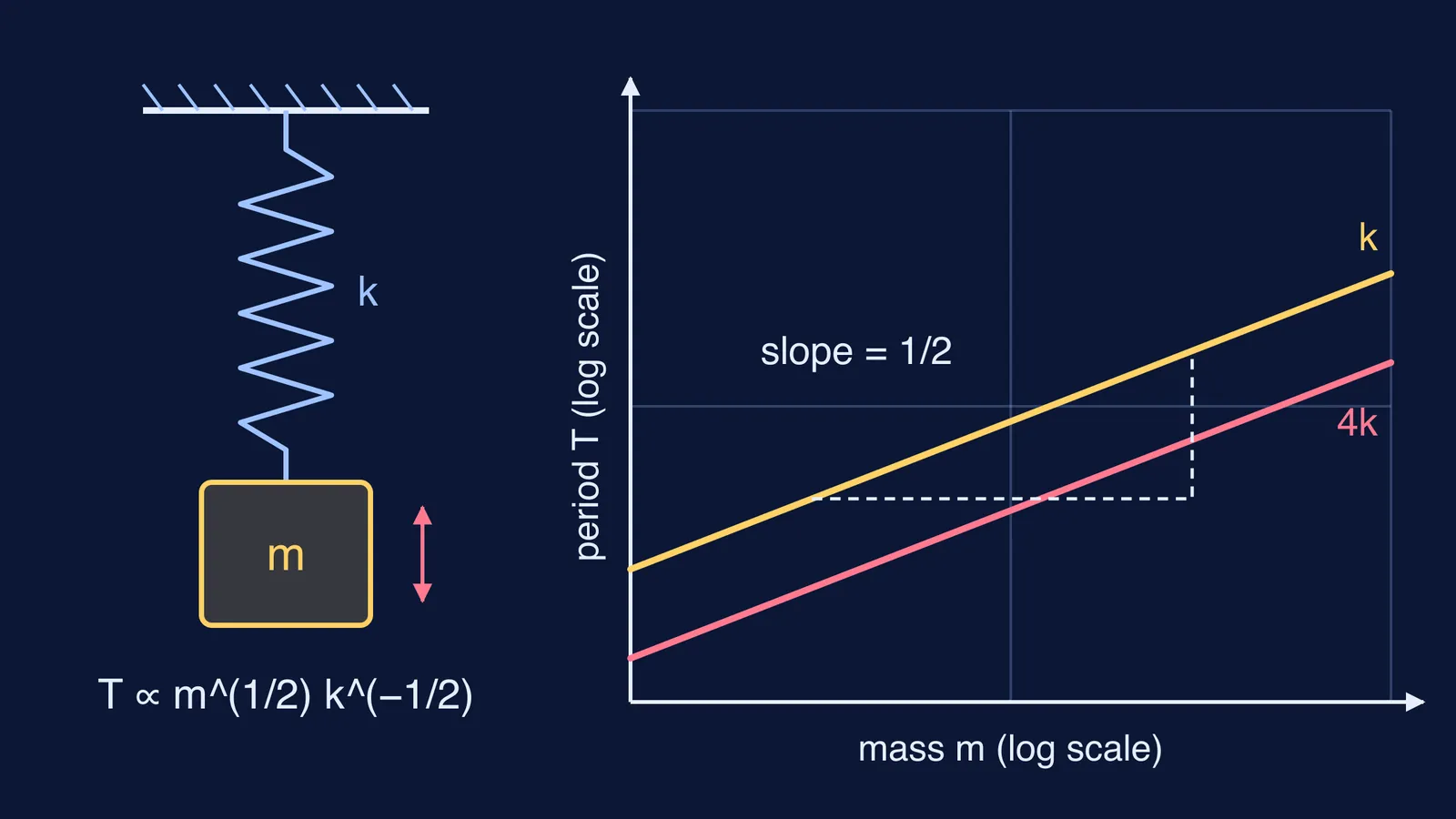
So T = C · m^(1/2) · k^(−1/2), or T = C√(m/k).
OpenStax states that the period of a simple harmonic oscillator is independent of amplitude, and that m and k are the only factors that affect it (OpenStax, section 15.1).
Where does the 2π come from?
Not from dimensions. To get C you have to solve the equation of motion, F = −kx, which gives T = 2π√(m/k) (OpenStax, section 15.1).
A quick check: with m = 0.5 kg and k = 50 N/m, m/k = 0.01 s², so √(m/k) = 0.1 s and T = 2π × 0.1 ≈ 0.63 s.
The scaling is where dimensions pay off. Make the block four times heavier and the period doubles. Use a spring four times stiffer and the period halves. You can test these predictions yourself in our mass-spring SHM simulation post.
When does dimensional analysis fail?
It fails when you have more unknowns than equations, or when the true formula is not a single power law. It never finds pure numbers such as 2π.
Too many variables. Suppose you worry that g matters for a vertical spring and add g^d, with [g] = [LT⁻²]. Now M gives a + b = 0, L gives c + d = 0, and T gives −2b − 2d = 1. That is three equations for four unknowns, so dimensions cannot decide whether g matters. Only the force equation can.
Sums inside the formula. A spring with its own mass behaves like m + m_s/3. Both terms have dimension M, so dimensions cannot see the 1/3. Our post on the effect of a spring's mass on its period shows where it comes from.
A five-step routine for any "derive using dimensions" question
List every quantity the answer could depend on, including ones you suspect do not matter.
Derive each dimension from a formula you trust (k from F = −kx, g from an acceleration) rather than from memory.
Write one equation per base dimension: M, L, T.
Count unknowns against equations. More unknowns means the method alone is not enough.
Check the result with a scaling question ("what if the mass is four times larger?") and say that the constant must come from theory or experiment.
Try it on a simple pendulum with T ∝ m^a l^b g^c. You should get a = 0, b = 1/2, c = −1/2, so T ∝ √(l/g), with the mass dropping out. For more practice with checking answers this way, see how to use dimensions to check your physics answers.
If you get stuck at the step where you set up the powers, the Fermi Problem Library has worked problems with a step-by-step solver that explains the reasoning rather than printing an answer. If the gap is the idea of dimensions itself, the Fermi Concept Library gives each physics concept its own lesson.


